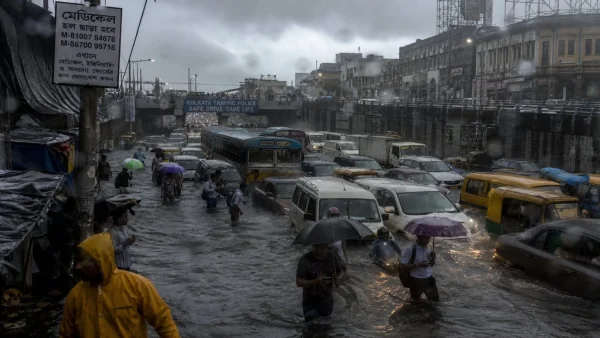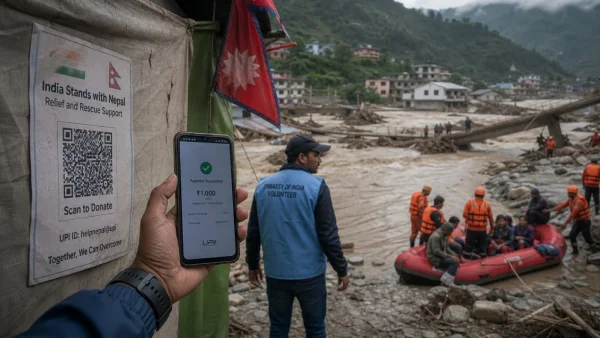
The flooding in Nepal has left a deadly path and put India’s UPI in an unanticipated light. With 1,127 confirmed dead and 4,858 still missing, the Nepal Embassy in India has made a plea for donors to turn to UPI International and use its QR code facility to support the Prime Minister Disaster Relief Fund.
In a public statement, the embassy advised any donor in India whose QR scan did not go through to simply activate ‘UPI International’ on their banking or UPI app. This comes after flash floods in the vicinity of the Tibet border have cut off communications in some areas and hampered several regions, adding value to digital collections that are quick and without friction.
Nepal’s appeal shifts UPI’s role
There is a new perspective on UPI International brought about by this donation drive. What was once a convenience for the Indian traveller is now an inbound collection rail for a foreign state. While the contribution shows up in Indian rupees on an international UPI transaction, it settles in Nepalese currency. Of course, one’s bank or payment app will dictate the validity windows and how to go about activation.
Donors in India will find it a simple matter:
– Turn on UPI International in your app of choice
– Put the relief fund QR code to the scanner
– See the payment through; the funds will be in Nepalese rupees
The extent of the tragedy is plain from the figures given by Nepal Police on where they have made recoveries. They have accounted for 348 in Chitwan, 217 in Nawalparasi East, 190 in the west of the same district and 155 in Nuwakot. In addition there have been 66 in Gorkha, 59 in Dhading, 45 in Rasuwa and 38 in Tanahu.
Global positioning and competition
It is a strategic move as much as an operational one. Ashwin Bhatnagar of Xflow, the cross-border fintech, told Business Standard that having UPI in the company of Alipay and UnionPay is evidence that “scale and trust are starting to translate into global acceptance, not just domestic dominance”.
Bhatnagar would call it “a meaningful marker for UPI’s journey outside India”. He noted the Nepal Embassy has treated UPI as “a legitimate inbound collection rail by a foreign government”, and expects to see more foreign entities opt for it over the old ways of banking.
From pilots to emergency-ready rails
This is built on the India-Nepal corridor that already exists. Back in March 2024, NIPL and Fonepay Payment Service of Nepal put in place the ability for cross-border UPI. An Indian could walk into a merchant in Nepal, scan a Fonepay code and pay from his account, with the merchant getting Nepalese rupees.
Now that same infrastructure is being put to work for crisis funding. It is a good example of how consumer rails can be repurposed at short notice when there is institutional coordination.
Where UPI already works
You will find UPI accepted well beyond South Asia these days. France, Qatar, the UAE, Bhutan, Cambodia, Singapore, Sri Lanka and Mauritius are among the countries where it is in use, with other markets in the pipeline. The service is run by NIPL, the National Payments Corporation of India’s international division.
That matters for charity and relief work, which needs a rail the payer can trust. Being in the same peer set as Alipay and UnionPay makes UPI a competitor for cross-border collections rather than just a means of outbound spending.
Payments and alternatives
Should a donor wish to take another route, the Nepal government has an online portal for the Prime Minister Disaster Relief Fund. Visa and Mastercard debit and credit cards are open to international donors. UPI is but one option, though it is set up for the speed of a QR transaction.
The UPI flow has the advantage of turning Indian rupees into Nepalese at settlement, removing any friction for the donor and suiting the destination. The embassy has been at pains to make sure a failed scan does not put people off giving.
Why this matters now
One can see what is happening: a rail meant for the everyday is being called on for disaster response. But the implications are wider. As UPI goes further afield, it may well be used for inbound collection by public bodies and global organisations as much as for outbound spending.
All eyes will be on institutional adoption going forward. If agencies start to put UPI on a par with established rails for collections, its standing abroad will be reinforced. For the time being, Nepal has put UPI International to the test under pressure and it has proved to be more than a payments system.