The national intervention is part of a broader push to blunt the retail rate surge driven by the weather. By making the subsidised onions available at Rs 35 per kg in 19 cities, the Centre hopes to establish a firm benchmark against the Rs 50 to 70 per kg one can find in private retail. Delhi will take 1,000 metric tonnes for immediate offloading at that price.
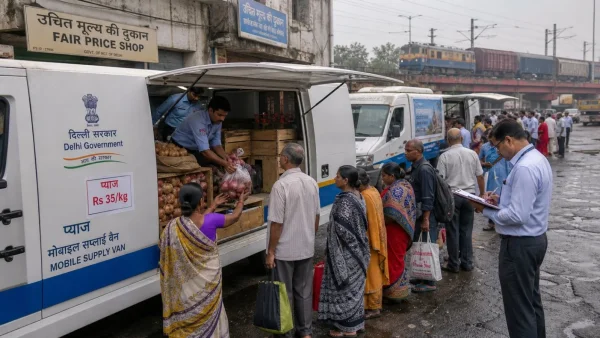
Rekha Gupta, the Chief Minister, laid out the plan for Delhi on 1 September 2026: the stock would be put out through fair price shops and a mobile van in every one of the city’s 13 districts. The idea is for the vans to go where fair price shops are not so easily found.
National rollout and Delhi’s allocation
There is a clear signal being sent to the market with this extension to 19 cities, an attempt to put a price anchor in place and steady supplies in short order. With the capital’s demand and influence on pricing being what it is, Delhi's 1,000 metric tonne allotment is key to the strategy.
One need only look at Delhi’s markets to see why; onions have been going for about Rs 50-60 per kg, and in some quarters as much as Rs 70. Officials put the spike down to a supply shock from crop damage in the rains which has made arrivals tight.
Access-first distribution model
“We will have a van in each district to sell at Rs 35 and make our way into neighbourhoods where a fair price shop is not on hand,” said Gupta. The approach is being followed in other places too, with mobile vans in operation in Jaipur, Varanasi and Lucknow.
Noida is seeing the same, with NCCF outlets and vans offering the produce. In Delhi, departments have been put to work tracking stocks and putting up a front against hoarding to see the supply pipeline through without issue.
Why the Rs 35 price matters
It is more than a figure; it is a tool for visibility and a means to undercut the private sector. By underpricing them, the Centre can dampen the kind of expectations that tend to fuel further spikes. The 1,000 metric tonnes gives the capital the heft to make a point on near-term pricing.
Authorities have outlined the following steps:
– Scheme now in 19 cities
– 1,000 metric tonnes for Delhi
– A fixed price of Rs 35 per kg
– One van to each of the 13 districts
– Active anti-hoarding and monitoring
Contingency plan if prices climb
This comes after a review on 25 August chaired by Gupta, which looked at onion and sugar prices and availability in Delhi. While no shortage was evident then, the meeting gave its nod to measures that would protect the consumer from any fresh upturn.
Should prices continue their upward trend, the Delhi government has said it will turn to the National Agricultural Cooperative Marketing Federation of India Ltd for onions and sugar. These will be sold at procurement cost with the government footing the bill for transport and the like.
Supply chain watch and recent arrivals
Gupta was emphatic that the city will not countenance a shortage and will be watching prices and availability closely. The administration has given orders for all consignments to be monitored and moved to market in a timely fashion.
You can see the mobilisation in action. A special goods train from Nashik pulled into New Delhi on 28 August 2026, a sign of the speed with which stock is being ferried to consumption centres as rates go up.
What to watch next
Execution is the test. All eyes will be on how well the fair price shops handle the footfall and whether open market prices in Delhi and elsewhere will heed the Rs 35 example set by the vans in hard-to-reach areas.
For the consumer there is some immediate respite in the subsidised stock. For the private seller, it is a hard ceiling to contend with. Officials say they will do what is necessary to forestall any sharp rise or lack of supply.