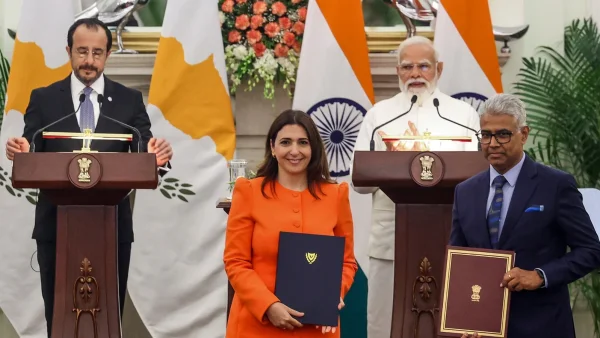
The MEA has put it this way: from next year, UPI will be live in Cyprus, allowing Indian digital payments to feed straight into the EU and making for a more straightforward way to pay. It is a strategic nudge to get UPI over the border, following on from a string of other international deals.
Sibi George, the MEA Secretary (West), made it official on Friday. He put UPI down as one of the take-aways from the most recent round of talks with Cyprus. All of this is on the back of an MoU with Eurobank Cyprus and NPCI International Payments Limited to open up the real-time payment line.
Why Cyprus is in the mix for UPI
There is a diplomatic angle to the timing. The visit came while Cyprus was holding the reins of the Council of the European Union, which gives the whole thing some political weight. When it comes to India-EU ties, having a dependable way to make instant payments can only help with the kind of retail and small-business trade we are looking at.
Then there is the user side of things. It is about removing some of the hassle for an Indian student or visitor with a no-fuss, QR-based system. Businesses, for their part, get a rail that is in sync with what is happening in India. The MEA sees it as a way to put some depth into the two countries’ work together in fintech.
How it came to be
Put simply, the government says the deal was done when PM Narendra Modi made his way to the Republic of Cyprus on June 15-16, 2025. It was the first time a Prime Minister has made the trip in 20-something years. The PM and his hosts had a business roundtable in Limassol on the 15th and got down to delegation-level talks the day after.
They covered a lot of ground: trade, defence, the maritime side of things, technology, and how to engage with the EU. Sibi George would have you believe UPI was a big part of those discussions.
Here is what you can point to from the visit:
– An MoU with Eurobank Cyprus from NIPL for cross-border payments
– A strategic understanding with the Cyprus Stock Exchange and NSE International for dual and cross listings
– An MoU to put a Chair of Indian Studies in place at the University of Nicosia
– A plan to put together a Joint Action Plan for 2025-29
– Word from Cyprus that it is opening a trade office in Mumbai
– President Christodoulides paying his respects to the 26/11 victims in Mumbai
UPI is making its mark
Cyprus is just the latest in UPI’s spread. You could use it at the Eiffel Tower as of February 2024. Over in the Gulf, the UAE has been on board with UPI at most of the big merchant networks, which is good for any Indian consumer or for remittances coming in.
Singapore made a link with PayNow in 2023 for remittances, a good example of how to do account-to-account. And if you look at Sri Lanka, Mauritius, Nepal, Bhutan or Oman, they are all already using UPI for merchants. It is a sign the region is on board with India’s system.
It is not just about being accepted, though. India is also putting the model out there. NIPL has inks on MoUs with Peru, Namibia and Trinidad & Tobago to build something like UPI. For us, it is a matter of extending our standards and seeing them work in other markets.
What’s on the horizon
New Delhi and Nicosia like to think of this as part of a larger economic picture. They have put their heads together for a Joint Action Plan for 2025-29 to steer things. As for UPI in Cyprus, the MEA has said it will be a go from next year.
In a way, it is a test case for an instant network put together by India and its banks to see how it sits with the card and wire set-up in Europe. If it goes well, it makes for a stronger argument for more of a presence in the EU and cements a kind of fintech link from South Asia to the Med.
For those involved, you have to focus on a few things: getting merchants on board, making sure the customer doesn’t have to jump through hoops, and keeping compliance in order. With the government touting UPI as a key part of how we do business abroad, Cyprus is shaping up to be the European showcase for our digital infrastructure.