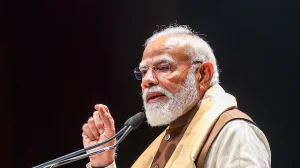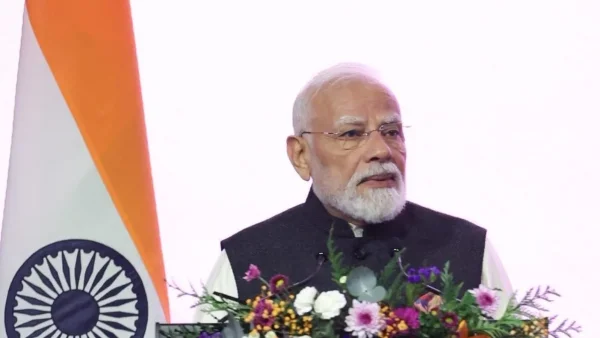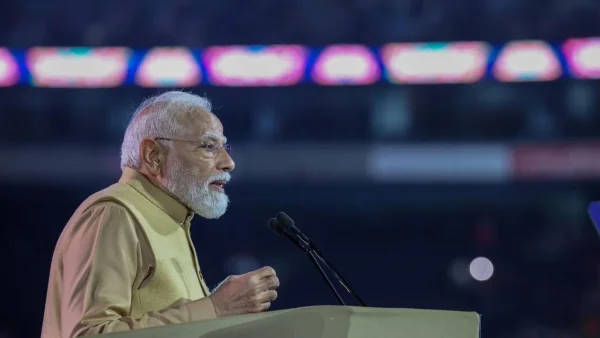
Standing before a packed diaspora audience in Melbourne, Prime Minister Narendra Modi placed India’s humanitarian identity at the centre of its global image, declaring that when the country helps, it does not check passports. He framed the principle as a reason many nations trust New Delhi during crises.
Humanitarian credo at centre stage
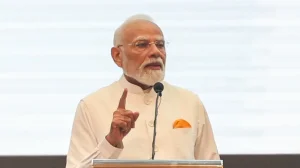
Speaking at Marvel Stadium to over 30,000 people, the Prime Minister said India’s growing capabilities are being used for the benefit of humanity, and that its actions speak louder than promises. A short clip from the venue captured him saying India does not look at the colour of the passport when sending aid.
He argued that India’s role as a first responder has expanded with its capacity. According to him, this approach reflects a sense of shared responsibility that goes beyond geography or nationality, reinforcing India’s reputation as a reliable partner in emergencies.
From words to operations
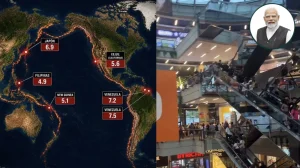
To illustrate the point, he cited India’s rapid mobilisation after a devastating earthquake in Venezuela last month, saying relief materials, rescue teams and medical experts were dispatched swiftly. He added that immediate medical action on the ground helped save lives.
He highlighted ‘Operation Amistad’, under which a 41-member Indian contingent of rescue personnel and medical professionals was deployed. The team carried approximately six tonnes of medical stores and humanitarian relief supplies and transported a BHISHM Cube under India’s Aarogya Maitri Project, capable of treating up to 200 patients.
The Prime Minister also referred to India’s emergency missions after earthquakes in Turkiye and Syria. He pointed to regional operations too, including ‘Operation Brahma’ in Myanmar last year and ‘Operation Sagar Bandhu’ after a cyclone struck Sri Lanka, as examples of quick, coordinated response.
Why it matters for the diaspora and partners
For the diaspora, the message sought to bind national pride with global responsibility. It also signalled to partner governments that New Delhi wants to be counted on in the first hours after disaster, when speed and logistics determine outcomes.
The remarks followed a high-level summit with Australian Prime Minister Anthony Albanese in Melbourne. The meeting, part of a three-day official visit, deepened the Comprehensive Strategic Partnership with a focus on practical cooperation.
Officials said the visit from July 8 to July 10 culminated in 18 major outcomes across defence, maritime security, energy, critical technologies, education, mining, research and cultural cooperation. That breadth suggests humanitarian coordination and disaster relief could gain fresh momentum through joint planning and exercises.
Key developments in Melbourne
Here are the major takeaways from the event and visit:
– Aid will not be conditioned by nationality, the Prime Minister reiterated
– Venezuela mission underscored rapid deployment of experts and supplies
– Over 30,000 attended the Marvel Stadium community gathering
– The visit concluded with 18 outcomes expanding the partnership
A bigger ambition, a wider responsibility
Modi linked the humanitarian approach to India’s domestic trajectory. He said the India of the 21st century is working to become a developed nation, and that every achievement spurs a new ambition for its 1.4 billion citizens.
‘When one goal is achieved, an even greater resolve takes its place,’ he said, adding that the country believes in ‘Grow More, Achieve More’. He presented humanitarian action as an extension of that resolve, with India’s expanded strength benefiting all of humanity.
The Prime Minister also framed crisis response as an expression of empathy. He said India did not look at distance when Venezuela suffered, but saw the tragedy as its own, and acted swiftly to reduce suffering where possible.
What comes next
The test now lies in execution. Translating the 18 outcomes into operational gains could include deeper coordination on humanitarian assistance and disaster relief, especially across the Indian Ocean region where both countries have strong maritime interests.
India’s case for global trust will hinge on maintaining the pace and professionalism displayed in recent missions. The capabilities showcased under Operation Amistad, from trained teams to deployable medical infrastructure, will be watched closely as templates for future responses.
By putting a simple pledge at the heart of foreign outreach, the Prime Minister sought to align India’s strategic rise with a universal ethic: a stronger India should mean faster help for those in distress, without anyone asking to see a passport.