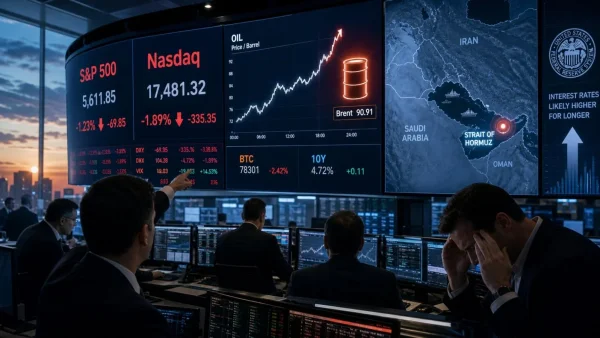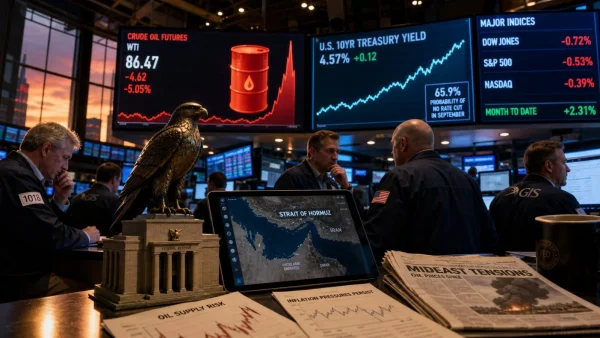
It was a cautious close for Wall Street after a sharp move in crude rekindled worries over inflation and sent bond yields higher. US stocks finished lower on Monday; one could still point to monthly gains from August and the AI momentum that has carried them, but attention has been drawn back to the risks in energy and policy.
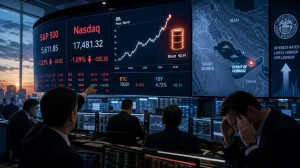
Oil shock resets market focus
Investors have been refocused on inflation by the oil spike at a time when tech’s leadership was waning and other sectors were making up ground in August. The blue-chip Dow is set for a fifth straight month of gains and the Nasdaq has put up the best percentage figures of the month even with some recent pullbacks.
There is also the matter of the Federal Reserve. Hawkish overtones have added to the tension and, in the wake of Friday’s Jackson Hole comments, investors have re-priced the odds of tightening on the horizon. CME’s FedWatch tool puts the probability of a 25-basis-point hike at the September meeting at 65.9%.
Paul Nolte says investors are mulling over those Jackson Hole remarks and what they portend for rates and inflation. His view is that if the Fed does not act in September, the market will be apt to react dramatically having been conditioned to expect it for some time now.
Indexes retreat but August holds up
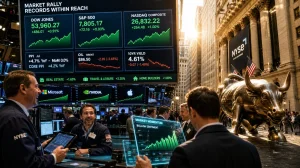
Preliminary figures have the Dow Jones Industrial Average down 380.22 points, or 0.71%, to 53,179.77. The S&P 500 gave up 27.39 points (0.36%) to 7,684.37 and the Nasdaq Composite was off 41.51 points, or 0.16%, to 26,360.91.
The session showed some weakness in earlier trading as well. At one point the Dow was 306.71 points lower at 53,253.28. The S&P 500 had lost 27.95 points to 7,683.81 and the Nasdaq had declined 81.08 to 26,321.34.
Peter Tuz would not make of Monday a day to buy the dip. With the Middle East situation and the thin participation typical of the week before Labor Day in play, he said odd things can happen.
Energy leads, utilities slump, chips stay resilient
With crude on the rise, energy was the unambiguous winner of the day. Halliburton put in a 1.9% gain and Valero Energy was up 1.2%. Utilities were another story, lagging under the weight of a California senate bill amendment that left grid operators’ wildfire liabilities largely unaddressed.
PG&E in California was hard hit, sliding 18.2% to post what will be its biggest percentage loss in six years. It is a case in point for how quickly policy risk can re-price a supposed defensive haven when there are unresolved liabilities.
Semiconductors did not want for buyers. Nvidia was up 0.9%, Sandisk 1.2% and Qualcomm made a 3.4% advance. Nasdaq was able to hold on to its leadership for the month in no small part to the chip strength, which in turn kept the AI trade in focus even through some of the more unsettled sessions.
Stock-specific movers highlight a shifting playbook
GameStop is up 3.4% on news that it will use cash from the books to settle roughly 27% of an earlier announced $1.4 billion debt exchange instead of putting out new shares. The decision sidesteps further dilution and suggests a tighter grip on capital discipline in these higher-rate times.
But there was caution in the market breadth. On the NYSE, decliners put in a 2.16-to-1 showing over advancers, with 183 new lows to 79 new highs. The Nasdaq told a similar story: 3,088 fell to 1,610 gainers (a 1.92 ratio), and new lows at 134 far outnumbered the 31 new highs.
The S&P 500 had 10 new lows and only five 52-week highs, underscoring how narrow the leadership is and that weakness lingers under the headline numbers. Rotations into the defensive side have been anything but uniform; energy has done well while utilities have not.
Geopolitics and inflation expectations collide
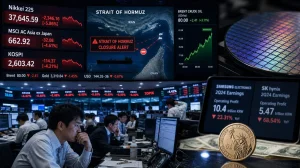
Oil has been on the rise with the escalation of tensions in the Strait of Hormuz, stoking fears of supply issues and persistent price pressure. After U.S. President Donald Trump put in place some costly economic sanctions, hostilities have mounted with days of airstrike exchanges. Iran’s Masoud Pezeshkian has said Tehran is still after a negotiated end to the war.
All the same, the standoff and the prospect of chokepoints for energy shipments have given investors pause. There are worries that the hit to fuel costs could metastasize into something more systemic, which would likely force the Fed to stay on a tight course. Some are already positioning for a move as early as next month.
Warsh’s comments on inflation targets at Jackson Hole did little to allay those concerns. In effect, policy messaging and geopolitics have set up a feedback loop: higher oil means higher yields and compressed equity multiples, while the threat of rate hikes puts risk-sensitive areas under pressure.
Why it matters now, and what comes next
One could say August’s resilience was superficial. As a strategist noted, the month was less about tech and more about the rest of the market looking to find some footing. Monday’s action was a reminder of how fast that can be taken away when an energy shock reprices inflation risk.
Should rate expectations continue to harden, expect volatility in the valuation-heavy parts of the market. A de-escalation or some stability in supply would go a long way to calm inflation jitters and help the cyclicals. But with September coming up, the policy path is the story.
As we head into the month, here is what to watch:
– A 65.9% chance of a 25-basis-point hike
– Supply risks in the Strait of Hormuz
– California’s policy exposure for utilities
– Treasury yields and their response to inflation data
– Breadth metrics that point to defensive plays
The bar for a dovish surprise has been raised; investors have set their expectations to the hawkish side. If the Fed follows the line of recent remarks, it will take stronger earnings or a let-up in geopolitical stress to carry August’s performance forward.
For the moment, the green on the headline indexes is being propped up while the dynamic between crude, rate odds and inflation does what it tends to do late in a cycle: thin the breadth, test conviction and shuffle the leadership around.