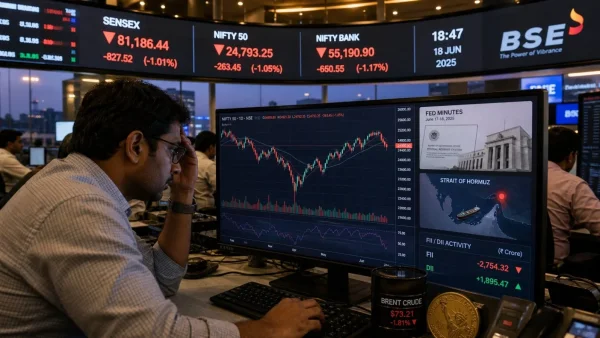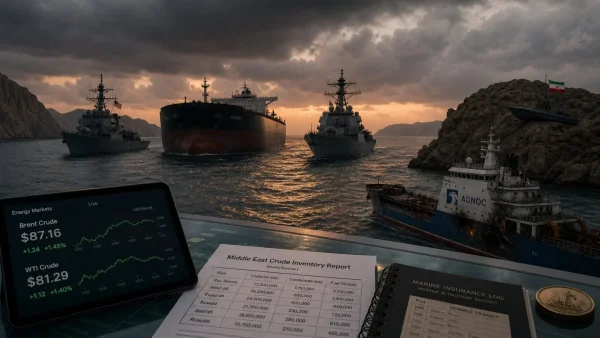
Friday’s session saw prices hold firm as Washington’s move to impose an indefinite blockade on Iran brought supply-risk premiums back into focus, though softer demand put a lid on any major gains. Traders were left to balance the geopolitics with the fact that US crude stocks have had their biggest weekly build in three and a half years. In the end, Brent edged up to $87.16 a barrel and WTI to $81.29.
Why a blockade shifts oil’s risk calculus
The White House has put the world on notice of possible long-running disruption at the most sensitive shipping choke point in existence. Iran has been making life difficult for traffic in the Strait of Hormuz – which accounted for 20 per cent of global oil prior to the conflict – and freight and insurance costs reflect that unease.
Hossein Taeb, the new Basij chief in Iran, made it plain the strait is under the control of the Islamic Republic. And there was confirmation from UAE authorities of an incident on Thursday evening when two Abu Dhabi National Oil Company ships were attacked while in the strait, an act they condemned as coming from Iran.
On the economic side, US officials have hinted at more to come. “Watch this space for more announcements next week,” said Treasury Secretary Scott Bessent in an interview. “We are going to apply measures like have never been seen in the history of economic isolation on a country.”
Prices hold gains but momentum cools
Even with the hard line being taken in rhetoric, macro headwinds have kept the bulls in check. The benchmarks were set for a weekly rise of some 4% after a run of multi-session rallies, even if they gave up more than 2% in the last session.
Market sentiment today is driven by the following:
– Brent was up 9 cents (0.1%) at $87.16
– WTI put on 4 cents to reach $81.29
– A fall of over 2% for both in the previous sitting
– Weekly gains in the vicinity of 4%
– The largest weekly jump in US crude stocks in over three and a half years
– OPEC and the IEA trimming their demand growth outlooks
It is the kind of classic push-pull scenario where you have geopolitical underpinning for prices, yet swelling inventories and slower consumption make a sustained breakout unlikely. Discretionary longs are treading carefully and eyes are on the Gulf for headlines.
Demand downgrades curb upside
The narrative on demand has been put in a cooler light by forecast reductions from the International Energy Agency and OPEC. Given the stockpile surge in the United States, paper markets would need a fresh supply shock to put a higher bar in place for new highs.
Trade ranges are proving sticky as a result. Tim Waterer of KCM sums it up: with these opposing forces at work, the market is supported enough but will not break meaningfully higher.
Strait of Hormuz flashpoints intensify
Supply has been the near-term focus thanks to two things. One is Tehran’s own admission that it is overseeing transit, which leaves shippers with operational uncertainty. Then there is the matter of the ADNOC vessels; the attack on them opens the door to more incidents that could impede flows or add to transport bills.
Were the US to put a blockade in place, refiners would be forced to reprice delivery risks and bottlenecks would harden. Consumer economies are acutely aware of that, since even a minor delay around Hormuz has a way of rippling through product markets.
Gold slips below $4,400 as rate bets firm
Elsewhere in the markets, gold has given way as signs of cooling inflation have bolstered the view the Fed will leave rates where they are next month. Spot bullion was down as much as 1.5% on Thursday to $4,343.91 an ounce, slipping under the $4,400 mark.
Silver fell 1.4% to $64.42, with platinum and palladium also in retreat. The dollar index was holding at about 99.9 as traders looked at the opportunity cost of non-yielding assets and the Fed’s likely course.
Those with a foot in both commodities see it clearly. Oil is at the mercy of geopolitics but tied to macro demand, whereas precious metals are turning on rates. Whether we see a decisive move will depend on if tensions in the Gulf ratchet up or if the demand data is soft enough to negate the risk premium.