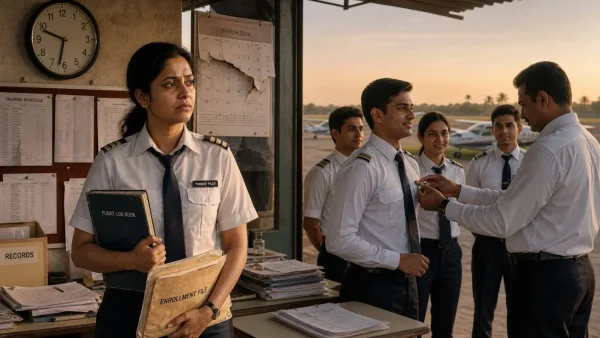
A video featuring a woman identified as Preeti has triggered concern on social media after she alleged that caste-based discrimination has prevented her from completing her pilot training despite spending years pursuing the profession.
According to claims made in the video, Preeti belongs to the Scheduled Caste (SC) community and began preparing to become a commercial pilot in 2019. She says that what should ordinarily have been a roughly three-year journey has stretched into approximately seven years, leaving her still unable to realise her ambition.
Preeti reportedly says she is now 34 years old and fears that the delay could permanently close the door on her dream because of the age-related requirements applicable to commercial pilot licensing.
Allegation of caste discrimination
The most serious allegation in the video is that Preeti’s prolonged struggle was not simply the result of training difficulties or administrative delays, but caste-based discrimination at the institute.
She reportedly claims that students who joined the institution after her have already completed their training and gone on to become pilots, while she remains stuck in the system.
These are serious allegations. However, they have not been independently established through an official inquiry or judicial finding based on the information currently available.
The identity of the aviation institute, the specific instructors or officials allegedly responsible, and documentary evidence supporting the discrimination allegation would need to be established before the accusation can be treated as proven.
Why the allegation matters
India’s Constitution prohibits discrimination on grounds including caste, and the Scheduled Castes and Scheduled Tribes (Prevention of Atrocities) Act, 1989 provides specific legal protections against certain caste-based offences.
In an aviation-training environment, however, discrimination allegations would also need to be examined under the applicable rules governing the institution, aviation training, examinations, licensing and student grievances.
A proper investigation would therefore need to distinguish between legitimate training or safety requirements and conduct that may amount to discriminatory treatment.
The age question
Preeti’s claim that she is approaching an age limit makes the matter particularly urgent.
Commercial pilot licensing involves specific eligibility and medical requirements, and the applicable age rules can differ depending on the licence and aviation activity. Therefore, the assertion that a person can become a pilot only until the age of 35 should not be treated as a universal aviation rule without specifying the licence involved.
If Preeti is pursuing a Commercial Pilot Licence (CPL), the relevant Directorate General of Civil Aviation (DGCA) requirements would need to be examined to determine exactly how her age affects her eligibility and career prospects.
That distinction is important because a viral claim about an age deadline should not replace the actual regulatory position.
What should happen now?
If Preeti’s allegations are genuine, the case deserves an impartial examination rather than being reduced to a social-media argument.
A transparent inquiry should establish:
When Preeti enrolled at the aviation institute and what training programme she joined.
Her complete training and examination records from 2019 onward.
The number of training hours, examinations and attempts completed by her.
The reasons recorded by the institute for every significant delay.
Whether students who joined later received materially different treatment.
Whether any complaints regarding caste discrimination were previously submitted.
Whether instructors or officials made caste-related remarks or decisions affecting her training.
Whether all payments, training requirements and examination opportunities were applied consistently.
Whether her current age and medical/licensing status affect her ability to obtain the licence.
Whether any aviation regulator, institute grievance body or government authority has already examined her complaint.
DGCA’s role
Because pilot training and licensing fall within India’s civil-aviation regulatory framework, any complaint involving training standards or licensing should also be brought before the appropriate aviation authorities where applicable.
The Directorate General of Civil Aviation (DGCA) oversees civil aviation safety regulation and licensing in India. If the allegations concern the conduct of an approved flying-training organisation, relevant records and complaints can potentially be examined through the regulatory framework applicable to that organisation.
At present, however, there is no independently verified information establishing that DGCA has initiated a formal investigation into Preeti’s allegations.
A dream delayed for seven years
The human dimension of the story is difficult to ignore.
Whether the delay ultimately proves to have resulted from discrimination, administrative problems, training failures, examinations, finances, medical requirements or another reason, spending years pursuing a professional goal can have enormous personal and financial consequences.
If an investigation establishes that caste discrimination contributed to the delay, the consequences would be particularly serious. A person’s social identity should never determine whether they receive equal access to training, examinations or professional opportunities.
At the same time, allegations of discrimination must be investigated fairly so that responsibility is established on evidence rather than viral claims.
What is known—and what remains to be verified?
Reported in the viral account:
The woman is identified as Preeti.
She says she belongs to the SC community.
She reportedly began pursuing pilot training in 2019.
She says her training has continued for approximately seven years.
She alleges that caste discrimination contributed to the delay.
She says she is now 34 years old.
She claims that several students who joined after her have already become pilots.
Not independently established from reliable sources reviewed:
The identity and official response of the aviation institute.
Documentary proof of caste discrimination.
The exact number of years Preeti has spent in each stage of training.
Whether she has completed all required flying hours and examinations.
Whether any DGCA investigation has been initiated.
Whether any disciplinary action has been taken against an instructor or institution.
Whether her age creates an absolute legal deadline preventing her from obtaining a commercial pilot licence.
The need for an evidence-based inquiry
The most constructive response now would be a formal, time-bound and independent inquiry.
If Preeti’s records demonstrate that she was repeatedly denied opportunities available to similarly placed students because of her caste, those responsible should face appropriate action.
If the records show that the delays arose from legitimate training, examination, medical or regulatory requirements, those reasons should also be publicly explained so that the controversy can be resolved fairly.
Either way, Preeti deserves clarity.
A seven-year delay in pursuing a professional dream is significant. And if discrimination played any role in that delay, the issue goes far beyond one aspiring pilot—it raises questions about equal opportunity and whether institutional systems are genuinely accessible to people from historically disadvantaged communities.
The viral video has brought Preeti’s story into the public eye. The next step should be evidence, investigation and accountability—not merely outrage on social media.