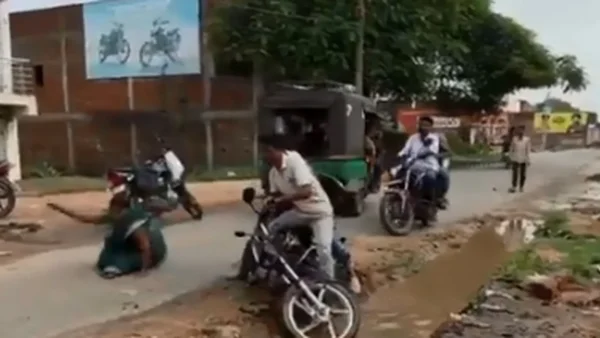
A disturbing video circulating on social media has sparked renewed debate over road safety, open drainage systems and the condition of public infrastructure during the monsoon.
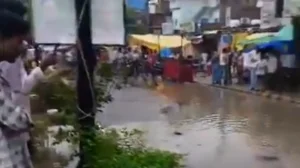
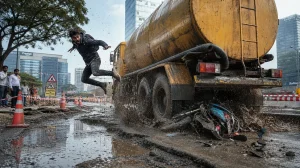
The footage appears to show a family travelling on a motorcycle encountering a severely waterlogged stretch of road. The motorcycle becomes submerged in floodwater, while one of the passengers appears to lose balance and fall as the vehicle struggles through the flooded section.
The video has triggered criticism of both the road conditions and the behaviour of the riders. Social-media users have pointed out that riding without helmets and carrying three people on a two-wheeler are serious safety violations. At the same time, questions are being raised about whether citizens should be exposed to dangerous road conditions, uncovered drains and waterlogged stretches without adequate warning or barricading.
Is the incident from Satara?
A key question surrounding the viral footage is its exact location.
The video has been circulated with claims that it may have been recorded in Satara, Maharashtra, but the specific location of the incident could not be independently established from reliable reporting available at the time of publication.
Satara has nevertheless experienced significant monsoon-related infrastructure problems this year. In July 2026, heavy rainfall triggered a landslide that temporarily closed the Satara–Mahabaleshwar road (State Highway 58).
Reporting from Satara’s rural areas has also documented how intense rainfall can leave roads effectively unusable. In Navaja village, for example, heavy rain caused streams to overflow across an approximately eight-kilometre stretch of unpaved road, making it difficult for ordinary cars to pass. The village recorded 394 mm of rainfall on July 28, 2026, according to Maharashtra Agriculture Ministry rainfall data cited by The Indian Express.
The Satara district administration has also formally undertaken monsoon-preparedness planning covering floods, storms, landslides and other natural calamities.
Road safety and civic responsibility
The incident also highlights an important distinction: poor infrastructure does not eliminate individual responsibility, and individual mistakes do not eliminate government responsibility.
If the riders were travelling triple on a motorcycle or without helmets, those actions can increase the severity of an accident and may constitute violations of traffic regulations.
But that does not answer questions about the condition of the road itself.
Where a road is severely flooded, an open drain is difficult to see or a dangerous stretch has become impassable, authorities have a responsibility to provide appropriate warnings, barricades, drainage and emergency measures.
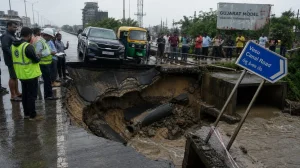
An uncovered drain hidden beneath floodwater can be particularly dangerous because motorists may be unable to distinguish between a normal flooded roadway and a potentially deep or open drainage channel.
Who is responsible when public infrastructure becomes dangerous?
Determining responsibility would require establishing several facts:
The exact location of the incident.
Which authority owns and maintains the road.
Whether the drainage structure belongs to a municipal body, gram panchayat, PWD or another agency.
Whether the drain was legally covered or protected.
Whether warning signs or barricades were installed.
Whether the road had previously been reported as dangerous.
Whether drainage and desilting work had been carried out before the monsoon.
Whether the flooding resulted from exceptional rainfall or inadequate drainage capacity.
Whether any contractor or maintenance agency was responsible for the defective infrastructure.
Without these details, it would be premature to assign liability to a particular department or contractor.
Satara’s wider monsoon challenge
The viral footage comes against the backdrop of repeated reports of monsoon disruption in Satara district.
In May 2025, a video from Kulkajai village in Man taluka showed a young man carrying his motorcycle on his shoulders because heavy rain had turned the road into deep mud and made it difficult to ride through. Local reports described the road as heavily damaged and filled with mud and potholes.
In July 2026, heavy rainfall also caused a major landslide on the Satara–Mahabaleshwar route, bringing traffic to a halt and even leaving a JCB stranded.
These incidents illustrate a broader problem faced by many parts of Maharashtra during intense monsoon periods: roads, drainage systems and slopes must cope with very large volumes of water in short periods.
The taxpayer’s question
The central public concern is not whether road users should follow safety rules—they unquestionably should.
The larger question is whether taxpayers should have to choose between breaking traffic rules and risking their lives, or avoiding roads that have effectively become hazardous zones during heavy rain.
Road tax, GST, fuel taxes and other charges contribute to government revenues, but these payments do not automatically establish legal liability for every accident or guarantee compensation for every road-related loss.
Compensation generally depends on the circumstances of the accident and applicable law. If negligence by a public authority can be established, affected individuals may have legal remedies, but such responsibility must be determined on evidence rather than assumed from a viral video.
Authorities need to identify the location
The immediate priority should therefore be to establish exactly where the video was recorded.
If the location is confirmed, the responsible civic or road authority should inspect the site, determine whether an open drain or defective road contributed to the incident, and take immediate steps to prevent another accident.
That should include barricading dangerous drains, installing visible warning signs, improving drainage and repairing damaged road surfaces wherever necessary.
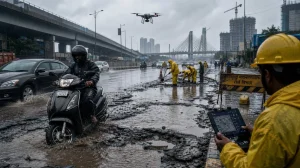
The incident is also a reminder that monsoon preparedness cannot stop at issuing weather warnings. Roads, drains, culverts and pedestrian infrastructure must be inspected before and during periods of heavy rainfall.
For the family shown in the video, the immediate priority was simply getting through a dangerous stretch of road.
For authorities, the larger responsibility is ensuring that the next family does not have to face the same danger.