India’s ambition to become a developed nation by 2047 is increasingly being measured against a much more immediate test: whether its roads can withstand the annual monsoon.
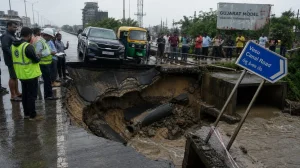
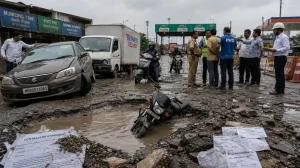
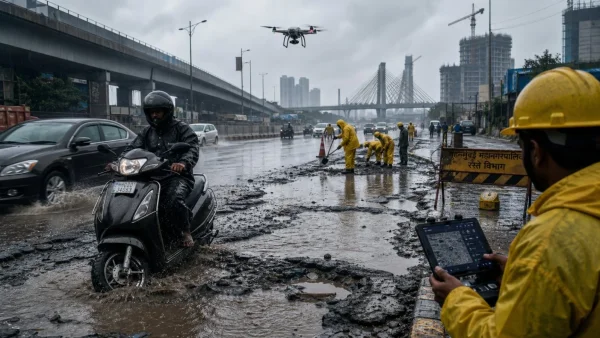
Images and videos of severely damaged roads, deep potholes, waterlogged streets and crumbling surfaces have once again circulated widely this monsoon, highlighting the gap between India’s ambitious infrastructure goals and the everyday experience of motorists.
The contrast is striking. India is investing in expressways, highways, bridges and major transport corridors while millions of commuters continue to encounter roads that become difficult—or sometimes dangerous—to navigate after heavy rainfall.
Prime Minister Narendra Modi’s government has repeatedly linked infrastructure development with the broader Viksit Bharat 2047 vision. In a 2026 post-Budget address, the Prime Minister described the goal of building a developed India by 2047 and emphasized infrastructure expansion and improved quality of life as important measures of progress.
The government has also significantly expanded the national highway network. According to government figures, India’s national-highway length increased from about 91,287 km in 2014 to 1,46,572 km by March 2026, while four-lane-and-above national highways increased from 18,371 km to 45,516 km during the same period.
But building more roads is only one part of infrastructure development. The real test is whether those roads remain safe and functional after extreme weather.
Monsoon exposes the weak points
Heavy rainfall can quickly reveal problems that may remain hidden during dry weather. Poor drainage, inadequate road foundations, water infiltration, weak construction materials, insufficient maintenance and delayed repairs can all contribute to pavement deterioration.
Recent reporting has again highlighted this problem. In Bhopal, repeated monsoon rainfall has damaged several major and internal roads, raising concerns about the quality and durability of road maintenance.
Gurgaon has faced a similar recurring problem, with heavy rainfall causing major roads to flood despite substantial expenditure on drainage and desilting. Reports noted that pending road repairs and weaknesses in civic infrastructure continue to contribute to the disruption.
The problem is not restricted to one city.
A recent analysis of India’s urban infrastructure pointed out that cities have expanded roads, flyovers and expressways without always expanding drainage networks, natural water channels and other supporting infrastructure at the same pace. As a result, intense rainfall can overwhelm urban systems within hours.
Potholes are not merely an inconvenience
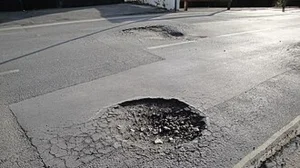
For motorists, a pothole is more than an ugly patch of asphalt.
A deep or poorly visible pothole can cause damage to tyres, wheels, suspension systems and steering components. It can also force drivers to make sudden manoeuvres, increasing the risk of collisions.
The Ministry of Road Transport and Highways has acknowledged pothole-related crashes as a road-safety issue. In a February 2026 parliamentary response, the government provided state-wise data on crashes, injuries and fatalities attributed to potholes and poor road-surface conditions for 2020–2024.
This makes road quality a public-safety issue, not simply a question of aesthetics.
India is already spending heavily on roads
It would be inaccurate to suggest that India has not invested in road infrastructure.
Government data show the enormous scale of road construction undertaken in recent years. Under the Pradhan Mantri Gram Sadak Yojana, 1,85,651 roads covering nearly 7.97 lakh kilometres had been constructed as of July 2026, along with more than 10,800 bridges.
The national highway network has also expanded substantially, and thousands of kilometres of roads have been developed under major infrastructure programmes.
The question, therefore, is not simply how many kilometres of road are being built.
It is:
How long do those roads remain usable, safe and resilient?
Government introduces stronger quality controls
There are signs that authorities themselves recognize the need to improve construction quality.
NHAI has recently mandated automated and intelligent machine-aided construction technology for highway projects exceeding certain length and cost thresholds. The system is intended to provide greater real-time monitoring of construction and reduce the possibility of quality shortcuts.
The government has also announced plans to use third-party inspection agencies to monitor thousands of kilometres of expressways and highways from construction through completion. The move comes amid concerns about premature deterioration and construction quality.
Earlier, NHAI had also undertaken dedicated monsoon-preparedness drives involving inspections, drain and culvert cleaning, water-flow management and pothole repairs.
These measures suggest that road durability is being treated as a serious engineering and governance challenge.
Climate may make the challenge harder
There is another factor that cannot be ignored: changing rainfall patterns.
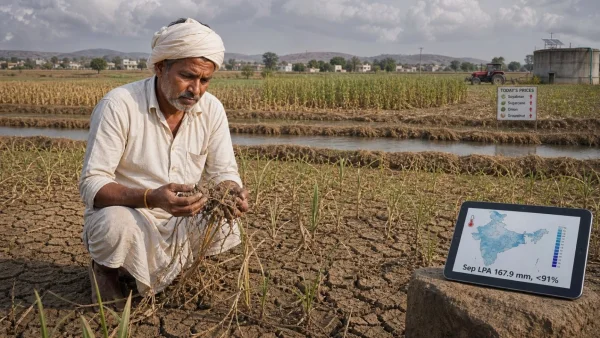
A recent IIT Roorkee study reported that India’s future monsoon could increasingly feature fewer but more intense rainfall events. Such concentrated downpours can overwhelm drainage systems and increase flood and road-damage risks.
That means infrastructure designed only for historical rainfall patterns may not be sufficient in the future.
Road construction therefore needs to account not only for traffic loads but also for drainage, groundwater, extreme rainfall, temperature variations and long-term maintenance.
The real meaning of “developed”
India’s infrastructure achievements are substantial, but development cannot be measured only by the number of expressways inaugurated or kilometres of highway constructed.
A developed transport system must also provide:
Roads that withstand seasonal weather
Proper drainage
Timely maintenance
Transparent quality monitoring
Accountability for premature failures
Safe conditions for pedestrians and motorists
Rapid response to dangerous potholes
Long-term value for public money
The government’s 2047 vision is undeniably ambitious. But for ordinary citizens, development is experienced at ground level.
It is experienced while driving to work.
It is experienced when taking a child to school.
It is experienced when an ambulance needs to reach a hospital.
And it is experienced every time a vehicle crosses a road after heavy rain.
India can build world-class expressways and pursue a developed-country vision. But the credibility of that vision will ultimately depend not only on spectacular infrastructure projects, but also on whether ordinary roads remain safe and functional when the monsoon arrives.
The question is therefore not whether India should aspire to become developed by 2047.
The question is whether the country’s basic infrastructure can keep pace with that ambition—and whether taxpayers can expect the roads beneath their vehicles to be as durable as the promises made about them.