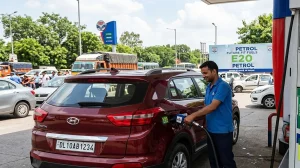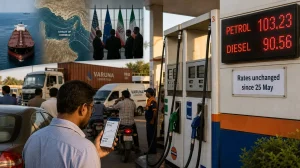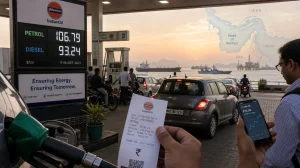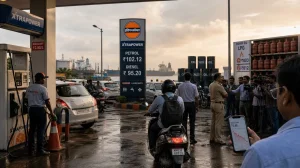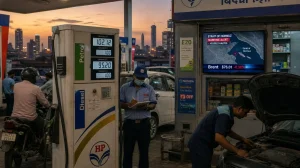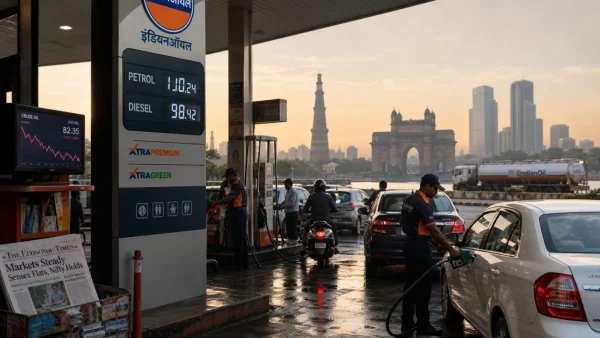
The figures at the pump in Delhi, Mumbai and Bengaluru were familiar ones for commuters when the day started, a testament to how the OMCs are holding the line. This steadiness came despite the fact that global crude has cooled off after a five-day run of gains.
City prices: steady, with metros diverging
OMCs have left retail rates for the most part alone, save for minor tweaks in some locations. One sees the metro-tier spread in plain view: petrol is over Rs 110 in a number of metros, diesel for its part is generally below Rs 100.
A look at 21 August in select cities:
– Hyderabad: petrol at Rs 115.69, diesel Rs 103.82
– Mumbai: petrol Rs 111.21, diesel Rs 97.83
– New Delhi: petrol Rs 102.12, diesel Rs 95.20
– Bengaluru: petrol Rs 110.93, diesel Rs 98.80
– Chennai: petrol Rs 107.76, diesel Rs 99.55
– Gurugram: petrol Rs 102.97, diesel Rs 95.64
– Chandigarh: petrol Rs 101.54, diesel Rs 89.47
– Patna: petrol Rs 113.35, diesel Rs 99.36
– Thiruvananthapuram: petrol Rs 115.49, diesel Rs 104.40
Why Indian pump prices stayed calm
In part because the state-run OMCs set the price for petrol and diesel, the average Indian is shielded from the daily vagaries of crude. It is an approach that curbs the pass-through effect of any global disruption and ensures stability for the time being.
Then there are the domestic variables that account for city-to-city variance. A good portion of what the driver pays is made up of Centre and state taxes, with transport costs and local supply and demand rounding out the figure.
Global crude rally cools
Market data shows the benchmarks have given back some ground following five sessions in the green. Brent was down 0.7% to the $93.10 area, yet still set to close the week up by more than 5%. West Texas Intermediate for October also saw a small decline to about $86 a barrel.
Geopolitical tension behind the pause
Washington’s hard line has been a factor. US President Donald Trump put forth the threat of broad economic measures against Iran, speaking of ‘economic warfare’ and the price to be paid by any nation that extends a lifeline to Tehran.
Tehran would have none of it. The foreign ministry in Iran branded US sanctions as ‘economic terrorism’ and ‘crimes against humanity’. For Foreign Minister Abbas Araghchi, the threats are a ploy to take the eye off America’s own financial troubles.
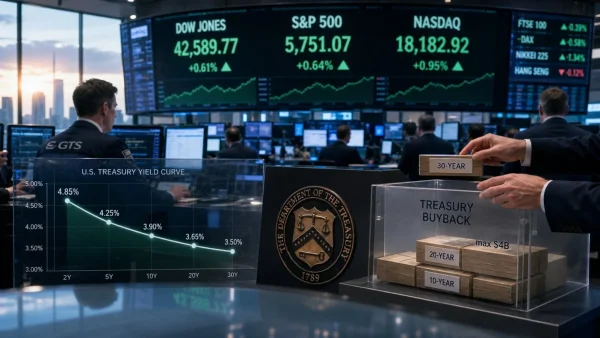
US Treasury Secretary Scott Bessent was on record supporting the warnings, predicting Iran is in for the ‘greatest coordinated economic isolation in the history of the world’. He promised a Monday briefing to lay out exactly what is in store.
China, one of the biggest purchasers of Iranian oil, has called for diplomacy and shown no sign of caving to the pressure. In other developments, Abdolnaser Hemmati of the Iranian Central Bank put it bluntly: flows through the Strait of Hormuz ‘have virtually stopped’.
What this means for Indian motorists
Given that Brent is still up on the week, OMCs have chosen to let things be at the pump. It is a firm way of limiting the impact on logistics operators and households while import costs remain under scrutiny due to Middle East risk and currency action.
From here it is a matter of watching three levers: the rupee-dollar rate, the path of global crude and any policy or tax moves. Motorists can count on a measured response in the daily revisions rather than a knee-jerk reaction to every tick in the global market.