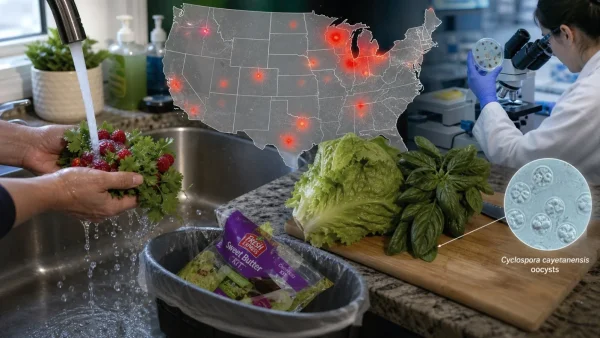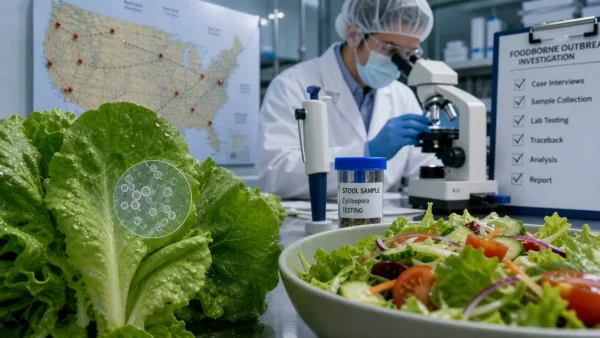
Even if your summer salad is spotless, there is a fast-moving Cyclospora problem in the US for which no one has yet to point a finger. The numbers are mounting: the Michigan Department of Health and Human Services has 2,600 ill and 44 in the hospital, and the CDC is in the process of confirming well over 5,000 more.
It comes down to timing. The parasite has a way of being right there on produce that seems and smells unremarkable. Once the symptoms make themselves known, it is not uncommon for a patient to have a hard time putting together what was on their plate, which puts a crimp in the investigation and holds up any kind of public alert.
Why the source remains unknown
You do not see a Cyclospora infection as quickly as you might with other foodborne issues. The CDC will tell you it is usually about a week after exposure before anything shows, though it can be two days or even a fortnight. That lag time makes for some imprecise interviewing and leaves common items in question.
Then there is the matter of tracking down where the produce came from. A given item has been through its share of hands – from the grower to the processor, the distributor and the store. By the time a case is in the books, the greens or berries in question are likely off the shelf, and the CDC, FDA and state teams are left with little to test.
There is also no indication from officials that all these reports stem from one place across the country. It could be several different products or a series of separate incidents, so a straightforward recall is not an option.
How Cyclospora spreads and how it feels
It is a microscopic parasite, and it gets into the body via food or water that has been contaminated with human waste. We have seen this before in the US with things like imported cilantro, basil, raspberries and leafy greens. ‘It is completely microscopic… one contaminated salad is all it takes,’ says Dr Priyam Bordoloi.
When you are sick with it, you are looking at watery or explosive diarrhoea, bad cramps, nausea, no appetite, and a general feeling of being run down. There can be bloating, weight loss and a low-grade fever. For the elderly, anyone with a compromised immune system, or those undergoing chemo, the risk of serious dehydration is higher.
Testing and treatment
A standard stool test will not do. The doctor has to put in for something that will find the parasite. And while a viral bug may run its course, cyclosporiasis is not something you just wait out; it calls for some antibiotics to put an end to it.
What investigators are checking now
By July 13th, the CDC had put a stamp on 1,600 cases and were on top of 5,000 more. In Michigan, they are reporting 2,600 illnesses and 44 inpatient stays. Lettuce is being looked at, but nothing else is off the table.
Some 800 home-grown cases have been verified in 30-odd states so far this year. You need early warning to do the job. Jill Roberts, who teaches environmental health biology, would have it that less money for the CDC’s FoodNet has made for a tougher time in detection, even if federal types have not made that connection to the present situation.
Reduce your risk now
Give the produce a good wash under the tap, but do not be under the impression that a rinse is a sure thing. If you can, cook it. That is the best way to be rid of the parasite. Be safe with your water and keep your hands clean when you are in the kitchen.
A few clinicians are holding back on some things until we know more. One gastroenterologist is forgoing bagged lettuce, cilantro and the like, and will have a banana or an orange with the peel on. It is a matter of personal prudence, not an edict from on high.
For today, here is what to do:
– Run the water strong and rinse the produce
– Do not let fruits and vegetables sit in a soak
– Go with a head of lettuce and put the outer leaves aside
– Put some heat on the produce if you can
– Wash up before and after you are done prepping
When to seek medical care
If the runs do not stop, do not put it off. A few days of it or any sign of dehydration means it is time to see a doctor. They can put in for the right tests and start you on some therapy. This goes for anyone in a more delicate condition.
Be on the lookout for:
– Diarrhoea that has been going on for a while
– Any severe pain in the abdomen or if you are vomiting
– Dizziness or a dry mouth, which are signs you are dehydrated
– After having some of the kind of produce that has been in the news
The work is not done. The CDC, FDA and the states are still at it, and you can expect some new guidance as the facts come in. In the meantime, a bit of sense in the kitchen and a timely visit to the clinic are the way to go.