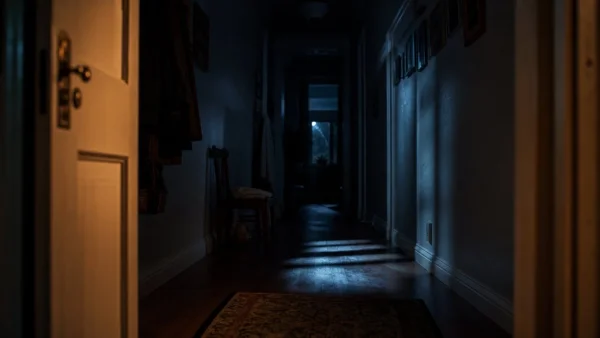
A dark room is rarely the problem. It is the unanswered questions inside it that spike the pulse. Psychologists say the brain dislikes uncertainty, and darkness removes the cues we use to feel safe. That gap invites the mind to imagine what might be there, not what is.
Think about a hallway that feels routine at noon but uneasy at night. Familiar creaks seem louder. Shapes blur into possibilities. That shift is not weakness. It is the brain switching into a safety-first mode when details are missing.
This reaction can happen to children and adults alike. Most people are physically safe at home after sunset, yet the mind treats limited information as a reason to be careful.
What the brain does when lights go out
Fear begins with a threat signal, real or imagined. The amygdala, an almond-sized hub for detecting danger, responds fast. In darkness, visual input drops, so the brain has less to work with and becomes more alert.
Psychologists describe this as hypervigilance: scanning for risks more intensely than usual. It is useful if a threat exists, but in a quiet bedroom it can make ordinary sounds feel ominous.
Only later do reasoning areas help recheck the scene. That is why you might jump at a shadow before realising it is only a chair or a coat on a door.
Why the mind imagines the worst
Evolutionary psychology offers a clear clue. For most of human history, darkness made it harder to spot predators or dangerous terrain. Caution improved survival. The modern brain can still treat uncertainty as risk, even where actual danger is unlikely.
Another factor is intolerance of uncertainty. When details are unclear, some people picture many outcomes. Most will never happen, but the act of filling the gap can raise anxiety. With fewer facts, the mind tends to complete the story with worst-case scenes.
How experience shapes that fear
Fear can also be learned. Classical conditioning research shows that if someone felt terrified in the dark, the brain may link darkness with danger. Getting lost at night, hearing alarming noises, or even scary bedtime stories can build that association.
Over time, the emotional response can become automatic. The light goes off, and the fear switches on, even without a present threat.
Childhood echoes that linger into adulthood
Children commonly fear darkness because imagination develops faster than risk-evaluation skills. Most grow out of it as experience builds confidence. Some adults, however, still feel uneasy in the dark, especially if earlier fears were reinforced by stress or anxiety.
That discomfort does not mean a psychological disorder. Courage is not the absence of fear. It is continuing to function while feeling afraid. Many professionals in high-stakes roles acknowledge fear and still act responsibly.
How to ease night-time anxiety
Relief rarely comes from arguing with fear in the moment. Psychologists recommend introducing darkness gradually so the brain learns that uncertainty does not equal danger. Simple regulation tools help the body settle and let logic catch up.
Try these small, practical steps over time:
– Dim lights slowly before bedtime
– Practise deep breathing for a few minutes
– Use brief, daily meditation sessions
– Challenge one worst-case thought at night
– Remind yourself uncertainty is not danger
– Repeat the routine to retrain your brain
As the brain gets used to darkness without a negative outcome, its threat response often softens. The goal is not to force bravery, but to reduce the reflex that treats every unknown as a risk.
The bottom line
You are not afraid of lightlessness. You are wary of what might be in it. That makes sense when information is scarce and the amygdala reacts before reasoning does.
If fear of darkness causes significant distress or interferes with daily life, psychologists say it becomes a concern worth addressing. For many people, though, understanding the brain’s pattern and practising gradual exposure can restore calm after lights out.