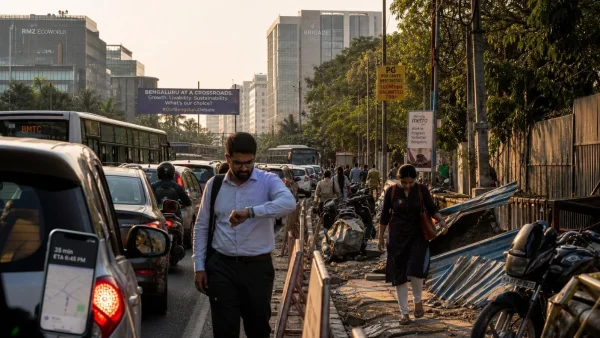
You could say Bengaluru is in the spotlight again. After a founder put out a post that went around, the gridlock was put in a new light: a mindset issue. When a 4 km run can eat up 35 minutes at 7 kmph, you have to ask if the tech capital of India has become too comfortable with being unproductive.
The flashpoint: a 4 km drive at jogging speed
It all came to a head when Dipika Jaikishan, a founder, put pen to paper on a commute that should have been short but turned into 35 minutes for 4 km. The numbers don’t lie: 7 kmph on average.
She put it in a post that got a lot of eyes: 35 minutes for 4 km, 7 kmph, about as fast as you can jog. Then she asked what gave us the right to make of that a habit.
But her point wasn’t the tangle of cars. It was the culture of it. She made the case that we’ve started to build heavy delays into our day as a given, like an entry fee for living in the city.
Why it matters for Bengaluru’s edge
Bengaluru's name is made on how fast we can get things done and the talent we have. Ongoing roadblocks wear that down, and the response to Jaikishan’s post shows folks are aware of it. The talk has moved past mere annoyance to something more: does this kind of acceptance put a dent in the city’s productivity?
One thing in the replies rang true: we have no shortage of patience, just options. You learn to live with it when there isn’t a safe or reliable way to do otherwise.
Residents push back and pile on
Her post let the cat out of the bag on some real-world stories. A few said putting down the car is easier said than done. They’ll tell you the footpaths are in disrepair or blocked by parked cars and construction, not to mention the dust. Walking is hardly an option.
Then you have the other side, who say the good parts of life here still outweigh the bad. Some will put up with a hard ride to work for the weather and the scene in town.
And some of the heat was on the drivers. With so many one-person cars on the road, they say, it’s the behaviour as much as the roads that makes for a longer trip home.
Here is what users were saying online:
– We plan for the delay because we have to
– Can’t walk where the path is in the way
– More solo drivers, more of a jam
– But we like the city for what it is
Mumbai comparisons surface again
As you might expect, Mumbai was brought in. One person said the financial capital has its own version of this, with some exits from a busy area taking an hour. Another was quick to say it’s worse over there. Some even told the Bengaluru crowd to be grateful for the climate.
That didn’t put a stop to it. If anything, it made for a better argument about what we’re willing to put up with and why. In this city, some say, re-timing your day for a delay is a sign of a deeper problem.
The bigger question: acceptance vs action
Before you know it, it wasn’t about one 35-minute trip anymore. Jaikishan hit a nerve because she put her finger on a city that seems to plan for the standstill instead of fighting it.
People can relate. You see it in those who over-prepare for a short hop, or in anyone stuck between a sidewalk you can’t use and a road you can’t move on.
What comes next
This is a crossroads for Bengaluru in a way. The whole point of the place is the free flow of people and ideas. So when 4 km is a 7 kmph affair, you start to wonder how much of a trade-off you’re going to keep making.
For the time being, the talking is the doing. The post has brought together everyone from the hard-liners on infrastructure to those who defend the lifestyle. Whether we turn that into some kind of pressure, or file it away and go with the flow, is up to us.