The one place where heat is making Indian farming most vulnerable is in its labour force. An analysis from the UK’s Energy and Climate Intelligence Unit has some stark numbers: farm hands are down 81 working days on average per year due to the heat. It’s an erosion of income and a threat to what’s on the table. The report makes for a compelling case for why we have to close the adaptation gap now.
What the new study reveals
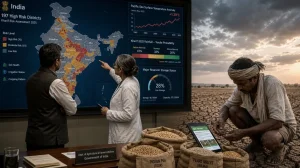
The Energy and Climate Intelligence Unit put a microscope on how heat is sapping the productivity of workers in the nations that put food on the UK’s table. India is the poster child for this, with the steepest drop in work hours of any country they looked at, which is a red flag for crop yields and the people who depend on them.
You don’t have to be in India to see it; in every country in their purview, 50 working days are being given up to the heat. And as the mercury goes up, the report puts the annual loss at four or five more hours than before.
In 2024 alone, an Indian worker was without 648 hours of output, up 52 per cent from 1990. Do the math on an eight-hour day and you have 81 days missing. Then there’s the El Nino to factor in, which the report says could make things even harder for the farm sector.
Why this matters for supply chains
There is a direct line from the field to the supermarket, and the study makes that connection. This year, the UK will be bringing in 7.4 billion in food from 15 countries – 11 per cent of all our imports by the book.
We’re talking about the basics: rice, sugar, lentils, nuts, and the like. But also the fish and soy for feed, and the kind of produce and vintages you’d find in any well-stocked store – grapes, onions, coffee, chocolate, tequila, the works.
On the ground: fewer hours, thinner pay
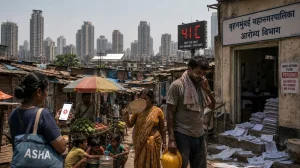
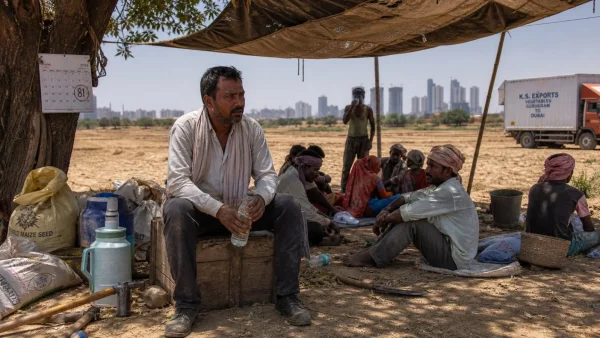
If you go to Gurugram, on the outskirts of Delhi, you can see the pressure. Jagganath, a contractor hailing from eastern Odisha, tells me the heat has turned a week’s job into 12. His crew has to put in an early start, call it a day sooner, and take it easy so they don’t get sick.
‘When the heat is this bad, it throws your body out of kilter,’ he says, taking a moment in the shade of a neem tree. He’s putting less money in his pocket to send back for the next round of farm supplies. And he has a point: the ones feeling the brunt of it are not the ones to blame for the emissions.
A lot of these men are from Bihar, Jharkhand, West Bengal and Odisha, and many are small-time farmers. In the off-season, the city is where they make enough to cover seeds and water back in the village. The heat is chipping away at that lifeline.
Food shocks are already here
It’s not just the man-hours you lose; you have the weather to contend with. Take 2023, when unseasonal rains in some parts of India wiped out tomato crops and sent prices up 400 per cent. Add in a monsoon and a level of heat and humidity that is 30 times more probable because of climate change, and you have a problem for rice growers too.
And that has meant we’ve had to look at home for what we can and put a hold on some exports.
You could read the report and see these as more than a few odd occurrences; they are put down as warning shots in the face of mounting climate pressure.
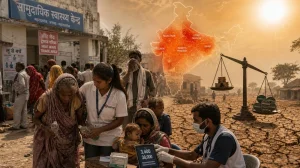
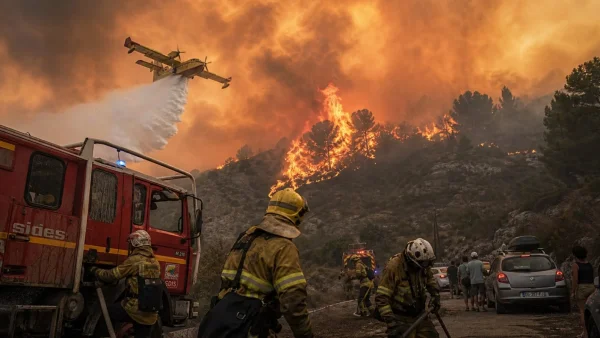
Take 2025 in India, for instance. A Delhi think tank put together some stark numbers: out of the first 334 days of the year, 331 were marked by extreme weather. Between the heat, the rain, the floods, the landslides and the cold, there have been 4,419 fatalities and no end to the damage to crops.
Global exposure and economic risk
This is an issue that goes well beyond India’s borders. The International Labour Organisation has it in their books that by 2030, heat stress will be responsible for a 2.2% drop in worldwide working hours. That’s a $2.4 trillion hit to GDP, a far cry from the $280 billion we saw in 1995. Those toiling in the open with little in the way of shade or relief are on the front line.
In 2024, roughly 71% of the world’s workers were overexposed to the heat. In Asia the number is 74.7%, in the Arab states 83.6%, and in Africa you’re looking at 92.9%. It’s a clear sign of the labour squeeze setting in where it’s most vulnerable.
We’ve had some record-breaking years. 2025 is already in the running for the third hottest, right after 2023 and 2024. Every time the seasons turn up the temperature, the time you can safely work outside shrinks.
Trade links amplify the stakes
If you look at who is set to be supplying the UK in 2025 – India, Brazil, Peru, Colombia, Ecuador, Mexico, Argentina and others like South Africa, Kenya, Egypt, Ghana, Cote d’Ivoire, and even some of Southeast Asia (Vietnam, Indonesia, Papua New Guinea) – many of them are already dealing with farm hands worn down by the heat.
What you’ll find if you check the ND-GAIN Climate Vulnerability Index is that most of these nations are under 50, which means they are at high risk and don’t have much room to adjust. When their output wanes in the hot months, you can expect ripples in the form of price and schedule changes further along the line.
Some of the key take-aways from the report:
– 648 hours of work given up by Indian farm labour in 2024
– A 52 per cent jump in those losses since 1990
– 50 days is the average loss globally
– $7.4 billion in food coming into the UK in 2025
What comes next and what needs to change
Heat is not something you can just put up with for a season anymore; it is a hard fact for anyone relying on their income or the food supply. The India case makes it plain how quickly things can get out of hand when the work is unregulated, the margins are small and there’s no safety net.
When the field gets tougher, the outcome is only one way: you put in less time, make less money and fall behind on what needs to be done. Before you know it, you’re looking at a bad harvest, higher prices and families with less to put on the table.
So what should be done? The report puts some onus on the employers, the authorities and the buyers:
– Move the hard work to when it’s cooler
– Make sure there is enough shade, water and a place to rest
– Put some heat-safety training in place
– Do your buying with the heat in mind
Put simply: if we don’t get on top of this, there is going to be less work getting done in the fields of India. For the ones who put our food on the table, that’s 81 days a year they are losing out on, and the cost of inaction is only going up.