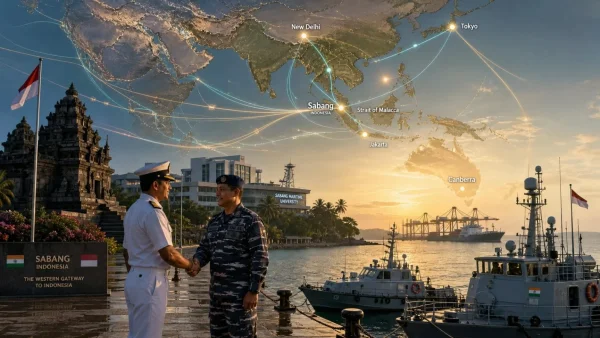
Gone are the days of simply responding to China’s moves in the region; New Delhi is writing its own rules now, with an eye on who it can work with. The arrangement at Sabang is telling. It is not about trying to outdo Beijing port for port, but about having a foot in the door at key junctures and an influence you can’t put a price on.
You could see the change when Prime Minister Narendra Modi made his way to Jakarta on July 7, 2026. In strengthening the bond with Indonesia, India is in a better position to operate near the Strait of Malacca, where as much as anything, it is about trust and being in the right place at the right time.
Why Sabang is a strategic multiplier
There is no better vantage point than the one at the top of Sumatra, where Sabang looks down on the way to the Strait of Malacca. Not many waterways have this kind of weight. Some 22 per cent of all shipping and almost 29 per cent of seaborne oil make their way through this narrow passage from the Indian Ocean to the Pacific.
It is not as if India is in charge of the strait or would say it is. What comes of the deal is the kind of access and a reliable ally that is hard to come by. When a chokepoint can throw a wrench in energy supplies and drive up insurance in a day, being there in a low-key fashion changes the equation.
What has happened in West Asia of late is a reminder that open transit is the lifeblood of the economy. With Sabang, India is nearer to the world’s most active sea lane and has put down roots with a key ASEAN member, which means there is less of a case for large, visible bases.
The value of having a hand in Sabang today is plain to see:
– You get more clout when you are close to a chokepoint
– A good partnership can keep pressure at bay, no base required
– In a tight spot, it opens up more doors
Outmanoeuvring the String of Pearls
China has been at it for some 20 years, putting up and paying for a string of ports from Hambantota in Sri Lanka to Gwadar in Pakistan, and on to Myanmar and the African coast. They may be sold as business, but they have given Beijing some leverage, what some call a String of Pearls.
We know how it works: put up the money, create a reliance, and you have your influence. India had the option to do the same. But it is one thing to try to outspend Beijing and another to outflank them with better relations. The latter is within reach.
This is especially true as China makes itself felt along India’s eastern side, with some recent activity in Bangladesh coming to light before the trip to Jakarta. New Delhi is not going to be drawn into a game of catch-up. The bets being made are selective and meant to tip the scales, not just make the news.
It is a matter of how you define power. Where China might count berths and leases, India is looking at how many other capitals will sit down and plan for the future with it.
Beyond a port deal: defence, minerals, soft power
The relationship with Indonesia is not confined to the sea. There is more to it, like the push in defence ties with BrahMos and Astra missiles, and a lot of ground to cover in manufacturing and security.
Then there is the matter of critical minerals, with both sides keen to insulate their supply chains from risk.
There is a new kind of coordination at work, one that makes sure exercises, patrols and industry relations are in step with one another instead of being walled off.
The soft-power side of things is just as calculated. Take the joint effort to put a ninth-century Hindu temple back in order: it is a way of underlining the civilisational ties that form the bedrock of contemporary trust. Or consider IIM Bangalore’s foray into Indonesia with its first campus abroad. It is an export of education and leadership, a bet on people and policy with a shelf life well beyond any given project.
Trust as currency
You can put a port on a lease or make it bigger. You can’t do the same with trust. That is where Beijing’s method has an opening. Infrastructure may hold down a coastline, but it doesn’t guarantee goodwill when the political winds change.
Sabang is of interest because it shows a partner in India to bolster security for both sides, not a host trying to make the numbers on a debt sheet add up. It is a message to the neighbourhood that working with India means more in common and less fine print, so there is no need to be wary of getting tied up.
A wider Indo-Pacific web
Indonesia is a single point in a net that is only getting larger. In the western Indian Ocean, for instance, India has been of service to island nations like the Seychelles with coastal radar and better maritime domain awareness. These tools close off the blind spots where illicit operations and other grey-zone moves might otherwise go by.
To the east, the Quad with Japan is where the practical side of maritime cooperation is handled. Australia is becoming a key ally on the defence front, and New Delhi’s overtures to it and to New Zealand are part of a move to see that no one is left to be strong-armed in isolation.
Put it all together and the design is evident: India is putting in place a multi-faceted kind of influence. The military and the classroom; the sea lanes and the supply chain; even some old-world culture to put a human face on diplomacy.
In short:
– Influence is not a straight line
– Hard and soft power are two sides of the same coin
– One new connection puts more heft behind the rest
Why this contest looks different now
China’s edge is still there – a bigger navy, more money, the means to put up infrastructure in a hurry. But the way regional clout is tallied has evolved. Out in the water, it is not only about the number of hulls or piers, but who is on board to share the risk.
India is made for that. By making access a priority and eschewing hard-nosed leverage for something like trust, New Delhi sidesteps the kind of friction that comes with a purely transactional relationship. It is an approach that has a certain appeal to the midsize states of the Indo-Pacific.
Then there is the matter of deterrence at Sabang. A footprint near Malacca throws a wrench in the works for any would-be troublemaker without crossing a line or starting an arms race. It is a way of upping the ante on coercion while also putting out some public goods, like a safer passage for ships.
What to watch next
The story here is not of India lording over the Strait of Malacca. It is of co-managing the risks with Indonesia at a critical juncture and, in the process, deepening ties of all kinds. How it is put into practice will be the true test: from the nitty-gritty of defence and maritime work to the progress on the ground in education and heritage.
One can count on China to keep on with its financing of ports and the like. It is a proven way to open doors. But as New Delhi’s side of the ledger offers real security without the burden, more will come to appreciate a balance that is not one-sided.
This is no longer a case of comparing maps of ports. It is about the choices available. China has had the chequebook down to a science. India is at work on the trust part. And in the new equation of the Indo-Pacific, that is what can make the difference.