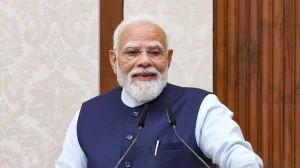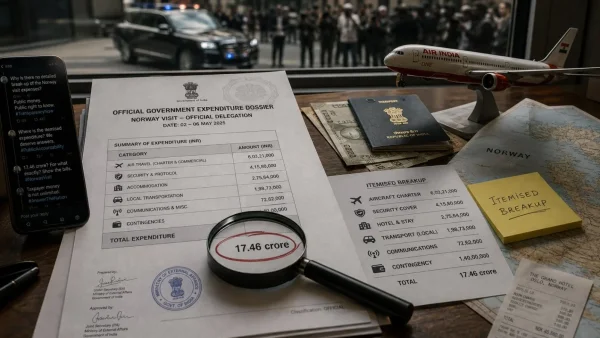
A government expenditure document detailing the Prime Minister’s overseas visits has ignited fresh political debate after revealing that the Norway leg of Prime Minister Narendra Modi’s 2026 foreign tour cost ₹17.46 crore.
The figure, now widely circulating on social media, has prompted questions over how much taxpayer money is spent on official foreign visits and whether citizens should receive a detailed breakdown of such expenses.
While critics have described the amount as excessive for a short visit, government officials and diplomatic experts argue that the cost reflects much more than the Prime Minister’s stay in the country.
What Does the Official Document Say?
The expenditure table for 2026 lists the expenses incurred during several foreign visits undertaken by the Prime Minister.
Among them:
Malaysia (February 7–8): ₹5.57 crore
Israel (February 25–26): ₹11.92 crore
Norway (May 15–20 tour): ₹17.46 crore
Sweden: ₹6.32 crore
Netherlands: ₹3.59 crore
Italy: ₹4.23 crore
Indonesia: ₹3.87 crore
Australia: ₹1.18 crore
New Zealand: ₹5.43 crore
The document notes that these are the final expenditure figures after settlement of bills for most countries.
Does ₹17 Crore Mean One Day Cost ₹17 Crore?
This is where the debate becomes more nuanced.
The Norway visit may have lasted only a day, but the expenditure is not simply the cost of accommodation or the Prime Minister’s personal travel.
Official foreign visits typically involve:
Operation of Air India One or special aircraft.
Security arrangements.
Special Protection Group (SPG) deployment.
Advance security teams.
Local transportation.
Hotel accommodation for the official delegation.
Communication infrastructure.
Venue arrangements.
Diplomatic protocol.
Coordination with host governments.
These costs are part of conducting high-level state visits and are not limited to the Prime Minister alone.
Why Are These Visits Important?
Prime Ministerial visits are generally aimed at advancing India’s strategic and economic interests.
Such visits often involve:
Bilateral meetings.
Trade negotiations.
Investment discussions.
Defence cooperation.
Technology partnerships.
Energy security.
Meetings with the Indian diaspora.
Supporters argue that successful diplomatic engagements can lead to investments, business agreements, and stronger international partnerships that outweigh the costs.
The Opposition’s Question
The figures have nevertheless provided fresh ammunition to opposition parties and critics.
They argue that when governments ask citizens to bear higher taxes and rising living costs, expenditure running into crores on official travel deserves closer scrutiny.
Their primary demand is not necessarily that such visits should stop, but that governments should publish a detailed, itemised breakup of expenditure so taxpayers understand exactly where the money goes.
Should Every Rupee Be Explained?
Transparency advocates believe that public expenditure should be accompanied by clear disclosures.
A detailed breakdown could include:
Aircraft operating costs.
Security expenditure.
Accommodation.
Local logistics.
Event management.
Communication arrangements.
Such disclosures could help reduce speculation and allow citizens to distinguish between necessary diplomatic expenses and discretionary spending.
The Taxpayer’s Perspective
For many taxpayers, the numbers naturally invite comparison.
A middle-class family carefully budgets for travel.
Government expenditure, however, involves an entirely different scale due to the security and diplomatic requirements attached to the office of the Prime Minister.
Still, citizens often ask a straightforward question:
If public money is being spent, shouldn’t the public know exactly how it was spent?
That expectation has become stronger in an era where governments increasingly emphasise transparency and digital governance.
Diplomacy Has a Price—But So Does Accountability
No major democracy conducts international diplomacy without incurring significant expenditure.
Whether it is the President of the United States, the Prime Minister of the United Kingdom, or the leaders of Japan and France, official overseas visits require extensive logistical planning and security arrangements.
The debate, therefore, is less about whether such expenditure exists and more about how transparently it is communicated.
The Bigger Question
The ₹17.46 crore figure has become more than a statistic.
It has reignited an old debate about the balance between diplomacy and accountability.
Supporters see these visits as investments in India’s global influence.
Critics see them as expenditures that deserve greater public scrutiny.
Ultimately, both positions converge on one principle:
In a democracy, taxpayers have the right to know not only how much was spent—but also what the nation gained in return.