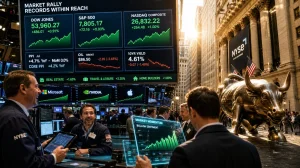
After three days of sliding, Wall Street put on a reversal as the Treasury signalled it would be doing more in the way of debt buybacks. That was enough to ease long-end yields and loosen the stranglehold higher borrowing costs had on equities. Headlines were positive today for the US stock market as the Dow made a jump and the S&P 500 and Nasdaq were lifted.
Debt buybacks recalibrate the rates narrative
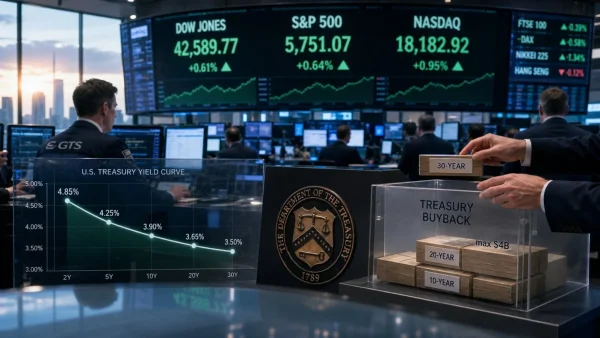
Since late June demand has been thin in some areas, so the US Treasury Department has decided to step in and expand its government debt repurchase operations. Officials have put the maximum size at no less than $4 billion, up from $2 billion, with an eye on the 10- to 20-year and 20- to 30-year segments.
In the department’s view, this is about ‘providing greater liquidity support in longer-dated nominal sectors where there is consistent strong sponsorship from market participants.’ It worked; within minutes the pressure on long-duration yields let up and you could see risk appetite in equities pick up.
Treasury move at a glance:
– Maximum buyback size is now at least $4 billion, up from $2 billion
– 10- to 20-year and 20- to 30-year notes are the focus
– Greater liquidity in the longer-dated sectors is the objective
The effect was immediate. The 30-year Treasury yield, which hit a 19-year high above 5.33% last session, gave back nearly 9 basis points to 5.196%. The 10-year fell some 6 basis points to 4.647%, a meaningful reduction in what has been a headwind for stock valuations.
Indexes rebound as rates headwind fades
Equities were pushed higher on the relief from rates. The Dow Jones Industrial Average was up 193.69 points (0.36%), the S&P 500 added 33.71 or 0.44%, and the Nasdaq Composite advanced 113.52 points for a 0.44% gain.
Then again, the broader context is important. Yields have been driven higher in recent sessions by inflation concerns and the weight of government debt. But Wednesday’s activity was a reminder that policy can still put a stop to illiquidity, at the long end at any rate.
Biotech and consumer names lead, valuation fears ease
Healthcare was the outperformer on the day after some good trial news. Moderna was up 89.5% and Merck 9.7% on the strength of a cancer vaccine developed in tandem with Keytruda. Against Keytruda by itself, the new regimen offered better recurrence-free survival for melanoma patients.
There were earnings runners too. Estee Lauder leapt 15.7% once CEO Stephane de La Faverie noted an acceleration in a key revenue metric for the fourth quarter running. FactSet says the company put in 39 cents a share on an adjusted basis, well over the 32 cents called for by analysts and up from 9 cents a year ago.
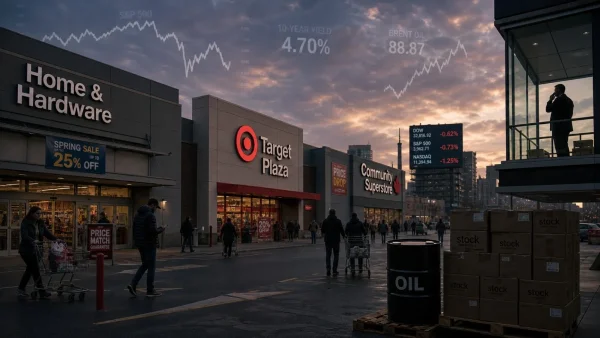
That kind of profit momentum is necessary when valuations are stretched as they are. Consumer and housing plays provided cover: Target was up 4.5%, Lowe’s 1% and Toll Brothers 7.1% on quarterly numbers that beat the mark.
Tech sentiment splits as deals and data collide
You could tell the chip and cloud stories were diverging. Marvell Technology put on more than 12% following a strategic pact with Google over Tensor Processing Units; under the terms, Alphabet gets a warrant for close to 59 million Marvell shares.
Yet a report on OpenAI’s second quarter put a damper on some of the enthusiasm. With losses widening even as revenue was up 18% from the prior quarter, sentiment was pressured. Oracle was down nearly 1.43%, as was Alphabet, and Intel and other chipmakers were in the doghouse at times.
Global backdrop remains uneven
Not so overseas. The Nikkei 225 in Tokyo was 3.2% lower as technology came under fire from higher yields. In South Korea the Kospi tumbled 5.8%, the heavy AI exposure making for some volatility.
US investors may find some breathing room in the rates reprieve, but the risks from debt and inflation that put yields where they are have not been erased. The buyback programme goes some way to shore up liquidity, but how durable it is will come down to funding conditions and the data.
What comes next for markets
Now that long-end yields have come off their peak, leadership might spread beyond the megacap techs if the earnings keep surprising. The Treasury has done its part to stabilise the far end of the curve and prop up risk assets.
All eyes will be on whether the corporate profit beats hold and the yields stay down. Should that be the case, the current bounce has legs. If not, expect the volatility to make a comeback.