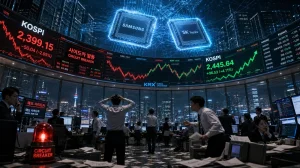
The stock in Seoul was up almost 13% on Wednesday as investors recalibrated to the reality of easing inflation and the pull of AI. It is a sign that the conversation in semiconductors is turning back to growth, with the hard facts of supply and the cost of building out AI infrastructure taking precedence over any cyclical headwinds.
AI memory tightness flips the narrative
There have been weeks of whipsawing in chip equities over the prospect that milder price hikes in the second half of 2026 might put a damper on earnings. You can still see some of that wariness, but it is being put in the shade by the fact that supply is simply not there to meet what AI is calling for.
What is underpinning the market, according to some, is the kind of demand you do not get from anywhere but AI. Meritz Securities puts it at 75-80% for how much DRAM suppliers are able to fill as the shortage has deepened in 2026. They see that number falling to the 60s in 2027 once you take out any speculative orders.
Then there is the view from the top. SK Hynix CEO Kwak Noh-jung is not mincing words: he foresees the global industry in its most severe supply pinch in 2027. Even with plans to ramp up, he figures demand will be ahead of the company’s output for years to come, well past 2030.
Stocks jump as macro wind shifts
On the back of some more palatable US inflation numbers, technology shares around the world have had a lift. The S&P 500 and Nasdaq were up when Wall Street called it a day, with big US banks putting in good work to counteract any jitters from the Middle East.
It was a similar story in Korea. Samsung put on nearly 8%, and Hanmi Semiconductor, a maker of chip equipment, was up 25% in the morning session. A case in point for how a little macro relief and a lot of AI enthusiasm can re-rate the whole chain.
Brokerage calls and capital cycle
You see more of a constructive tone from brokerages when it comes to what is visible on the earnings side. HSBC is of the mind that as AI services become more profitable, cloud spending will hold up, and the move to longer, three- to five-year deals in the industry should smooth things out in the coming years.
Some new reports have given the market a nudge. Barclays opened its book on SK Hynix’s ADRs with an overweight and a $330 target. The ADRs were up 28% to $193.92 on Nasdaq on Tuesday; a clear sign of how much investors are willing to put down for a piece of the AI memory action.
On the other hand, a few strategists would have you believe the recent selloff in Korea had as much to do with the unwinding of some new ETFs as it did with the underlying business. In that light, the current recovery is more of a reset than anything else.
What investors are watching next
For the time being, sentiment could be swayed by a handful of issues:
– Where cloud providers are with their capex
– How memory prices behave in the latter part of 2026
– The cost of financing for inventory and expansion
– Whether long-term supply pacts are being honoured
Can supply expansion catch up with AI demand?
The question on the table is whether a bit of a let-up in US cloud capex, or the need to fund new capacity, will even out the books. The balance is still in short order, which is what is propping up the bull thesis for this sector.
Meritz’s numbers say the shortages are here to stay. Put that with the CEO’s 2027 warning and the idea that demand will be in the driver’s seat for a long while, and the bears may have misjudged the staying power of these prices.
Competitive stakes for Samsung and SK Hynix
The way the market moved on Wednesday is a reminder of how AI is changing the rules of the road. With its role in high-bandwidth and advanced chips, SK Hynix is right in the thick of the next wave of AI buildouts.
Samsung’s 8% gain tells you there is room for more than one to do well. But the steeper climb for SK Hynix is a reward for being more in tune with the AI memory side of things, where you can put a number on your earnings because of the contracts and the lack of product.
In the end, the message is plain: with US inflation in check and AI workloads on the rise, the market will go with the ones who can put scarce memory in front of them. For the moment, that has made SK Hynix the star of the show.