In its quest for AI, China is taking its ambitions to the countryside. By relocating to the west, it can secure the room to scale and the milder weather and power costs that come with it. The plan is to have the country’s data centre capacity nearly double in five years’ time, all while being mindful of energy consumption.
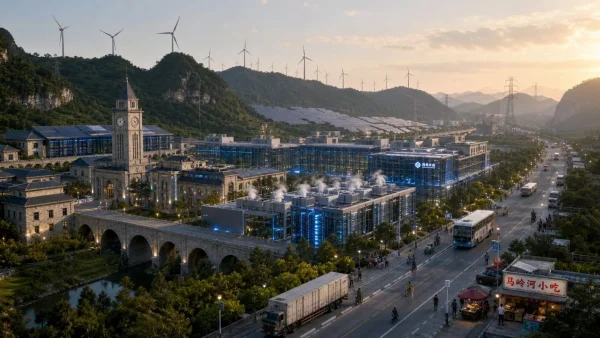
One need only look at Guizhou to see the change. Huawei’s biggest data centre is housed in a group of European-style buildings complete with a clock tower and a multi-arched bridge, the steady hum giving away the computing going on within. You can find street vendors putting in an appearance to feed workers at lunch, a sign of how this kind of AI infrastructure is altering life in the area.
Why China is shifting data centres west
Beijing made it official in 2021 with a policy it dubs ‘Eastern Data Western Computing’. The reasoning is straightforward: AI is a heavy user of energy, and you will find empty space and plenty of fast-growing renewables in Guizhou and similar locales, along with cooler air.
Operators are being steered toward western hubs like Guizhou and Inner Mongolia where wind and solar are strong, after China mandated that data centres must source 80 per cent of their power from renewables before the decade is out.
Then there is the grid to consider. At off-peak times, wind and solar tend to generate more than can be used, an issue called curtailment. “The data centres can be an engine to digest or absorb the surplus of renewable power generation,” according to Simeng Deng, a senior analyst with Rystad Energy.
It is a strategy meant to address several things at once. Dozens of facilities have been put up in Guizhou in recent years alone. In doing so, the plan supports AI and takes up the slack in green power, while opening development corridors well away from the coast.
Put simply, the case for building out in the west rests on these factors:
– Lower costs for land and construction
– A ready supply of renewables
– Climates that are conducive to efficiency
– The ability to put in more capacity in short order
Local gains, mixed outcomes
The local economy in Guian New Area has been put through its paces since the server farms and Huawei’s complex came to town. “It was a barren mountain until the area developed and transportation became more convenient,” says Shu Peihua of his shop.
Small businesses have had to adapt. Vendors are on hand for the data centre employees and residents note the supporting investments. A pancake seller mentions the two universities that have been set up since the facilities were constructed. Li Xixiu points to a main road that has been widened and says the centres have “really boosted the economy of this entire area”.
Employment figures tell part of the tale. “All the villagers in our neighbourhood now have jobs nearby,” Li said. “Before they had to go elsewhere.” Researchers would have one be wary of assuming that server farms are a surefire way to disseminate prosperity, and quickly.
“Data centres do not necessarily engender a ‘huge spillover effect’ for local employment,” observes Andrew Stokols of Singapore Management University. The expectation is that in time the digital industries will coalesce around these hubs, but “immediate benefits have been elusive” in China as much as anywhere else.
Renewables, computing crunch and the AI race
There is method to the timing. With the global AI contest with the United States and an impending computing crunch, capacity has become an economic imperative for China, which plans to almost double its data centre stock in five years’s time.
Stokols says the policy papers that came before the AI boom were already making the case that computing power is synonymous with national power. “It is essential for national competitiveness in the age of digital technology,” he said, and the head-to-head competition has only hastened the effort.
The turn to rural areas also avoids some of the political headwinds found in other parts of the world. Where a server farm in Europe or the U.S. might meet opposition on account of noise or water and energy costs, in China such dissent is kept in check, particularly when it comes to central policy, allowing major projects to proceed without delay.
Practicalities remain, of course. Inland regions require sound planning for grid integration and water. But with renewable targets and the demands of AI, the route is obvious: put down roots where there is room and cleaner energy at a lower price, and run the compute back to the east.
Debt risks and what comes next
One has to look at the numbers to get the full picture. Guizhou has put up 7.4 percent annual GDP growth for the last ten years, yet by the reckoning of the Taiwan-based Research Institute for Democracy, Society and Emerging Technology (DSET), its wage growth was near the bottom of the country.
“The contrast is telling; you see the heavy investment in equipment and land, but the per capita income does not reflect it to the same degree,” wrote DSET’s Cartus Bo-Xiang You and Angela Glowacki in an email. The province has put out large incentives and infrastructure spending to show for it.
According to DSET, that aggressive courting of digital infrastructure has left its mark on the finances. In 2024 Guizhou was 30th in the nation for debt-to-revenue and 27th for debt-to-GDP, a standing that speaks to the fiscal risk of building before the industry can deliver.
Momentum will not wane, however. Nations are vying for technological supremacy and the need for processing power is insatiable. National goals and market forces will see the build-out continue.
What remains to be seen is if the western hubs can foster a more robust ecosystem. Should AI tooling and cloud services set up shop beside the server farms, the spillovers may well follow. At present, the activity at Huawei’s sprawling complex is indicative of a national strategy: invest in the infrastructure now and let the results come later.
It is a straightforward proposition. Put the data centres in the green, rural west and scale them to stave off a crunch. Whether the bet pays off will be judged by more than petaflops; it will be in how far the benefits extend to the communities that house them.