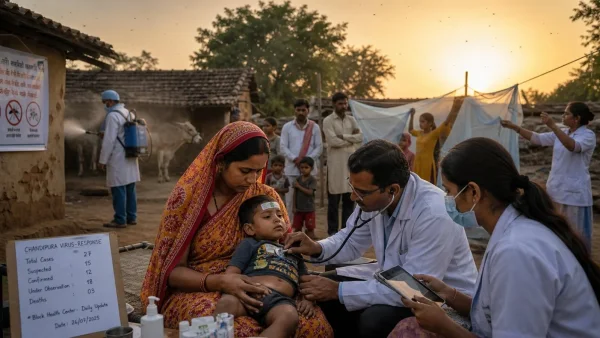
Since June 30 there have been 27 deaths and 41 laboratory-confirmed cases as Gujarat works to contain the surge. Health officials are calling for strict prevention and early medical assessment in light of the situation; they are particularly concerned with children who can go from fever and seizures to serious decline in short order.
What the numbers reveal
According to figures put out by the state health department on Friday, 257 suspected cases have come in across Gujarat through 5 p.m. on August 14. Of those, 246 have had their lab results returned while 11 are still outstanding.
You can see the upward trend. Back on July 21 the count was 63 suspected cases with only 12 confirmed and eight pending. Now confirmed infections stand at 41, a clear indication of how the outbreak has widened in that time.
Why children are at risk
This is a vector-borne infection associated with Acute Encephalitis Syndrome. The National Centre for Disease Control has pointed to sudden neurological symptoms and fever, making those under 15 especially vulnerable.
Most often the virus is passed on by sandflies in central and western India. If one waits too long to seek care, the illness can run its course with little option but to manage the symptoms.
How authorities are responding
As the numbers have gone up, officials have ramped up their response in the affected areas. This means door-to-door screening and vector control in and around cattle sheds and homes. They have also put more emphasis on community awareness, cleanliness and insecticide spraying to keep sandfly populations and bites down.
A National Joint Outbreak Response Team is looking into the matter in both Rajasthan and Gujarat. Maharashtra has put out an alert of its own. It is a renewed effort after Gujarat was hard hit by a major outbreak two years back.
Spot the signs early
Medical professionals will tell you that time is of the essence when it comes to neurological symptoms. One should not hesitate to get care if any of these red flags are noticed:
– A child coming down with a high fever all of a sudden
– Persistent vomiting
– Any form of seizure or convulsion
– Signs of confusion or a change in mental status
Cutting risk at home and outdoors
With no vaccine or antiviral for Chandipura virus, one has to rely on keeping the area clean and staying out of the way of sandflies.
Exposure can be reduced with some straightforward measures:
– Put on full-length clothing and long sleeves
– Make use of well-fitted nets when sleeping
– Apply repellents according to instructions
– See that the vicinity of the home and cattle sheds is kept in order
What comes next
There are 11 results yet to be had and the surveillance continues, so the case tally is bound to change. For now the focus is on nipping transmission in the bud and identifying severe cases in children before they become critical.
The message for families is a practical one: heeding local health advisories and minimising contact with sandflies. As for the wider community, sustained awareness and vector control are the best way to blunt the momentum of this outbreak.