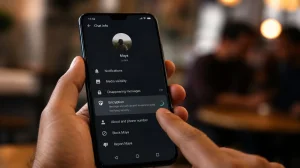
A new social-media claim has added an unexpected twist to India’s growing UPI charges controversy: that RBI Governor Sanjay Malhotra was allegedly blocked on WhatsApp by Finance Minister Nirmala Sitharaman.
It makes for a sensational headline.
Unfortunately, there is no credible evidence currently available to establish that the Finance Minister blocked the RBI Governor on WhatsApp.
In fact, the available record points in the opposite direction. In February 2026, Malhotra publicly met Sitharaman at Parliament House, with the Finance Minister’s office itself posting about the meeting. (ETBFSI.com)
So the WhatsApp-block claim should be treated as unverified, not reported as fact.
But behind the viral joke lies a very real policy disagreement.
What Did the RBI Governor Actually Say About UPI?
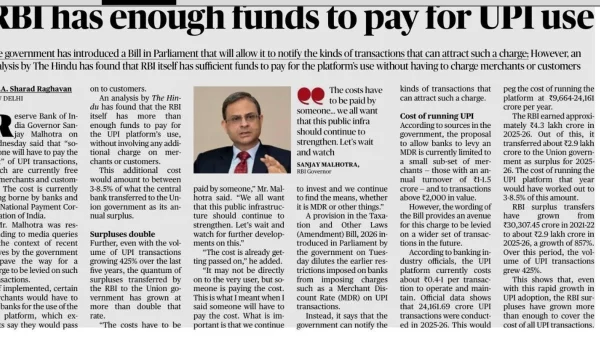
On August 5, RBI Governor Sanjay Malhotra addressed the question of who would ultimately bear the cost of India’s enormous UPI infrastructure.
His answer was essentially straightforward economics:
Someone has to pay for running the system.
Malhotra said it was too early to determine who would ultimately bear the cost as the government considers changes that could permit Merchant Discount Rate (MDR) charges on certain UPI transactions.
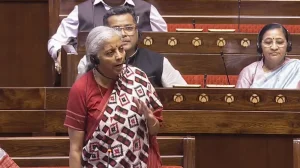
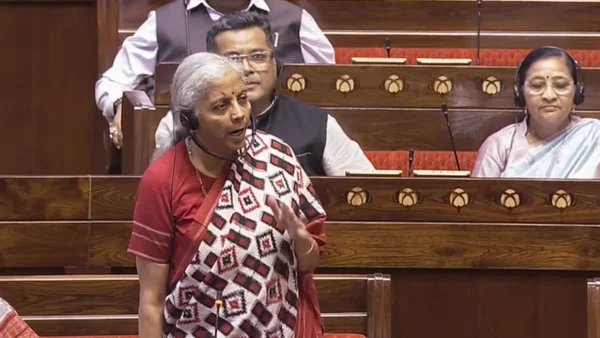
That comment came just after Finance Minister Nirmala Sitharaman introduced the Taxation and Other Laws (Amendment) Bill, 2026.
So What Has Actually Happened to UPI?
This is where the controversy becomes serious.
The Lok Sabha passed the Taxation and Other Laws (Amendment) Bill on August 6. Among its provisions are amendments to the Payment and Settlement Systems Act, 2007, creating a framework under which the Centre could permit MDR on notified electronic payment modes, including UPI.
But there is an important distinction:
The Bill does not itself impose a UPI fee on every transaction. It creates the legal possibility for charges to be permitted through subsequent government action.
Reports have indicated that a possible MDR of around 0.25%–0.4% on certain merchant UPI transactions above ₹2,000 has been discussed, while person-to-person transactions are expected to remain outside such a framework. However, no final UPI fee has been imposed by the Bill itself.
And This Is Where the “WhatsApp Block” Joke Begins
The internet has effectively created its own version of the story:
Finance Minister: “Let’s change the rules.”
RBI Governor: “Someone has to pay for UPI.”
Internet: “Did they block each other on WhatsApp?” 😂
It’s funny.
It is also currently unsupported by evidence.
There is no credible report establishing that Sitharaman blocked Malhotra.
And given that the two were publicly meeting earlier this year, the claim should not be presented as a confirmed political feud.
The Real Controversy Is Much Bigger Than WhatsApp
The important question isn’t whether two senior policymakers are fighting on a messaging app.
It is:
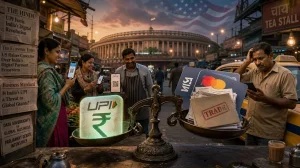
Who should pay for India’s UPI infrastructure? UPI has become one of India’s most important digital public-payment systems.
For years, consumers have become accustomed to the idea that ordinary UPI payments are free.
Changing that model—even indirectly—raises several questions.
Would the cost be borne by:
Merchants?
Banks?
Payment apps?
The government?
Consumers indirectly through higher prices?
Or some combination of these?
The RBI Governor’s comments highlight precisely this economic problem.
“Free UPI” Was Never Really Free
Here’s the uncomfortable truth.
When you scan a QR code and pay ₹500, you may not pay a separate UPI fee.
But operating the system still costs money.
There are banks, payment processors, technology infrastructure, cybersecurity systems, network operations and settlement mechanisms behind that seemingly instant “Payment Successful” notification.
So the real question was never whether UPI costs money to operate.
It does.
The question is:
Who should foot the bill?
Why Merchants Are Worried
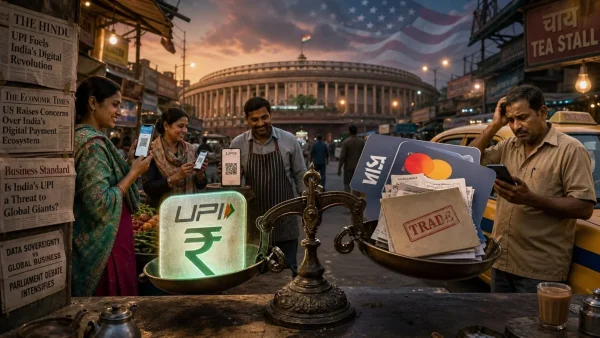
If MDR is introduced on certain merchant transactions, businesses could face an additional cost for accepting digital payments.
Large businesses may be able to absorb some of that expense.
Small retailers and street vendors could be more sensitive to even small transaction charges.
And there is another concern:
Could today’s merchant charge eventually become tomorrow’s consumer charge?
Nothing in the current development automatically means consumers will be charged directly.
But businesses facing additional payment costs could potentially factor those costs into pricing.
That’s why the issue deserves scrutiny rather than panic.
The Government’s Side of the Argument
The government can reasonably argue that a sustainable payment ecosystem cannot depend indefinitely on subsidies or zero-cost arrangements if infrastructure and transaction volumes continue to expand.
India’s UPI ecosystem has grown enormously, and the financial model supporting that infrastructure has to remain viable.
The government’s proposed changes therefore need to be viewed in that context.
At the same time, policymakers have to consider the broader objective of keeping digital payments affordable and encouraging formalisation.
The Opposition’s Objection
The political controversy is straightforward:
Critics fear that opening the door to MDR could undermine one of UPI’s biggest advantages—simple, low-cost digital payments.
The manner in which the legislation moved through the Lok Sabha has added fuel to that criticism.
The Bill was passed amid disruptions and without a substantive debate, according to multiple reports. (The Times of India)
That raises a legitimate parliamentary question:
If the future pricing of a payment system used by millions of Indians is being changed, shouldn’t Parliament debate it properly?
Sarcasm Aside, Don’t Turn a Policy Debate Into WhatsApp Gossip
There is an amusing temptation to turn every disagreement between two senior officials into a personal drama.
“RBI Governor blocked by FM!”
“UPI fight reaches WhatsApp!”
Great social-media content.
Poor journalism.
The real story is much more consequential.
India has built one of the world’s most widely used instant-payment ecosystems.
Now policymakers are debating how to finance it.
That deserves numbers, transparency and parliamentary scrutiny—not an invented WhatsApp feud.
The Bottom Line
The WhatsApp-block story is currently a social-media claim, not a verified fact.
But the controversy surrounding UPI is very real.
The government has moved to create greater flexibility around MDR. The RBI Governor has publicly acknowledged that running UPI has a cost and that somebody ultimately has to bear it. Parliament has now passed the relevant Bill in the Lok Sabha, although the legislation itself does not automatically impose a UPI fee on users.
So forget the WhatsApp gossip for a moment.
The question Indians should actually be asking is:
If UPI is the symbol of India’s digital-payment revolution, who should pay to keep that revolution running—and how much? Because “UPI is free” sounds wonderful.
Until someone has to pay the bill.