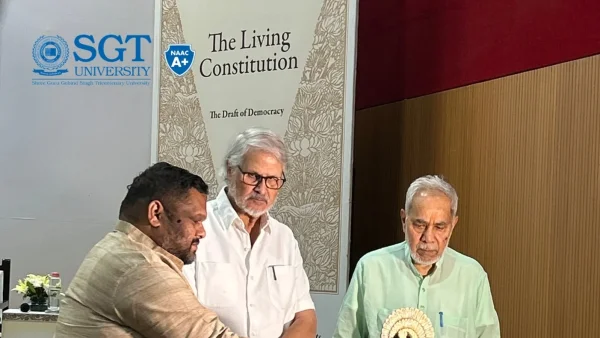
The digital museum, a project of the Advanced Study Institute of Asia and the Faculty of Law at SGT University, is being said to be the first of its kind to fully cover the Constitution. It was created to celebrate the 75th anniversary of the Constitution being adopted.
Key features of the digital museum
The website for the museum, which is now working, has historical materials, records of what happened in the Constituent Assembly (the group that wrote the Constitution), details about the people who wrote it, visual art, timelines, and multimedia. It’s meant to look at the social, political, and historical situations when constitutional ideas developed, were questioned, and changed in meaning.
Hemant Verma, Vice-Chancellor of SGT University, said at the launch that the platform turns knowledge about the Constitution into an experience that’s easy to use and really get into. He said the Constitution is India's guide for how to be a democracy, and its ideas of fairness, freedom, equality and working together continue to inspire.
It was originally planned as something to help with teaching, a guide for research and a complete collection of constitutional material. It also aims to make it easier to understand difficult topics and how things happened in the past.
The virtual museum is split into sections. These include full versions in Hindi and English of all the debates of the Constituent Assembly, information about the committees involved in the writing process and stories from what happened during those meetings. Another section explains the structure, powers and basic beliefs of the Republic.
The portal focuses on these areas: Constituent Assembly debates (in both Hindi and English), details and notes from the work of the committees, interesting stories from the assembly meetings, how the articles of the Constitution are put together, visual art and designs from Indian history, details of the main people who created the Constitution, timelines and multimedia explanations.
Constituent Assembly Debates and archives
The Constituent Assembly debates are in twelve volumes in English and eight in Hindi, and they cover December 1946 to January 1950. They show how the people involved discussed how the country would be run, what rights people would have, how the country would be a federation (a group of states working together), how to protect minorities, social fairness and what kind of country India would be.
These records show how the ideas that formed the Republic developed. They also show how people disagreed with each other within the assembly and how they came to an agreement, creating a basic structure for the country that would be strong but also allow for change.
Priyank Kanoongo from the National Human Rights Commission described the Constitution as something that is still developing with the people of India. He compared it to a house built so that future generations can also add to it, keeping both a basic structure and freedom.
Artistic heritage within the Constitution
The platform shows the appearance of the original handwritten document and the designs used in it, which came from India’s long history. It highlights the work of Nandalal Bose and his team at Kala Bhavana, Visva-Bharati, Santiniketan, who were responsible for the Constitution being a beautifully illustrated document.
The website says Bose and his students created the borders, illustrated panels and pictures with symbolic meaning, taking inspiration from the murals of Ajanta, classical statues, miniature paintings and folk art. Their work visually told the story of India’ night history and culture.
Beohar Rammanohar Sinha, Dinanath Bhargava, Vinayak Sivaram Masoji, and Biswarup Bose were amongst the main artists. Prem Behari Narain Raizada wrote the English version of the Constitution by hand, and Vasant Krishanrao Vaidya wrote the Hindi version.
Teaching modules and academic use
To make learning easier, the platform has ‘Teaching Modules’ that encourage people to really think about constitutional ideas. These are designed to help people connect the debates, rights, responsibilities and how the country is run to how the Constitution has been understood over time.
These modules are about: how the Constitution was made, how the country’s systems were designed and why, rights and fairness in society, responsibilities and how the country is run, and how the Constitution has changed through interpretation and amendments.
The project is about making things easier to access, and so wants more people than just those in academic circles to study the Constitution. By putting the debates, historical documents, art and details of the people involved all in one place, it’s a good place to start for teaching in the classroom or doing your own research.
For people reading for pleasure, the platform gives a general overview of how the Constitution is set up and the choices that formed the Republic. Those doing more advanced study can look at the full transcripts and historical documents to investigate particular topics and moments in history in more detail.
Those who created the museum see it as a way to link the past to what’s happening now. By focusing on the context and how things have been understood, the website shows how constitutional ideas have been discussed, improved and thought about in public life.
With India celebrating 75 years of the Constitution, the launch of this platform has a clear goal: to make the creation and development of the document easier to understand, to keep a record of the past and to allow new generations to understand its principles clearly and in detail.