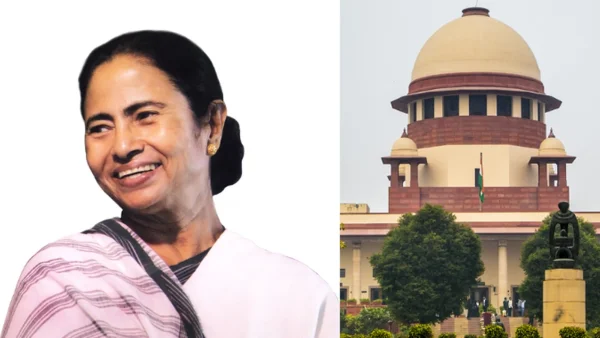
In January, the ED searched the home of Pratik Jain, who co-founded I-PAC, because they suspected money laundering. Banerjee suddenly went to Jain’s house during the search, and this caused a lot of political argument.
Banerjee’s claim and ED’s charge
The ED says Banerjee took important evidence from the house. Banerjee herself said she was there for around 20-25 minutes and left with a green folder in order to safeguard material belonging to her political party.
Banerjee claimed the ED was trying to take her party’s internal documents, computer hard drives and confidential details about their plans for the election, and she took them back.
The ED insists vital evidence disappeared during the search. These completely opposite stories have since created a larger legal battle.
The central points of disagreement are: the ED says important evidence was removed, Banerjee says she protected her party’s strategy data, and the disagreement is about documents and hard disks.
Justices Prashant Kumar Mishra and N V Anjaria heard the ED’s request for the CBI to begin a formal investigation (FIR) against Banerjee and West Bengal police for obstructing the search. The judges said that a Chief Minister of any state can’t unexpectedly enter a place while a search is happening.
Supreme Court’s sharp remarks
The court made clear this wasn’t a fight between the State and the central government. They said Banerjee’s actions, as a person who happens to be Chief Minister, were putting democracy in danger.
The judges specifically said: this isn’t a State versus Union problem, a Chief Minister can’t just walk into a search during an investigation, and the act itself threatens the whole of democracy.
Arguments before the bench
Menaka Guruswamy, a senior lawyer representing the State of West Bengal, argued this was a dispute between the State and the Union. However, the judges didn’t agree, and emphasized the problem was Banerjee’s own behaviour during the active investigation.
The court stressed that a chosen leader interfering with a central government investigation cannot be accepted as a normal part of the relationship between the central government and a state.
The judges said they couldn’t ignore what’s really going on in West Bengal. They described the situation as unusual and very different from normal court cases.
The court also said judgements need to consider how things are in the political and social world and that the way things are done is always changing. They told the lawyers not to push them into saying more about the political situation in the state.
What the court said clearly sets a boundary for political leaders to not get directly involved in searches as they happen. It shows that interfering with investigations risks weakening the protections that are in place.
This case highlights a problem that happens often in public life in India: the power of elected officials comes up against what central investigation agencies are allowed to do.
What comes next
The judges heard the ED’s request for a CBI FIR against the Chief Minister and the state police for getting in the way. The court indicated they would make a decision taking the political and social situation into account.
How the court decides things from here will affect how similar conflicts are dealt with in the future, especially when political power and ongoing investigations overlap. For now, the court is very clear about how much interference is too much.