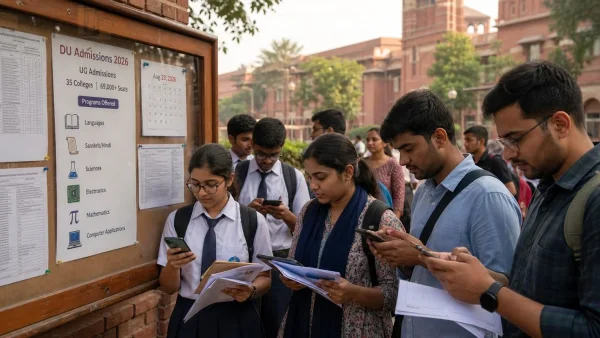
In a public notice of August 23, 2026, DU confirmed it has added nine colleges to this category, bringing the total to 35. This is the latest in a series of announcements from the university over the past few days, following updates on August 20 and 21, 2026.
What this means for students and colleges
By not having to rely on a single high-stakes test, the new policy provides some much needed flexibility for colleges to match intake with what they do best. Students are presented with options where selection is driven by Class 12 performance, as long as they meet the college’s own eligibility standards for the programme.
DU has been clear that each college is the authority on its admission and eligibility rules; candidates would be well advised to review the criteria for their chosen programme before putting in an application. The university has also put a stop to any thought of double-dipping: those already in through the marks-based route at one DU college cannot try for another via the same method.
Where Class 12 scores will be accepted now
There is a greater range of language programmes on offer at both women’s and co-ed institutions. Indraprastha College for Women is taking applications for BA (Hons) Sanskrit and Hindi, while Gargi and Ramanujan Colleges will have openings for BA (Hons) Sanskrit and Hindi respectively.
For those inclined towards science, Bhaskaracharya College of Applied Sciences will admit to BSc (Hons) in Electronics, Instrumentation and Polymer Science. Mata Sundri College for Women has BSc (Hons) Mathematics available.
Working or commuting students will find some accommodating choices at the evening colleges. Sri Aurobindo College (Evening) is admitting to BA (Hons) Hindi as well as BA Programmes in Economics + Sanskrit, English + Sanskrit and Hindi + Sanskrit.
At Motilal Nehru College (Evening), one can apply for BA (Hons) Hindi or a BA Programme in History + Sanskrit, Political Science + Sanskrit or English + Mathematics. Shyam Lal College (Evening) will be looking at applications for BA (Hons) Hindi and various combinations including Mathematics with Computer Application or Economics.
Sri Guru Nanak Dev Khalsa College is making inroads in several disciplines with offers of BA (Hons) Punjabi and Hindi Patrakarita, alongside BSc (Hons) Mathematics.
How the expansion rolled out
It was a gradual process. An August 20, 2026 notice first made the Class 12 marks-based option open to 11 colleges like Kalindi, Lakshmibai and Rajdhani. A day later, on the 21st, the list was extended by 15, with Deshbandhu and Dyal Singh (Evening) among them.
Then came the August 23 update to incorporate nine more colleges and their programmes for a final count of 35. DU has made no secret of the fact that these admissions are subject to whatever each college has notified.
How to use the marks-based route
A methodical approach is called for to ensure an application is not found wanting:
– Go to the college website and read the programme rules
– Make sure your subject mix and marks are up to scratch
– Have your documents in order per the college’s requirements
– Put in a call to the college for any clarification early on
– If you are already in via this route, do not reapply
Why it matters for planning
This is a useful parallel for Class 12 graduates who are juggling board results and entrance exams. It is a strategic move for an applicant with strong school-based credentials or one after a particular pairing like Economics + Sanskrit or Mathematics + Computer Application.
The institution gets to shape its cohort in line with departmental aims. The applicant, for his part, can pursue a programme that puts weight on Class 12 output rather than just the CUET score.
What to do next
Any eligible candidate should make time to check the college websites for cut-offs, documentation schedules and seat availability. As per DU’s guidance, the college is the final arbiter on programme-wise criteria.
Put simply, if your Class 12 numbers are in line with what these 35 colleges are asking for, there is a credible way to secure a DU place for 2026-27 without the CUET.