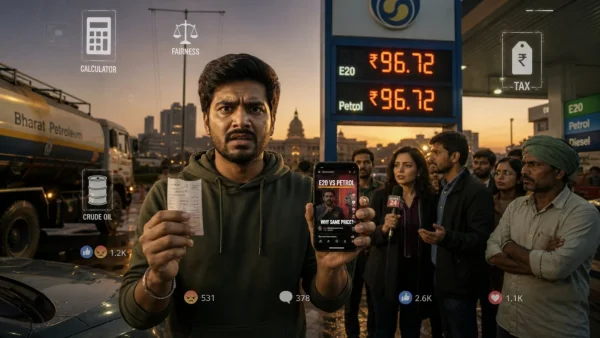
A viral video circulating on X has reignited the debate over India’s ethanol-blended petrol policy, with the creator alleging that consumers are being “scammed” by paying nearly the same price for fuel despite ethanol generally costing less than petrol.
The video, which has attracted thousands of views and interactions, compares the price displayed at a fuel station with calculations claiming motorists should pay less if petrol contains ethanol.
The post comes days after the Petroleum Ministry stated that ethanol blending has helped shield consumers from even higher petrol prices by reducing dependence on imported crude oil.
What Does the Viral Claim Say?
According to the video, motorists purchasing E20 petrol—which contains up to 20% ethanol—should not be paying the same price as conventional petrol.
The creator argues that because ethanol is generally cheaper than petrol, blending it should result in noticeable savings for consumers at fuel stations.
The video labels the pricing model as unfair and questions why the retail price remains largely unchanged despite the increased use of ethanol.
Government’s Stand
The central government has repeatedly defended ethanol blending as a major energy policy.
According to the Petroleum Ministry, ethanol blending has helped:
Reduce India’s dependence on imported crude oil.
Save foreign exchange.
Support domestic farmers.
Lower carbon emissions.
Cushion consumers against spikes in global crude prices.
The ministry has also claimed that without ethanol blending, petrol prices could have been significantly higher during periods of elevated international crude prices.
Is Ethanol Really Cheaper?
Industry experts note that ethanol is often cheaper than petrol on an energy-equivalent basis, but retail fuel prices are determined by multiple factors.
These include:
International crude oil prices.
Refining costs.
Transportation.
Dealer commissions.
Central excise duty.
State VAT.
Blending and distribution costs.
As a result, the price paid by consumers is influenced by much more than the cost of ethanol alone.
Experts caution that simple price comparisons may not capture the full economics of fuel pricing.
Opposition and Critics Raise Questions
Critics of the government’s fuel policy argue that consumers deserve greater transparency regarding how ethanol blending affects pump prices.
Some opposition leaders have questioned why motorists have not seen larger reductions if blending lowers procurement costs.
They have called for clearer disclosure of the pricing formula used by oil marketing companies.
Supporters of the policy, however, argue that the objective of ethanol blending is not merely to reduce today’s petrol price but also to improve energy security and reduce import dependence over the long term.
Social Media Reacts
The video has generated a wave of online reactions.
One user commented:
“If blending reduces costs, people naturally want to know where those savings are reflected.”
Another wrote:
“Fuel pricing shouldn’t feel like solving a maths puzzle every time you visit a petrol pump.”
A third remarked:
“Transparency is the best answer to any public debate.”
These comments reflect opinions shared online and should not be interpreted as evidence regarding fuel pricing.
Sarcasm Floods the Internet
As expected, social media users also responded with humour.
One viral comment read:
“The only thing blending faster than ethanol is public confusion.”
Another joked:
“Petrol has become like airline tickets—everyone pays differently, and nobody understands the formula.”
A third user quipped:
“Consumers wanted mileage. Instead, they got a lesson in economics.”
The Bigger Picture
The controversy highlights a broader issue that extends beyond ethanol itself: public trust in fuel pricing.
Whether ethanol blending ultimately saves consumers money, strengthens India’s energy security, or primarily serves environmental and agricultural goals, experts agree that greater transparency can help the public better understand how petrol prices are determined.
As debate continues, one question remains at the center of the discussion:
If ethanol blending changes the cost of producing fuel, how much of that benefit should consumers expect to see at the pump?