After successfully landing near the Moon’s south pole and preparing for its first human spaceflight mission, India is now aiming even higher.
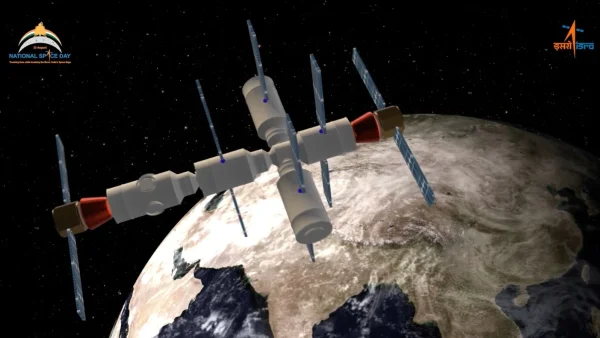
The Indian Space Research Organisation (ISRO) is building Bharatiya Antariksh Station (BAS)—India’s first indigenous space station—which is expected to establish a permanent Indian presence in Low Earth Orbit (LEO).
The first module, BAS-01, is scheduled to launch in 2028, while the complete station is expected to be operational by 2035.
Once completed, India will join an exclusive group of nations capable of independently operating a long-term human space station in orbit.
What Is the Bharatiya Antariksh Station?
Think of it as India’s laboratory in space.
Unlike satellites that operate without people, the Bharatiya Antariksh Station will serve as a home and research center where astronauts can live and work for months while orbiting Earth.
Key Features
First module (BAS-01): Launch planned for 2028.
Full completion target: 2035.
Orbit: Approximately 400–450 km above Earth.
Crew capacity: 3 to 4 astronauts.
Mission duration: 3 to 6 months per crew.
The station will continuously orbit Earth at nearly 28,000 km/h, completing multiple orbits every day.
Why Does India Need Its Own Space Station?
Until now, countries wanting long-duration human missions have relied on facilities such as the International Space Station (ISS).
With the ISS expected to be retired in the coming years, nations are planning the next generation of orbital laboratories.
India’s own station would provide:
Scientific Research
Astronauts will conduct experiments that cannot be performed under Earth’s gravity.
These include research on:
Human health in space.
Advanced materials.
Biotechnology.
Space medicine.
Agriculture in microgravity.
Preparing for Moon Missions
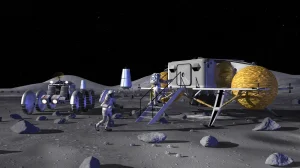
The Bharatiya Antariksh Station is also expected to serve as a stepping stone toward India’s future lunar ambitions.
Scientists can test technologies needed for:
Long-duration human missions.
Deep-space travel.
Docking systems.
Space habitats.
Life-support technologies.
These capabilities will become increasingly important as India pursues its long-term goal of sending astronauts to the Moon.
More Than Science—A Strategic Asset
Experts say the station is not just about scientific prestige.
Having an independent human space station would give India:
Greater technological self-reliance.
Expanded research opportunities.
Improved international collaboration.
A platform for commercial space activities.
Enhanced strategic capability in space exploration.
As the global space economy continues to grow, such infrastructure could also support private companies developing space technologies.
A Milestone for India’s Space Journey
India’s space programme has undergone a remarkable transformation over the past decade.
Recent milestones include:
Mars Orbiter Mission (Mangalyaan).
Chandrayaan-3’s successful Moon landing.
Aditya-L1 solar mission.
Upcoming Gaganyaan human spaceflight mission.
Now, the Bharatiya Antariksh Station.
Each mission has expanded India’s capabilities, moving from satellite launches to planetary exploration—and now toward sustained human presence in orbit.
Public Excitement Takes Off
News of the proposed space station has generated excitement online.
One user wrote:
“From launching satellites for the world to building our own home in space—what a journey.”
Another commented:
“Today it’s a space station. Tomorrow, perhaps a Moon base.”
A science enthusiast remarked:
“This isn’t just an investment in space. It’s an investment in future generations of scientists and engineers.”
Social Media Adds Some Humour
As always, the internet found a way to add a smile to the story.
One user joked:
“Property prices on Earth are so high that India is building real estate in orbit.”
Another wrote:
“Imagine telling your relatives: ‘I’m working from home’—and your home is 450 kilometres above Earth.”
A third quipped:
“Next stop after Chandni Chowk? Chandrayaan Chowk.”
The Bigger Picture
The Bharatiya Antariksh Station represents more than another space mission—it signals India’s ambition to become a leading spacefaring nation.
Building and operating a space station requires expertise in life-support systems, orbital construction, astronaut safety, spacecraft docking, and long-duration human habitation—technologies mastered by only a handful of countries.
If the project stays on schedule, the launch of BAS-01 in 2028 will mark the beginning of a new chapter in India’s space programme, with the fully operational station expected by 2035.
For India, the race is no longer just about reaching space.
It’s about staying there.