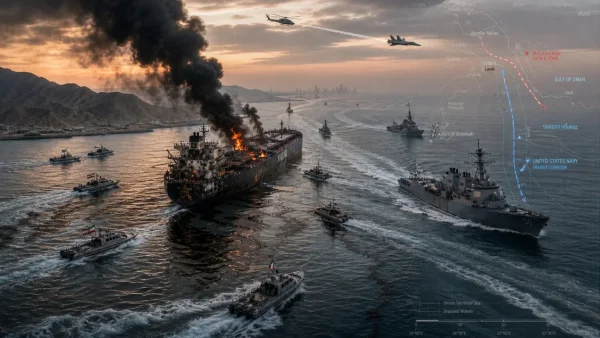
Fresh hostilities in the Strait have led Iran to halt the June 17 MoU with the United States and to scuttle plans for a second round of talks in Islamabad. After tankers were hit and strikes were made, holding the line in the waterway is what this widening confrontation is all about.
A fragile truce undone by the shipping lanes
Under the terms of the MoU, there was to be a longer ceasefire and some discussion of the nuclear file and Western sanctions. But with President Donald Trump saying the truce is done and both sides pointing fingers, that option is off the table.
Article 5 is the sticking point: it requires Iran to see to the safe passage of commercial ships in the Strait. Tehran put in place a new course close to its own shore; the U.S. Navy opened up another one along Oman. From Iran’s view, that is a flouting of the article.
Things came to a head on July 6 when three tankers in the U.S.-favored lane were targeted by Iran. Washington decried it as a violation and struck back at hundreds of Iranian sites. In response, the IRGC put a temporary ban on the strait, and the situation has only worsened.
Tehran’s charge: security claims masking escalation
Baghaei of the Foreign Ministry has put the onus on Washington for not living up to its word and for stoking trouble by providing escorts for commercial traffic. He is of the opinion that the U.S. has run roughshod over the ceasefire and meddled in how Iran runs the strait.
As for the hits on American bases, Baghaei calls them no more than self-defence. He makes it clear that Iran will not stand for any use of the waterway that is a threat to its security, even as it has done its part to keep shipping safe.
For the time being, he has also put the kibosh on any further dialogue in Islamabad. So diplomacy is in a holding pattern while the military risks in the Gulf and out are on the up.
Why Hormuz control is worth a fight
You can’t get from the Persian Gulf to the rest of the world without the Strait of Hormuz. It is a key conduit. This year alone some 20 million barrels of oil and 112 billion cubic metres of LNG have made their way through, not to mention a third of the seaborne urea trade.
The same goes for ammonia and sulphur, which make up a good chunk of the global fertiliser market. There are other corridors and pipelines in the works in the region, but they won’t be enough to take the wind out of Hormuz’s sails for a while yet.
Both sides know that if you can dictate the rules and the flow in this kind of chokepoint, you have a measure of power, both in the economic and strategic sense. There is a concern in Tehran that an established alternative to the strait, hugging the Omani coast, would take some of the bite out of its negotiating position. In Washington, the aim is to see to it that Iran is left without such leverage.
From leverage to strategy
The way Iranian leaders see it, their capacity to make good on the threat of shutting down the strait was what put pressure on the other side into a ceasefire and an MoU they consider to be in Tehran’s interest. That has set the tone for a more intransigent approach: hold firm on Hormuz, even if it comes with a price in the near term, and let the regional order adjust from there.
The U.S. had been amenable under the MoU, lifting a maritime cordon, making an exception for Iranian oil and other products, and putting some frozen assets within reach. But with the most recent flare-up, the waiver is gone and some of those sanctions are back in place.
How the war’s agenda has changed
Back in late February, when the U.S. and Israel made their move, the target was clear: the nuclear file, the missiles, and the backing of proxy forces. It is hard to believe now, four and a half months on, that American rhetoric has moved on from those to the matter of who gets to use the sea lanes.
Iran has put off any discussion of the nukes until the next session, while the part of the MoU meant to open up the waters around the Gulf of Oman is coming apart. The one thing Washington came for has been put on the back burner by an issue the war has created.
President Trump has made it known he wants the Hormuz question put to rest, be it by force or at the table, before any talk of a nuclear deal. It is a way of doing things that leaves a handle in Tehran’s grip.
Shipping, security and the numbers
A channel that sees about 25 per cent of the world’s seaborne oil has been jolted by the intensity of the stand-off. From Iran’s perspective, the presence of U.S. warships is what is making things unsafe. The U.S. will have it that the shelling of tankers is a violation of the MoU and a risk to trade.
Baghaei has put a warning out that this kind of posturing does little to put shippers at ease. Each side has staked its ground on matters of navigation, insurance and deterrence, and with the fighting as it is, there is little room for compromise.
Where the stakes lie
For those in the business of moving energy, or insuring it, uncertainty is mounting as military operations edge in on the key waterways. One wrong move could mean higher bills, or the rerouting of goods from a region that is the lynchpin of the global supply for oil, LNG and fertiliser.
The current face of the conflict is defined by a few things:
– The escalation after three tankers were hit
– A pronouncement from the IRGC on closing the strait
– U.S. air strikes on Iranian soil
– The end of the crude waiver
– No more talks in Islamabad
Tehran will say relations are in limbo until the U.S. does as it says. Washington’s line is that Iran’s conduct in the strait has voided the arrangement and the opening the MoU provided.
In a sense, the two are vying for the rules of the road as much as the waterway itself. Should Iran put in place the system it wants, the power equation in the Gulf could be rewritten. An American-backed bypass, on the other hand, would see Tehran’s influence wane.
Any path to a resolution will have to go through the same tight spot. The issue is whether a return to safe passage can be made before the back-and-forth makes holding the strait too expensive for anyone.