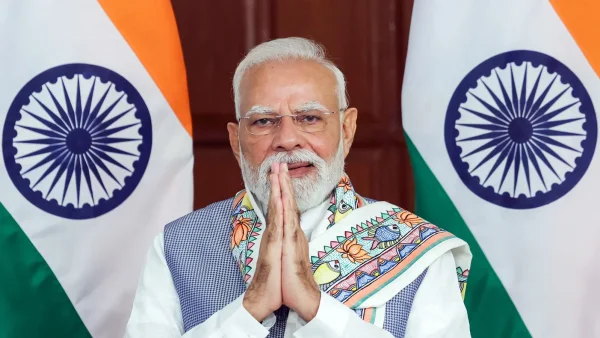
You could say India’s progress is running up against some new headwinds. So on Saturday, Prime Minister Narendra Modi put in some time with the Economic Advisory Council to the Prime Minister to figure out the way forward. Even as the world is in a bit of a tangle, the new GDP numbers have us in good shape, and the council was there to build on that.
If you ask the people in the know, the talk was all about propping up growth and making life a little easier for those who live and work here. They also put a fine point on what the West Asia situation means for us and the rest of the market, which will likely lead to some policy tweaks down the line.
Why the council met now
It comes down to the fact that things are a bit rougher on the outside. You have trade hiccups and geopolitical jitters in most economies. We’ve done well enough to have some room to manoeuvre, but when it’s this volatile, you need to be on top of your reforms to back up investment and look after the common man.
The council had a simple job: don’t let the momentum die, get in the way of business and consumers as little as possible, and size up the ripples from the conflict in West Asia. It’s a matter of being ready to act if the going gets tough or an opening presents itself.
Policymakers were mulling over a few things:
– See to it that growth holds up
– Put a damper on any spillover from West Asia
– Make a point of reforming for ease of living and business
From counsel to citizen action
This isn’t just a matter for the ministries. A month back, the prime minister made a case to the public for a change in how we go about our day-to-day to help the country’s resilience. He put it to us to move away from imported fuel and be a bit more frugal with what we don’t need while the West Asia issue is on our minds.
He was specific: work from home where you can, put off a trip abroad for a year, go for Swadeshi, and be mindful of your gold and cooking oil. It’s about easing the strain on demand and putting our own value chains to work.
Then there’s the question of fuel. To smooth out the volatility, he has asked for a change in how we get around and move goods. The idea is to cut down on petrol and diesel by being smarter about it:
– Take the metro or bus if you can
– Share a ride if you have to drive
– Let the railways do the heavy lifting for freight
– Make use of electric vehicles
The numbers behind resilience
The hard data came out on June 5 and it tells a good story. In the last quarter of FY 2025-26, the economy did better than some thought. Real GDP was up 7.8 per cent on the year, and for the full year we’re looking at 7.7 per cent. You can see the strength in both the factory floor and the service side of things.
Put another way, real GDP at constant prices hit Rs 87.77 lakh crore in Q4, a step up from Rs 81.40 lakh crore last year. On a nominal basis, the quarter is estimated at Rs 94.65 lakh crore, a 9.1 per cent jump. Over the course of the year, we’re at Rs 323.12 lakh crore in real terms (up from Rs 299.89 lakh crore in FY25) and Rs 346.36 lakh crore in nominal, an 8.9 per cent rise.
What the sectoral mix signals
Gross Value Added is telling a like tale. In the fourth quarter, real GVA was 7.9 per cent and the nominal side 9.9 per cent. For the year, we expect 7.9 per cent in real and 9.1 in nominal.
It’s the secondary and tertiary sectors that have been doing the heavy lifting. In FY26, at constant prices, we estimate 8.8 per cent for the former and 9.3 per cent for the latter. The primary side is up 3.2 per cent, with agriculture and fisheries to thank for that.
What to watch next
You have the council’s read on the situation and the prime minister’s words to the public, and it adds up to a two-pronged approach: clear the path for companies and have households be a bit more conservative where it counts. There was some discussion on making life and business a little less of a chore, and you can tell they mean to put it into practice.
As long as the world is in flux, we’ll be on our toes. Some well-aimed reforms, a little discipline in spending and a nudge towards greener ways of moving might be just what it takes to hold the line. The data has given us the runway; the meeting was to show we intend to make the most of it.