Plastic money could be on the way for India. The RBI has put the matter of polymer notes back on the table, something that would make a difference in how long our cash holds up, how hard it is to fake, and what it costs over time. We are at the beginning of this, but the implications for the way we handle cash are obvious.
Where the RBI stands now
“We are looking at the feasibility of it,” says Governor Sanjay Malhotra, “but no decision has been made.” He describes it as a work in progress and one where the central bank is having to weigh its options before it goes any further.
Malhotra concedes there is some substance to what you may have read in the papers, but he was quick to point out that it is still being reviewed. A final call will be made public once it is done.
Why the push for polymer again
It has been almost ten years since anyone first brought this up. Some have it down to the price of printing paper; if the notes last longer, you don’t have to keep replacing them and moving them around as much.
Then there is the green factor. You can see the RBI is open to rethinking a currency system that is not only more secure but also one you can recycle.
The time we had a go at it
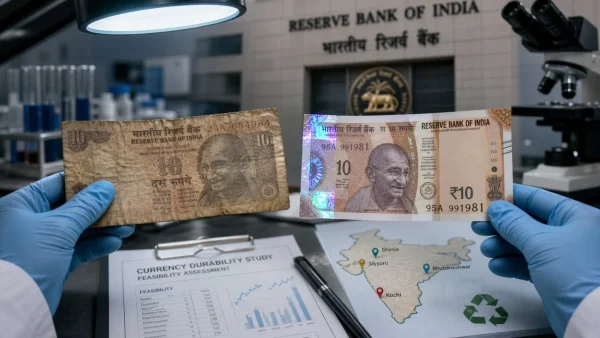
Back in 2014, the Government let Parliament know it was going to try out a billion of these plastic Rs 10 notes in five cities: Kochi, Mysuru, Jaipur, Shimla and Bhubaneswar.
They were to start in the latter part of the year to see how they fared in different climes and places. All the talk and prep work aside, those notes never made it to circulation in India.
What you see in the rest of the world
More than 60 nations are already using them in some form. The consensus is that they hold up, they’re harder to pass off as real, and they’re better for the environment.
Those are the kind of things the RBI is checking up on. If they pan out here at home, it makes for a good argument to bring them in, even if in stages.
Reading between the lines at the RBI
The central bank has been on the record about it. To be clear, here is what the Governor has put forward:
– We are considering it
– It is in the very early innings
– Nothing is decided
– We are looking at the upside and the downside
– You will be told when we are
It all adds up to a steady hand at the wheel. There is no rush; the timing will come down to a hard look at the numbers, the security and the logistics.
How it might play out
If 2014 is any guide, the RBI is not going to commit without putting it through its paces in a variety of settings. That earlier foray with the Rs 10 note in a few cities was a case in point of how much the terrain and how people use the money matters.
We are left to wait for the final say. But by being so open to the idea, the central bank has us thinking about the balance between keeping our cash safe, being responsible with the environment, and the bottom line of running a paper-based system.