The market seems to like what it’s hearing. When the open came around, the bank’s Hong Kong shares were up 2.3% even as the Hang Seng held steady.
Targets and timelines
In a recent update to investors, the lender laid out a path to more than 15% return on tangible equity for 2028, up from 2025, before hitting that 18% mark in 2030. It’s a way of sharpening the edge in a race with other Asia-focused lenders.
Here are the bank’s measurable checkpoints for the next phase:
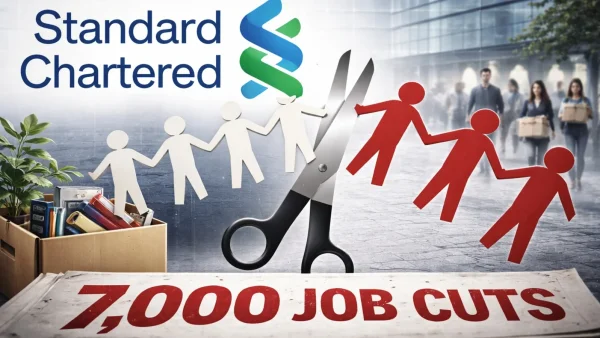
– More than 15% reduction in corporate functions roles by 2030
– Income per employee up about 20% by 2028
– Return on tangible equity above 15% in 2028
– About 18% return on tangible equity by 2030
– Costs to income ratio at 57% in 2028
What is changing and why
“We’re not just cutting costs,” Chief Executive Bill Winters told us. “We are in some cases swapping out lower-value human capital for the kind of financial and investment capital we are putting in.”
By 2030, you can expect to see a 15% drop in corporate function headcount. Right now, in a workforce of 80,000, the support side of the house is about 51,000 strong as of June 2025.
The goal is to have income per head up 20% by 2028 and to bring the cost to income ratio down to 57%. Management is of the view that if you put some muscle behind AI and advanced analytics, you make for a smoother operation and better service for the client.
Winters says they already hit their 2026 medium-term numbers a year ahead of schedule. “We have a more focused, streamlined and efficient organisation,” he put it.
Wealth and clients at the core
You’ll see them put their resources where the margin is: in the corporate and investment bank with financial institutions, and with well-heeled retail clients. In the first quarter alone, they made their best showing in new client money and wealth revenue.
That $18 billion in inflows to the wealth side was enough to muffle some of the noise from geopolitical risks. They did put aside $190 million in the first quarter for good measure, in case of any trouble in the Middle East.
What to watch next
Winters and his team will be at an event in Hong Kong on Tuesday to run through the details with analysts. “We are investing in the capabilities that will compound our competitive advantages… with clear targets in place,” he said.
Leadership and execution
There’s also been some movement in the C-suite. Manus Costello is in as permanent CFO, taking over for Diego De Giorgi who left in February. Costello, who has been with us since 2024, is stepping up as this plan gets under way.
Competitive implications
All part of the 'Fit for Growth‘ restructure that is supposed to save $1.5 billion and be done with by 2026. The stock had a wobble after De Giorgi’s departure and with the situation in the Middle East, but it has mostly righted itself after the 120% run-up we saw in the last year or so.
Like some of the others, we are using AI to change the cost base and lean into fee-rich business. It’s a way to double down on Asia-Pacific and Africa, where you have to be comfortable with risk to get the growth.
Then again, if the Iran thing lingers, we may have to be more conservative with loan-loss provisions. For us, the region is where the action is, and where the uncertainty is.
It all comes down to how we scale this without ruffling any feathers and keeping the wealth coming in. With the leadership in place and the numbers set, we let the quarters speak for themselves.