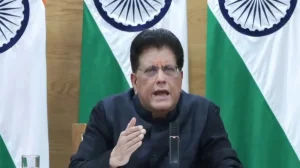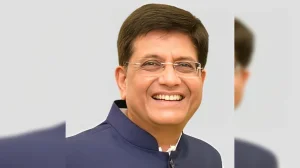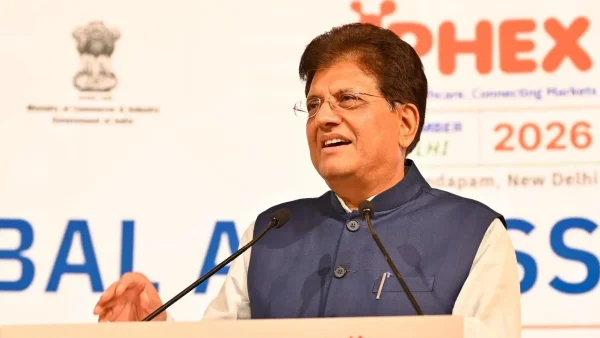
Piyush Goyal has put it plainly: the sector is set to go from $60 to $120 billion in five years. The old playbook of cost leadership is giving way to something new. The minister has called on global counterparts to work with India as it puts its days as just a generics supplier behind it, though it will still be the one providing the world with low-cost drugs.
India pivots from volume to value
Goyal says we are seeing good manufacturing practices come up to global standards and more of an inventive spirit. He has some numbers to back it up: patent filings have nearly 100% in the last few years alone.
Then there is the Biopharma Shakti mission, which is the government’s way of underwriting high-value research. And let’s not forget that outside of the US, you won’t find more FDA-approved pharma plants than in India, which speaks to how well we play by the rules.
Access, alliances, and FTAs
Partnership is what the minister sees as the key to the next leg of growth. He has put out an open invitation to multinationals to come in and co-develop or make for the world in India. We’re here to be a reliable tech partner, a place for clinical trials and a hub for manufacturing.
We have free trade pacts with over 50 nations, Goyal pointed out. Under most of them, our pharma exports will be able to enter markets without any tariffs, which only cements our place in the global supply chain.
He laid out a few things he thinks will be the driving force for the sector:
– You have to earn trust with quality and be there when they need you
– Put your head down and innovate on the products that matter
– Make the kind of partnerships that open up new markets
Scale advantage still matters
But don’t get the idea that size doesn’t count. As we work our way up the value chain, scale is still king. In the US, for instance, generic drugs might only be 10-15% of the value of what’s sold, but they make up 80-90% of the volume. That is why our ability to make at a lower cost is so important.
And it’s not just in the US. Some 65-70% of the WHO’s vaccine needs come from us. You have ten of the 25 biggest generic pharma firms in the world running out of India. It’s a solid base that is ready for whatever comes next.
Pandemic record underpins trust
Looking back at the pandemic, Goyal was clear on the intent behind the temporary hold on exports. It wasn’t to keep anyone out; it was to make sure the supply was fair and to put a stop to profiteering. We made sure no trader could hoard stock when the crisis was at its height.
More than 100 countries were given our medicines at no charge. And for every nation that came to us for help, we supplied them at the same prices we had before COVID hit.
What to watch next
Things are going to get more competitive as we let in top-shelf products from overseas and nudge our own companies to do better. Even with the noise from Ukraine and West Asia, and the 50% tariffs from the US, Goyal says we are still the fastest-growing big economy out there.
The developed world for the most part gives our goods and services a leg up in their markets. With the right incentives for innovation, the ministry is confident we can hit that $120 billion mark in half a decade.
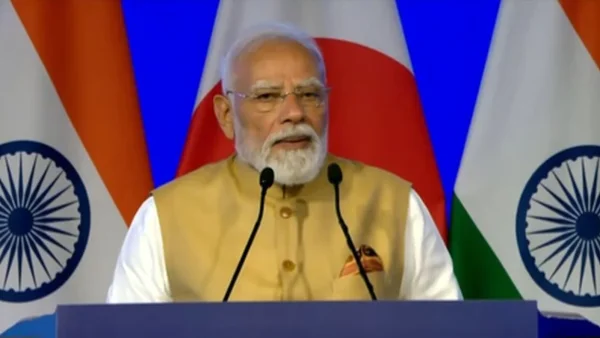
All this was on display at the Global Ambassador Meet and the opening for GDRC 2026 and IPHEX 2026 in New Delhi. Goyal was there to put iPHEX 2026 in front of everyone as a showcase for healthcare that is as compliant as it is affordable.
The word to the multinationals is we are looking for co-investment and co-creation, not to be a contract factory. For the Indian side of the house, the pressure is on: if you don’t get past the generics, you’ll be left behind by the rest of the world.
Carry this through and you could have a country that is no longer just the world’s pharmacy for generics, but a full-fledged hub for value and volume. The hard part will be pulling it off on a large scale and not losing the quality and price point that people know us for.