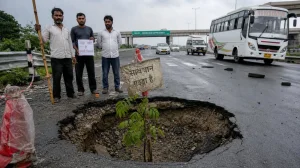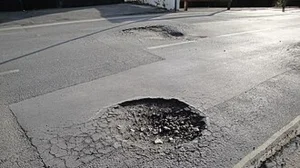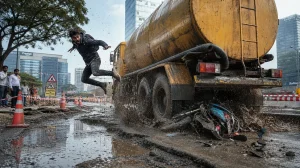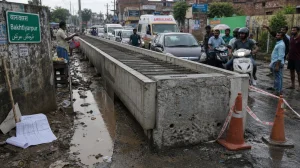
The latest spell of monsoon rain in Gujarat has once again put the state’s road infrastructure under the spotlight, with images and videos showing severely damaged roads, cave-ins and washed-out stretches prompting sharp criticism on social media.
The question being asked by critics is blunt:
“Is this the famous Gujarat Model? One heavy rainfall and the road itself starts disappearing?”
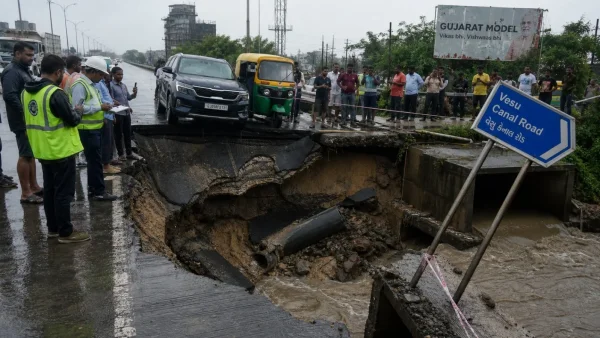
Recent reports from Gujarat have documented significant road damage following heavy rainfall. In Surat, a sinkhole appeared on the newly built Vesu Canal Road, prompting the civic authorities to begin repairs and raising questions about construction quality.
Not just potholes—sections of roads collapsing
The criticism goes beyond the familiar problem of potholes.
Videos circulating online show sections of road surfaces breaking apart, with layers of the roadway reportedly being washed away or collapsing following intense rainfall.
For motorists, such failures are more than an inconvenience. A damaged road can become a serious safety hazard, particularly at night or when standing water hides cracks, depressions and collapsed sections.
Gujarat has experienced several episodes of severe monsoon rainfall this year, with heavy rain causing flooding and waterlogging across parts of the state. In July, Surat and neighbouring districts were among the areas affected by repeated heavy rainfall.
The bigger question: Why are roads failing?
Heavy rain can damage roads for several reasons, including inadequate drainage, water infiltration into road layers, weak subgrade preparation, poor-quality materials and inadequate maintenance.
That does not mean every road failure automatically proves corruption or poor construction.
But when a newly constructed or recently repaired road fails soon after heavy rainfall, residents have a legitimate reason to demand answers.
Was the road designed for the area’s rainfall?
Was the drainage system adequate?
Were construction materials and thicknesses tested?
Was the work inspected before being opened to traffic?
And, most importantly, who is responsible when the road fails?
“World-class infrastructure” versus ground reality
India has invested heavily in roads, highways, bridges and expressways in recent years. Governments frequently present major infrastructure projects as evidence of rapid economic and urban development.
But infrastructure cannot be judged only by the size of a project or the cost of construction.
For ordinary citizens, the test is much simpler:
Does the road remain usable when the monsoon arrives?
A road that looks impressive when newly laid but deteriorates rapidly after heavy rain raises questions about lifecycle quality, maintenance and value for public money.
Rain is not an excuse for poor engineering
Defenders of infrastructure agencies may argue that exceptionally heavy rainfall can overwhelm even well-designed infrastructure.
That is a legitimate consideration.
But monsoon rainfall is not an unexpected event in Gujarat. Road engineers and authorities know that roads must be designed, constructed and maintained with seasonal rainfall and drainage conditions in mind.
The challenge, therefore, is not simply to build roads quickly.
It is to build roads that can survive the conditions for which they were designed.
Accountability matters
When a road collapses or its surface is washed away, repairing it is only the immediate solution.
Authorities should also determine the underlying cause.
If the problem is drainage, drainage must be corrected.
If the problem is construction quality, responsibility must be fixed.
If the problem is design, the design must be reviewed.
And if contractors have failed to meet specifications, there should be meaningful consequences rather than repeated cycles of construction and repair.
The road should be the report card
The political slogan may be “Gujarat Model,” but the real report card is visible on the streets.
Residents do not experience infrastructure through government presentations. They experience it while driving to work, taking children to school, travelling to hospitals and commuting during the monsoon.
That is why every road failure deserves an answer—not merely another layer of asphalt.
World-class infrastructure does not mean a road that looks new on inauguration day.
It means a road that is still a road after the rain.