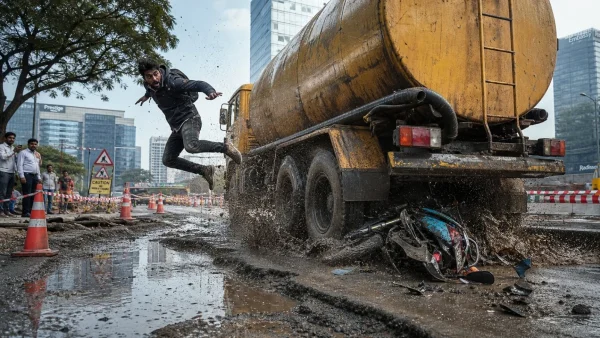
A shocking road accident near Gunjur in Bengaluru has once again raised serious questions about the condition and safety of the city’s roads.
A video circulating online shows a biker losing control after his motorcycle appears to hit a rainwater-filled pothole. Moments later, a tanker approaching from behind runs over the motorcycle. The rider, identified in reports as Saurabh, reportedly managed to jump away just in time and escaped what could have been a fatal accident.
The incident reportedly occurred on the under-construction Gunjur-Palya CDP Road near Panathur Tree Park on the morning of August 20. Reports said the tanker appeared to have no number plate, although that detail would need confirmation from authorities.
The Road Becomes the Real Danger
The video has attracted attention not simply because of the tanker crash, but because of the condition of the road.
The stretch appears to be severely damaged, with deep potholes, waterlogging and uneven surfaces making it difficult for motorists to judge where it is safe to ride.
For two-wheeler riders, such conditions are particularly dangerous.
A pothole hidden beneath rainwater can become almost impossible to see until a vehicle is already inside it.
That leaves riders with seconds—or sometimes fractions of a second—to react.
A Narrow Escape
According to reports, the biker’s motorcycle fell after hitting a water-filled pothole.
As he lost control, the tanker approaching behind him moved into the same stretch and subsequently ran over the bike.
The rider reportedly managed to get away from the motorcycle moments before the tanker reached it.
The motorcycle was badly damaged, but the rider escaped serious injury.
It was a matter of seconds between a damaged bike and a potential fatality.
Why Bengaluru’s Pothole Problem Keeps Returning
The latest incident comes amid renewed scrutiny of Bengaluru’s road infrastructure.
Just days earlier, the death of 32-year-old EPFO employee Medha Akarsh in Hebbagodi had triggered protests over damaged roads.
According to reports, the motorcycle carrying Medha lost control after a car ahead braked suddenly, and she subsequently fell onto the road and was run over by a goods vehicle. She died from her injuries. Local residents blamed the area’s poor road conditions and potholes for contributing to the danger.
Residents have also complained about roads being repeatedly dug up for underground drainage and water-pipeline work and then left in poor condition.
One City, Two Kinds of Infrastructure
Bengaluru is globally recognised as India’s technology capital.
It has multinational companies, startups, technology parks and some of the country’s highest concentrations of skilled workers.
Yet many commuters continue to encounter roads where:
potholes remain open after rain,
excavated stretches are poorly restored,
water accumulates over damaged surfaces,
road markings disappear,
two-wheelers struggle to maintain balance.
That contrast has become one of Bengaluru’s most persistent civic frustrations.
A city capable of building world-class technology should also be capable of building safe roads.
The Government’s Response Is Under Scrutiny
The latest accident comes shortly after the Karnataka government faced criticism over another pothole-related death.
Following Medha Akarsh’s death, Karnataka Minister Santosh Lad expressed condolences but argued that the existence of a pothole did not by itself mean that the entire infrastructure was poor, pointing to government spending on roads.
The comment generated criticism from residents and opposition leaders who argued that the immediate issue was road safety and accountability.
The latest Gunjur incident adds another visual reminder of the problem.
The Question Is Not Just Who Caused the Accident
There will inevitably be questions about the tanker driver’s actions, speed, visibility and ability to stop.
Those factors must be investigated.
But the road itself cannot be ignored.
If a pothole is filled with rainwater and large enough to make a motorcycle lose control, then it becomes a predictable road hazard.
The bigger question is:
Who is responsible for identifying and fixing such hazards before somebody crashes?
How Many More Near-Misses?
The terrifying part of the Gunjur video is that the rider survived.
But road safety cannot depend on luck.
A person travelling to work should not have to calculate:
“Can I see the pothole?”
“Will the vehicle behind me stop?”
“Can I safely move around this crater?”
These are failures of road design and maintenance when they become routine.
The Bigger Bengaluru Road-Safety Crisis
The Gunjur incident is not an isolated example of the dangers posed by potholes.
In October 2025, video footage showed a Bengaluru biker being thrown off his motorcycle after encountering seven potholes within a 50-metre stretch on Bannerghatta Road. The incident prompted attention from the civic authorities.
More recently, residents have continued demanding safer roads following fatal and non-fatal accidents.
The recurring pattern is becoming difficult to ignore:
Road damaged → rain fills potholes → visibility decreases → vehicle loses control → accident → public outrage → repairs promised → problem returns.
What Needs to Change?
Simply filling potholes after accidents is not enough.
Authorities need a system that includes:
Regular road audits
Damaged stretches should be identified before monsoon conditions make them more dangerous.
Rapid repairs
Dangerous potholes should be repaired within a defined response period.
Better drainage
Waterlogging hides potholes and accelerates road deterioration.
Accountability for repeated failures
If the same road repeatedly develops dangerous defects, responsibility should be traceable.
Proper restoration after utility work
Roads dug up for pipelines, cables or drainage should be restored to proper standards.
Public reporting and tracking
Citizens should be able to report potholes and see whether and when they were repaired.
A Tanker Crushed a Bike—But the Road Had Already Created the Danger
The most striking image from the Gunjur incident is the tanker running over the motorcycle.
But the accident began earlier—with a road surface so damaged and waterlogged that a rider could lose control.
The rider survived.
The bike did not.
Tomorrow, someone else may not be so lucky. Bengaluru's pothole problem is therefore no longer merely an issue of inconvenience or traffic congestion.
It is a road-safety issue.
And every time a commuter has to choose between a pothole and a moving vehicle, the city is effectively asking citizens to gamble with their lives.
The real measure of Bengaluru’s infrastructure should not be how many kilometres of road have been built—but how safely people can travel on them.