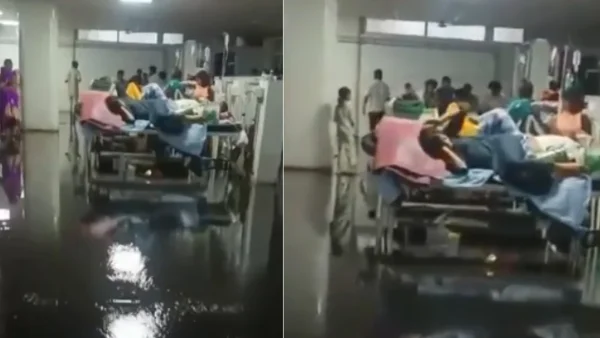
A video purportedly showing severe waterlogging inside the Rajendra Institute of Medical Sciences (RIMS), Ranchi, has gone viral on social media, triggering criticism over the condition of one of Jharkhand’s premier government hospitals.
The footage, widely shared online, appears to show hospital premises inundated with rainwater, prompting fresh questions about infrastructure maintenance, patient safety, and disaster preparedness during the monsoon season.
The authenticity of the video and the exact extent of the flooding should be verified by the concerned authorities.
Political Jibe Over ‘Surprise Inspections’
The viral video has also sparked political commentary.
A post shared on social media alleged that while the state’s Health Minister has been conducting and publicising surprise inspections of hospitals, the condition of RIMS reflects deeper structural issues that cannot be addressed through symbolic visits alone.
The post sarcastically remarked:
“Maybe the hospital knew the Health Minister wasn’t coming today. Otherwise, the hospital would never have been flooded.”
The comment reflects political criticism and should not be interpreted as a factual claim.
Patients Deserve Safe Hospitals
Hospitals are expected to remain functional even during heavy rainfall.
Waterlogging inside or around a medical facility can create multiple challenges:
Difficulty for patients and attendants to move around.
Risk of infections due to stagnant water.
Disruption of emergency medical services.
Damage to medical equipment and hospital infrastructure.
Increased inconvenience for doctors and healthcare workers.
Healthcare experts say that emergency preparedness should include effective drainage systems and regular maintenance, particularly during the monsoon.
What Is the Government Doing?
The Jharkhand government has repeatedly stated that improving public healthcare infrastructure remains one of its priorities.
In recent years, authorities have announced initiatives aimed at:
Modernising government hospitals.
Expanding healthcare facilities.
Improving medical equipment.
Strengthening emergency services.
Enhancing patient care.
However, incidents such as alleged waterlogging at a major referral hospital often lead to questions about maintenance, execution, and on-ground implementation.
Infrastructure vs. Publicity
The controversy has reignited a broader debate over governance.
Critics argue that inspections and public appearances should be accompanied by long-term improvements in hospital infrastructure.
Supporters of the government maintain that inspections are necessary to identify shortcomings and improve accountability.
Ultimately, citizens judge healthcare systems less by official announcements and more by the conditions they encounter when seeking treatment.
Monsoon Exposes Civic Challenges
Every monsoon, reports of flooding in public institutions—including hospitals, schools, roads, and government buildings—highlight longstanding infrastructure challenges.
Urban planners note that poor drainage, inadequate maintenance, and ageing civic infrastructure often contribute to waterlogging during heavy rainfall.
For hospitals, these problems carry added significance because uninterrupted medical services are critical during emergencies.
The Bigger Question
The viral visuals from RIMS have shifted attention from political rhetoric to a more fundamental issue:
Should patients visiting a government hospital have to worry about waterlogged corridors while seeking medical care?
Whether the flooding resulted from exceptionally heavy rainfall, drainage failure, or maintenance lapses will be determined by the authorities.
But the incident serves as a reminder that public healthcare is judged not only by policies and inspections but by the condition of hospitals when patients need them most.
For citizens, the expectation is simple: a hospital should be a place of healing—not another place where infrastructure failures become part of the emergency.