The death of a 15-year-old boy after he fell into an open drain in southeast Delhi’s Jasola has triggered anger over civic negligence, delayed rescue efforts and the lack of clarity over responsibility for maintaining the drain.
The teenager, identified as Mithun Kumar, a Class 8 student, fell into the open drain on August 22 while trying to retrieve a kite. A multi-agency rescue operation was launched, but the boy could not be located for more than three days. His body was eventually recovered on August 25 from a stretch of the Agra Canal, around 500 metres from where he had fallen.
The tragedy has since developed into a larger debate over which government agency was responsible for the drain, why the area was left exposed and why the rescue operation took so long.
A Child Fell Into an Open Drain
Mithun reportedly fell into the drain while chasing a kite near his residential area in Jasola.
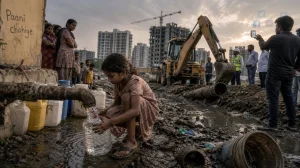
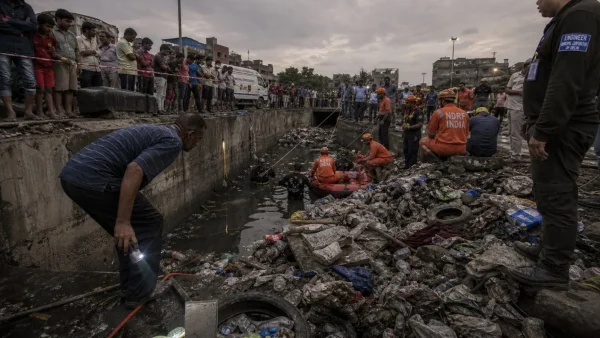
The drain was described by residents and reporters as being surrounded by garbage, construction debris and other waste. The accumulation reportedly complicated the search operation.
According to The Indian Express, heaps of plastic bottles, construction material, clothes and tyres had accumulated around the drain. Mithun’s body was recovered only after part of the garbage blocking the waterway was cleared.
For the family, the days between the accident and recovery became an agonising wait.
Mithun’s father, Awadhesh, was seen entering the drain himself in an attempt to find his son after the rescue operation failed to locate him.
Search Operation Continued for More Than 72 Hours
Fire department personnel, district administration teams, boat teams and the National Disaster Response Force (NDRF) were involved in the search.
Despite the deployment of multiple agencies, Mithun remained missing for more than 72 hours.
The delay became a major source of anger among residents and the family, particularly because the drain was reportedly filled with garbage and debris.
The boy’s body was ultimately found approximately 500 metres from the location where he fell.
MCD Junior Engineer Suspended
Amid mounting public outrage, the Municipal Corporation of Delhi (MCD) suspended a junior engineer.
The official order identified the officer as Anuj Kumar, JE (M)-IV, and cited “dereliction of duty” as the reason for the suspension. The order stated that disciplinary proceedings were contemplated against him.
The action followed Chief Minister Rekha Gupta’s direction that the responsible official be identified and action taken.
However, the suspension immediately raised another question:
Was MCD actually responsible for maintaining the drain?
The Blame Game Begins
The ownership and maintenance of the drain became a point of dispute among Delhi’s civic agencies.
When The Times of India asked different departments who was responsible for the drain, the Delhi Jal Board (DJB) denied having jurisdiction over it.
A DJB official reportedly said the Kachha Nallah, which carries treated effluent from the Okhla Sewage Treatment Plant, had been handed over to the MCD.
But the MCD reportedly gave a different response, saying that the Irrigation and Flood Control Department (I&FC) was responsible for maintaining the drain.
That disagreement is now central to the controversy.
Because if one department says the drain belongs to another, while a third department suspends its own junior engineer, the public is left asking:
Who was actually responsible for keeping the drain safe?
Pravesh Sahib Singh’s Role
The dispute has also acquired a political dimension because Pravesh Sahib Singh currently holds Delhi’s Irrigation & Flood Control portfolio.
According to the official Delhi government website, Sahib Singh is the Cabinet Minister for Public Works, Legislative Affairs, Irrigation & Flood Control, and Water and Gurudwara Elections.
The Irrigation & Flood Control Department itself confirms that it is a Delhi government department headed by a Secretary and supported by engineering officials, including executive engineers, assistant engineers and junior engineers.
This makes the question of departmental responsibility particularly important.
However, it would be inaccurate to conclude solely from the minister’s portfolio that he or his office was personally responsible for the boy’s death.
Administrative responsibility and individual criminal or personal responsibility are different matters.
The investigation must establish which department had legal and operational responsibility for this particular stretch of drain.
The Government’s Four-Engine Structure
Delhi’s current BJP government has six Cabinet ministers handling different portfolios, with responsibilities divided across departments.
Sahib Singh handles Irrigation & Flood Control, while Ashish Sood holds the Power, Urban Development and several other portfolios, according to the official Delhi government listing.
The division of responsibilities makes coordination between departments crucial.
A drainage system can involve multiple agencies depending on its location, function and history—including MCD, DJB, I&FC and other authorities.
But for residents, those administrative boundaries are invisible.
When a dangerous drain is left open, the public expects the government to know who is responsible and to fix it.
Delhi High Court Steps In
The tragedy has also reached the judiciary.
The Delhi High Court took serious note of the condition of open drains in the area and directed the MCD to immediately take safety measures.
The court ordered that an open drain be covered with slabs and that a separator wall be constructed without waiting for routine formalities.
The court described the unprotected drain as a serious safety hazard for residents and commuters.
The judicial intervention underlines the larger issue:
An open drain near residential areas cannot simply be treated as an ordinary piece of infrastructure.
It can become a deadly hazard, particularly for children.
₹5 Lakh Assistance Announced
Following the tragedy, Chief Minister Rekha Gupta announced ₹5 lakh in financial assistance for Mithun’s family, according to reports.
Financial assistance may provide some immediate support, but it cannot answer the family’s central question:
Could Mithun’s death have been prevented?
That question requires an examination of the drain’s condition, warning barriers, maintenance records, complaints from residents, rescue preparedness and the responsibilities assigned to each agency.
A Broader Civic Failure?
The incident is not simply about one open drain.
Delhi has repeatedly faced problems involving waterlogging, clogged drains and inadequate monsoon preparedness.
In June, the Delhi government issued its Flood Control Order 2026, covering drainage systems, pumping stations, river embankments and other flood-management arrangements. The Chief Minister also directed that nodal officers be appointed for identified waterlogging points with clearly defined responsibilities.
The Jasola tragedy therefore raises questions about whether those clearly defined responsibilities are actually reaching the ground level.
A government order is meaningful only when an officer knows:
Which drain is mine?
Who maintains it?
Who inspects it?
Who responds when residents complain?
And who is accountable when someone dies?
From a Kite to a Tragedy
Mithun was reportedly trying to retrieve a kite when he fell.
What began as an ordinary moment in a child’s life ended in tragedy.
His father spent days searching for him, at one point entering the drain himself.
His body was eventually recovered after more than 72 hours.
The image of a parent searching a filthy open drain for his missing child has now become a symbol of the human cost of civic failures.
The Accountability Question
The suspension of an MCD junior engineer may satisfy the immediate demand for action, but it does not by itself settle the larger issue.
Authorities need to establish, on record:
Which department legally controlled the drain?
Which agency was responsible for maintenance?
Why was the drain left open and unprotected?
Were complaints about garbage or safety previously received?
Why did the rescue operation take more than three days?
Was the accumulated garbage cleared earlier?
Were adequate barriers or warning signs present?
Who was responsible for inspecting the site?
Why did different departments give conflicting accounts of responsibility?
These questions deserve answers based on official records rather than political blame.
Delhi Needs Accountability, Not Departmental Ping-Pong
The tragedy has exposed an uncomfortable weakness in urban governance: when multiple agencies share overlapping responsibilities, accountability can become blurred.
For residents, however, there is no such ambiguity.
A dangerous drain is a government responsibility regardless of which department’s name appears on the file.
The suspension of one MCD engineer, the financial assistance announced for the family and the High Court’s intervention are important steps.
But they are not the end of the matter.
The real test of Delhi’s administration will be whether it can ensure that no other family has to spend three days searching a drain for a child who should have been safely at home.
Mithun Kumar's death should not become another case where departments argue over jurisdiction while the public is left asking who, ultimately, was responsible.