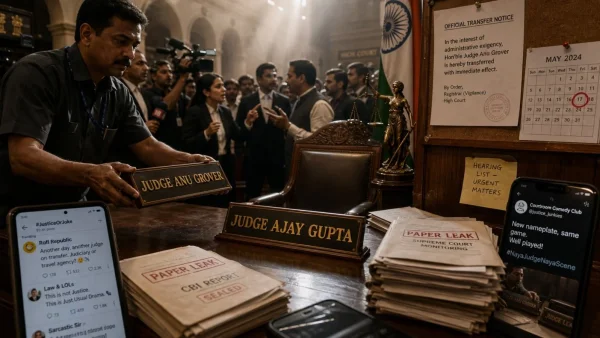
The transfer of Judge Anu Grover, who had been hearing a high-profile paper leak case, has triggered political controversy and intense debate on social media.
Following the transfer, Judge Ajay Gupta has been assigned to hear the matter, while Judge Anu Grover has been posted to the National Investigation Agency (NIA) Court.
Although judicial transfers are part of the normal administrative functioning of the judiciary, the timing of the move has prompted questions from critics, who argue that it could affect the continuity of proceedings in a sensitive case.
No official statement has indicated that the transfer was linked to the merits of the paper leak case.
Questions Raised Over Timing
The controversy intensified after several commentators questioned why the transfer occurred while the case was being heard.
Some critics have alleged that:
The change could delay proceedings.
A new judge would require time to familiarize themselves with the case.
Frequent changes in key personnel may affect the pace of high-profile trials.
These are concerns expressed by critics and have not been substantiated as evidence of wrongdoing.
“First the Lawyer, Now the Judge”
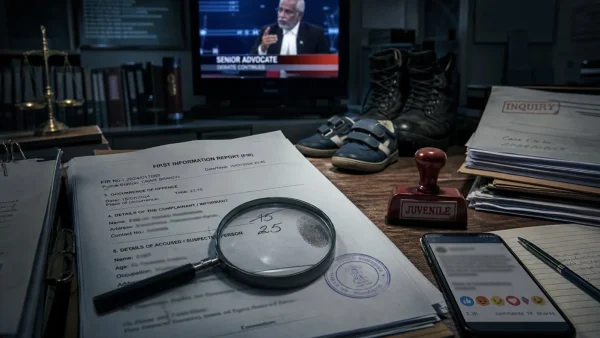
The transfer has also revived discussions surrounding earlier developments in the case.
Some opposition leaders and social media users pointed to previous reports regarding changes involving legal representation and argued that the latest judicial transfer has deepened public suspicion.
However, no evidence has been publicly presented linking these developments or suggesting any coordinated effort to influence judicial proceedings.
PM’s Earlier Remarks Resurface
Prime Minister Narendra Modi had previously emphasized the need for speedy investigations and strict punishment in paper leak cases, stating that those responsible should face swift legal consequences.
The latest transfer has prompted critics to question whether the promise of expedited proceedings can be maintained following a change in the presiding judge.
Supporters of the judicial process, however, note that cases continue irrespective of the individual judge and that transfers are a routine administrative matter.
Judicial Transfers: Routine or Controversial?
Judicial transfers are carried out for various administrative reasons and do not, by themselves, indicate interference in any particular case.
Legal experts point out that assigning a new judge does not automatically alter the legal process, although transitions in complex matters can require additional time for the incoming judge to review records and proceedings.
Ultimately, the impact—if any—will depend on how the case progresses under the new judge.
Political Reactions Intensify
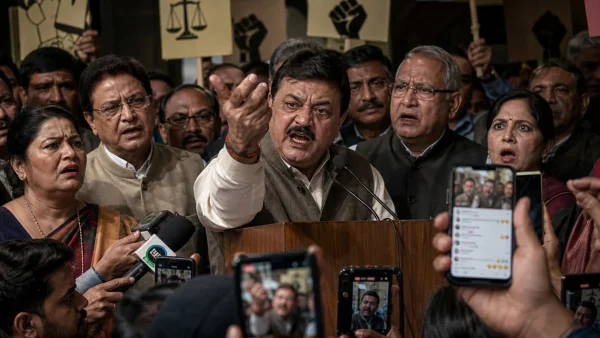
The transfer has quickly become a political flashpoint.
Opposition leaders have demanded greater transparency regarding the timing of the decision, while government supporters have accused critics of politicizing routine judicial administration.
As of now, no official authority has suggested that the transfer was improper or connected to the outcome of the case.
Social Media Reacts
The development generated strong reactions online.
One user commented:
“People don’t object to transfers. They question the timing.”
Another wrote:
“Justice must not only be done but must also inspire public confidence.”
A third remarked:
“The guilty should be punished—but the process should also remain transparent.”
These comments represent public opinion shared online.
Sarcasm Takes Over Social Media
The controversy also sparked a wave of satirical posts.
One user joked:
“Looks like the paper leak case now has a new syllabus—and a new examiner.”
Another quipped:
“Every time the story gains momentum, someone seems to hit the refresh button.”
A third sarcastically wrote:
“Fast-track justice shouldn’t require frequent change of drivers.”
Meanwhile, supporters of the government’s position responded with their own sarcasm:
“Apparently, every administrative transfer has now become a conspiracy theory.”
These remarks reflect opinions circulating on social media and should not be interpreted as factual conclusions.
The Bigger Picture
The transfer of Judge Anu Grover has once again placed the spotlight on the handling of paper leak cases, which have become a major political issue in recent years.
For critics, the timing raises legitimate questions about continuity and public confidence.
For others, the episode serves as a reminder that judicial transfers are a regular part of court administration and should not automatically be viewed through a political lens.
What remains unchanged is the expectation shared across the political spectrum: that the investigation and trial proceed fairly, transparently, and without unnecessary delay.