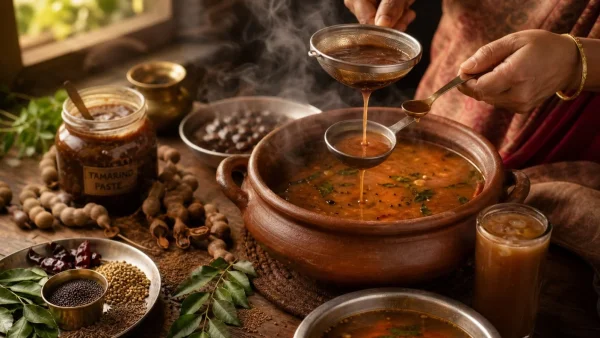
Tamarind (or imalee) is a small but incredibly useful thing to have in your kitchen; it can save a bland sambar, calm down a very spicy rasam, and give chutneys that special zing. The sweet and sour flavor isn’t just a flavor addition, it’s a quiet power that balances a dish, and it does so at exactly the moment it’s needed.
A morning ritual that sets the tone
One memory of cooking in a kitchen starts with a prayer and quickly soaking the tamarind. By the time the cooking fire was on, the tamarind liquid was ready to be mixed into sambar, rasam, kuzhambu, kootu, or thogayal.
That relaxed way of doing things shows how important it is. Over the years of recipes inspired by South Indian cooking, this column has frequently used tamarind as the ingredient which brings everything else together and makes it feel balanced.
The sweet-sour engine of balance
Really, tamarind is about that special combination of sweet and sour. The sourness breaks up the richness of oily or creamy food, while the mild sweetness softens a strong spiciness. If something is too salty, too hot, or just doesn’t have enough flavour, tamarind can correct it without being the main focus.
What’s so good about it is how complicated it is. You get a quick sharpness first, then a gentle sweetness, and finally a more substantial, earthy taste underneath. Tamarind doesn’t fight with the other flavours in the dish; instead, it brings them together, a bit like the bass player in a jazz band who you don’t really hear but is always essential.
Here are the key ways tamarind shapes flavour:
– Balances salt, heat, and sweetness
– Cuts heaviness and lifts dull flavours
– Adds depth while keeping brightness
– Enhances aroma without overpowering
From sambar to rasam: the tie that binds
Across South Asia, Southeast Asia, and parts of Africa and Latin America, tamarind is a foundational ingredient. In Indian cooking, it is essential for sambar, rasam and chutneys, not only to make them sour, but to hold all the flavours together.
The column explains how tamarind brings together cumin, coriander, mustard seeds and curry leaves into something that feels as one. Without it, these dishes feel unfinished, as if a vital part is missing.
Acidity that brightens, depth that endures
Acidity makes food seem more alive, and tamarind is excellent at doing that. When you add it, the spices smell more fragrant, the sweetness is more complete, and even umami (that savoury flavour) is more satisfying.
Unlike a quick squeeze of lemon or lime juice, tamarind provides both brightness and body. It makes the flavours louder while also adding a low, steady flavour that grounds the dish.
Texture that brings sauces together
Tamarind isn’t just about flavour, either. When you dissolve the pulp, it becomes smooth and slightly thicker. This thickness helps sauces and gravies stay together, so the flavours mingle instead of being separate.
It is as much a way of making things physically come together as it is a way of making the flavours combine. The dish both looks and tastes more like a whole.
Not just savoury: drinks and sweets stay bright
Tamarind is just as good in a drink or a dessert. In beverages, sweets and syrups, its sourness stops the sweetness from being too much. This creates a refreshing contrast that makes you want another drink, and isn’t too heavy.
That same balancing act is why it works with all different parts of a meal. It provides a contrast but doesn’t take over.
A tradition of intuition and restraint
There’s a history of cooking that goes with tamarind. In many old recipes, cooks just know how a small amount can change a dish. Too little and it’s bland, too much and it’s overly sharp.
Getting the amount right is part of being skilled at cooking. The column describes this as knowledge passed down through kitchens, where practicing something teaches you how much to use much more effectively than any instruction book.
The larger lesson: harmony over excess
Tamarind shows us a more general point about flavour. Really good cooking isn’t about adding loads of ingredients. It’s about getting sweetness, sourness, saltiness, bitterness and umami to work together.
Because of its many layers of flavour, tamarind is a link between tastes, making sure they go well with each other instead of competing. It isn’t the main attraction; it’s the conductor ensuring that all the flavours come together.
Where it shows up, and why that matters
You can see how flexible it is in everyday cooking. From sambar and rasam to kuzhambu, kootu and thogayal, a little tamarind provides the central strength of each dish. The same principle applies to chutneys, richer curries and even simple, cooling drinks.
When a dish isn’t quite right, tamarind offers a calm solution based on balance. It brightens, adds depth, and binds everything, all at once.
Here are familiar places you will find tamarind at work:
– Sambar, rasam, and kuzhambu
– Kootu and thogayal
– Chutneys and rich curries
– Drinks, candies, and syrups
What comes next in your kitchen
The column suggests that next time a dish is too salty, spicy, or tasteless, you add a measured amount of tamarind. Let it break down, let it settle in, then taste it again.
It’s likely the dish will now feel finished. That’s tamarind’s quiet guarantee. It brings all the flavours together, and it does so without trying to be the centre of attention.