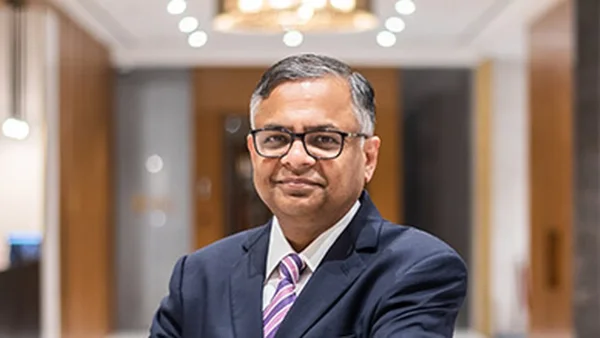
The bet here is that AI is going to be a market builder, not a destroyer. In front of shareholders on Tuesday, Tata Sons’ N Chandrasekaran put a number to it: within three years, TCS could have an equal number of AI agents and people. It’s a confident stance from a company that can point to $2.4 billion in annualised AI revenue and margins that have held firm even as some in the industry fret over automation.
AI as infrastructure, not a threat
Chandrasekaran has a way of putting things. He sees AI as a new kind of enterprise plumbing, not some fad. “AI is not merely a technology. It is infrastructure – an infrastructure of intelligence,” he put it at the 31st AGM, noting that as the price of intelligence comes down, you can do more with it.
He thinks some of the hand-wringing from investors is a misreading of what’s happening with spending. “Margins have held, revenues are up, and the deal pipeline is stronger than ever,” was his take. And when it comes to enterprise AI, he says the thing you can’t get enough of won’t be the model, but context and trust – and that is where the established players have the upper hand.
A bigger market and a new operating model
If you look at the numbers, three in four companies around the world are planning to put more money into tech in the next couple of years, and AI is the driver. Chandrasekaran figures the $1.6 trillion global enterprise IT market we have now could be a $3 trillion one by the end of the decade.
The fiscal 2026 results back that up. You had consolidated revenue of Rs 2.67 lakh crore, a 4.6% jump, and net profit up 8.8% to Rs 52,820 crore. Total contract value is over $40.7 billion. And as for that $2.4 billion in AI revenue? That’s a run-rate from last quarter, and it’s been compounding at 22.4%.
Why AI agents matter for services firms
“I predict that over the next three years, TCS will have as many AI agents as human employees,” said the chairman. But don’t think of it as a headcount swap. It’s more about rethinking how you get things done as you let AI handle more of the process, the decisions and the customer side of things.
There is a good-sized market for the kind of work that goes into training and keeping tabs on these agents once they are running on their own. You need strong frameworks for security, cost and performance, and that is where TCS has always been at home in large organisations.
Five growth tracks in the AI era
Chandrasekaran was specific about where the money is going to be spent. From the boardroom to the factory floor, he says you only see the value of AI when the governance and the execution are in place. Some of the key areas he pointed to are:
– A complete reworking of supply chain and customer processes
– Putting AI to use in energy, warehousing and manufacturing
– Sovereign AI for those in government or heavily regulated industries
– An upgrade for old data, cyber and infra set-ups
– The management of AI agents in any size
Take physical AI for instance. We put a four-legged robot with all the right sensors and cameras in a warehouse for an agribusiness to check on some less-than-ideal conditions. It’s a case of intelligence leaving the screen and going to work in the field.
Competitive lens: signals to the market
There is a story out there that gen AI is going to put the services sector out of a job. Chandrasekaran is keen to put that to bed. He says the ability to put complex tech in place for big enterprises is as relevant as ever, and that the pool of available work is getting larger, not smaller.
It’s a matter of moving with purpose for TCS. They are churning out AI agents, have put in place some sovereign AI in Europe and India, and the pipeline is looking good. If you want a partner to make a scaled deployment happen with the right level of trust, that’s where they want to be.
Down the line, the chairman is of the view that AI will be at the heart of the next leg of growth for TCS and the rest of the industry. As intelligence gets cheaper, the whole scope of what IT services can do will open up to include more of everything in an AI-led change.