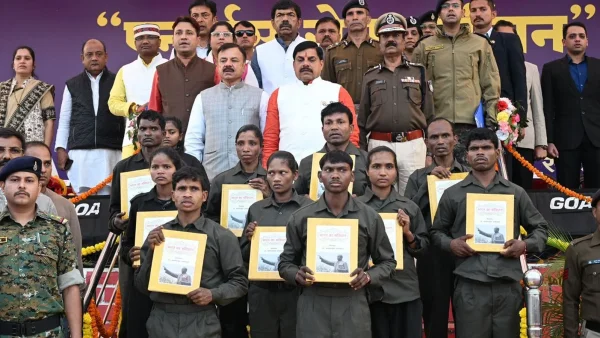
Ten Maoists, including four women, ended their involvement with the insurgency in Balaghat, Madhya Pradesh on December 7, 2025, while Chief Minister Mohan Yadav was there. This giving up of arms is a real step forward in an area that has had a long problem with Naxalism, and comes as they try more and more to use both strong police action and help for those who give up.
Important leaders were among those who gave up
Officials said that, together, the ten Maoists had rewards offered for their capture totaling ₹2.36 crore in Madhya Pradesh, Chhattisgarh, and Maharashtra. The group had important people in the Kanha-Bhoramdeo (KB) division of the MMC zone.
Among them was Surendra, also known as Soma Sodi, 50, a sub-zonal committee secretary tied to the MMC zone, and before that the military leader of the Darbha division. A reward of ₹62 lakh was offered for his capture. Another, Rakesh Odi, also known as Manish, 42, from Gadchiroli in Maharashtra, also had a ₹62 lakh reward on his head.
People in authority said the unit was with Kabir, the KB division’s most wanted commander, whose giving up with his team is seen as a major setback for the Maoist networks. Apart from Manish, the other nine are from Chhattisgarh.
Weapons and equipment handed over
The Maoists gave up weapons including two AK-47 rifles, two INSAS rifles, two single-shot rifles, and a self-loading rifle. Police also got back seven barrel grenade launcher cells, five detonators, four walkie-talkie sets, and more than 100 rounds of ammunition.
Getting these things back lowers the risk for police patrols, and breaks up supply lines inside the forests, especially around the Kanha Tiger Reserve.
Government says it will be firm, but also open to people leaving the Maoists
CM Mohan Yadav said again that the state will use two ways to deal with this: strong action against armed groups, and rewards for giving up. He said the campaign of ‘aakhiri salaam to lal salaam’ is going forward, to meet the national goal of a Madhya Pradesh with no Naxalism.
‘No one will be allowed to take up arms in the State,’ he said, and asked more Maoists to use the Madhya Pradesh Surrender, Rehabilitation cum Relief Policy, 2023. He added that the government will make sure they are safe, help them get better, and get them back into normal society.
The Chief Minister also praised the state police and the anti-naxal unit Hawk Force. He said that at least 10 serious Maoists had been killed this year in the Balaghat area, and that Mandla and Dindori areas are now free of Maoist activity.
Setting a clear time, he said that by January 2026 Maoists would either give up, or be dealt with.
What happened in the operation: contact, getting people to agree, and the policy
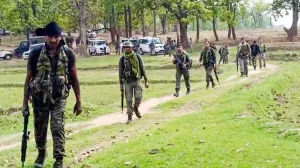
Hawk Force officials said the ten were part of a group of 18 working inside the forests of the Kanha Tiger Reserve. Six were killed in fights in February and April, while two ran to Narayanpur, Chhattisgarh, and gave up earlier this year.
Contact with the group started when a forest guard said Maoists had asked him for help to get to Chhattisgarh. Security teams then got in touch with them, asked them to meet the Inspector General of Police in Balaghat, and explained what the 2023 plan to help people leave the Maoists offered.
Forest guards, who live inside remote areas, have become important in reaching out. People in authority have told them about the policy, and said they will get rewards for helping with lawful processes.
Under the state rules, plans to help people give up go to a committee that decides what terms to offer, and watches people for a set time to help them get back to normal life.
The plan to help people give up is gaining support
This giving up of arms follows the case of a woman Maoist who gave up last month in Balaghat – the first under the state’s new policy since it was started in August 2023. The two giving ups one after the other show that more and more people know about the protections the policy offers, and the growing pressure on people in the Maoists as their supply lines are broken.
For the government, helping people give up is not just about letting them go free. It is about making sure they are safe, giving them ways to get better, and getting them back into the community – all of which lowers the appeal of underground networks.
More development in areas with fighting
While Balaghat is still the most important area, Sukma in neighboring Chhattisgarh is moving forward with ways to help people make a living, like the Aam Bagicha project. By helping with mango, coconut, lemon, and other orchards, the government hopes to raise money in the countryside, and fit in with the Lakhpati Didi program.
Models based on orchards can be a long-term answer to fighting, by widening jobs and reducing the economic hole that extreme groups take advantage of.
What the giving up of arms means for Balaghat
Security groups expect a clear fall in the number of Maoists in the Balaghat area after this giving up of arms. Removing important leaders, getting weapons, and opening ways to help people give up can break up command structures and ask more people to leave.
The state’s message is clear: there is a place for those who want to go back to normal life, and no place for guns. As the 2026 time comes close, a mix of targeted action and real help to people could change the balance in central India.