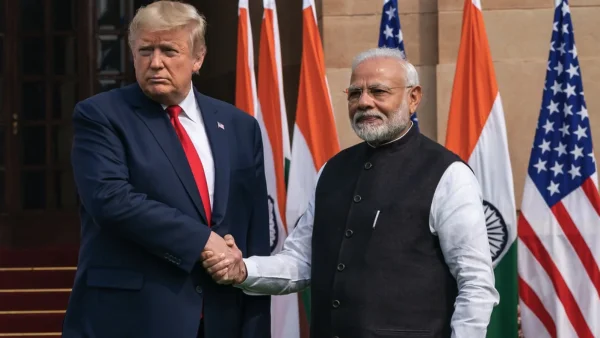
An additional increase in US tariffs on Indian goods would hurt exporters in the short run, but it could also move forward the long-planned efforts to make markets more varied and supply lines less risky. That’s what trade people generally think, as Washington says it could put duties on New Delhi very soon, connecting the warning to India’s buying of crude oil from Russia.
What caused the newest tariff warning
US President Donald Trump told the press he wasn’t pleased with India’s getting Russian crude oil, and that tariffs could be raised with little warning. As this tariff danger gets stronger, a number of trade people in the know say India has to make a firm decision about Russian oil, balancing energy safety with the risk of losing access to its biggest export market.
A big set of tariffs is already there
The Global Trade Research Initiative (GTRI) stated that Indian goods are already facing a large 50% tariff in the US, with half of that directly connected to purchases of Russian crude. It also said Indian sales to the US fell 20.7% from May to November 2025, and warned that things getting worse could cause a much sharper drop. GTRI’s founder, Ajay Srivastava, said India doesn’t have the strong position Washington gives Beijing. “China is the largest buyer of Russian crude, but the US has turned a blind eye, afraid of what would happen. India has more than doubled its imports of petroleum crude and products from the US, but the US will ignore this,” he said, and warned against thinking trade in energy would hold back tariff action.
Despite pressure, some strength in shipments
After two months of going down, India’s sales of actual goods to the US went up 22.61% in November to USD 6.98 billion. From April to November, exports to the US grew 11.38% to USD 59.04 billion, while imports went up 13.49% to USD 35.4 billion. The return to growth suggests basic demand is still strong, but a new tariff could quickly undo the gains.
Possible effect by what happens
The US is still India’s biggest trade partner and makes up about 18% of its exports. In 2024-25, trade between the two countries was USD 131.84 billion, of which USD 86.5 billion was Indian exports. These figures show why tariff increases are important: the loss of income would be instant, mainly for items where price is important.
Older sectors could be hurt the most
Exporters are saying that another tariff increase would really damage Indian exports, mostly in older kinds of industries. The Federation of Indian Export Organisations (FIEO) said the pressure could, though, act as a reason for quicker variation and lessening of risk. Director General Ajay Sahai noted that while some trade which depends on price may get smaller, shocks like these make companies reduce being too reliant on one market.
How exporters can act now
He used marine products as an example of where exporters varied markets within a short time, showing the industry can change quickly. The diamond industry, for its part, has asked for quick help as tariffs cut into profits. Similar changes are likely in other sectors, Sahai said, leading to a more even and worldwide varied range of exports.
Talks are aimed at easing the tariff crisis
The tariff threat comes as India and the US are talking about a trade deal between the two countries, which includes a plan to sort out the 50% duties on Indian goods. Six sessions of talks have taken place; US Deputy Trade Representative Rick Switzer and his group were in New Delhi for the most recent two-day session, on December 11, 2025.
What to see in the next few weeks
Commerce Secretary Rajesh Agrawal stated that India is hoping to finish the talks soon to get back to better access to markets. The agreement is sensitive in politics: Washington wants cuts in duties on farm items – like almonds, maize, and apples – and also on manufactured products. New Delhi has resisted giving in on agriculture and dairy, showing it will not put the interests of farmers and small and medium-sized businesses at risk.
Officials were told by leaders in February 2025 to deliver a first set of results by autumn 2025. The wider aim is to more than double trade between the two countries to USD 500 billion by 2030, up from approximately USD 191 billion. A deal which reliably lowers the doubt about tariffs would help make investment and supply-chain planning more stable on both sides.
Why the Russia issue makes trade harder
Linking tariffs to purchases of Russian oil puts a sanction-related aspect into what is, at its heart, a trade disagreement. For India, crude oil from Russia has been a main way to control import costs and inflation. For the US, putting pressure on countries makes them follow its energy policy without directly putting on sanctions. This difference makes exporters planning contracts, prices and movement of goods unsure of what will happen.
India’s thinking on energy is also changing. While it has increased buying of US oil, that has not changed Washington’s position, according to GTRI. The lesson for exporters: only working on energy relationships may not protect trade in goods from policy changes.
Main point
A further rise in US tariffs on goods from India would be damaging, mainly in traditional areas sensitive to price. But the same pressure could speed up the long-needed making of a wider range and adding of value to India’s export base. The best result is a deal which is agreed on which brings back certainty and access to markets. Until then, exporters should plan for a harder tariff situation while building a wider, more able to last global presence.