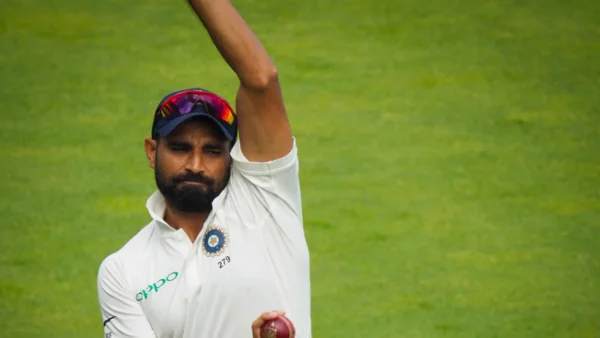
Badruddin Siddiqui seems both pleased with and confused by Shami’s not being chosen. When he talks about Shami being left off the team again, the coach keeps coming back to a direct question: Shami has skill, gets wickets, is fit, and in good shape… what else is needed? He isn’t asking for anyone to feel sorry for Shami. He is simply pointing out that what a player does should determine who plays, not what people think about the player.
A record of work that’s hard to miss
During India’s domestic season, Shami has done all that a senior fast bowler should be expected to do. In four Ranji Trophy games, he bowled around 20 overs per match and got 20 wickets at an average of 18.60, helping Bengal finish first in its group. In the Syed Mushtaq Ali Trophy, he took 16 wickets in seven games. In the Vijay Hazare Trophy, he got 11 wickets in five games at 22.50.
He’s back to having the amount of bowling, the quality, and the control that he needs. He’s thrown difficult overs, started with good new-ball spells, and finished innings without avoiding hard work. For a 35-year-old fast bowler who has come back from being hurt, those are clear signs of being in shape and in good form – not just short performances to meet requirements.
Left off the New Zealand ODIs
Even with all of that, Shami was not chosen for the ODI series against New Zealand. The choice brought on more than the usual amount of criticism. Siddiqui asked what more a senior bowler has to do to be thought about for the team. Bengal coach Laxmi Ratan Shukla said the choice was unfair, and praised Shami’s hard work in domestic games as being typical of an international veteran.
The worry isn’t just about one series. Shami’s coach is afraid that this means he will be left off India’s ODI plans for a long time. For a bowler who has always done well on important occasions, being left out after a great return to domestic play seems – to fans – like a break between the rules for choosing players and what is actually happening on the field.
A record on big stages that few can match
Shami’s case isn’t only about what he’s done lately, but about his history. He is India’s leading wicket-taker in Cricket World Cups, with 55 at 13.53 in 18 games, and has the most five-wicket hauls in the tournament. He does well under lights and pressure. He said last October that winning in 2027 is still his goal.
On hard, bouncy South African pitches, a fast bowling group of Jasprit Bumrah, Shami, and Mohammed Siraj could scare any batting lineup. Not many of the players who have been tried recently give people the same fear. Harshit Rana is still learning, Prasidh Krishna is not always accurate, and Nitish Kumar Reddy is still improving.
The selectors’ caution and looking towards 2027
There is a counter-argument, and it isn’t totally wrong. Choosing players is as much about managing risk as it is about getting reward. By 2027, Shami will be 36. India’s planning group may be careful about basing their World Cup plans on two great but injury-prone fast bowlers in their 30s. Building up players now could avoid a last-minute rush later.
India’s domestic fast bowling isn’t full of players who are ready. That might make those who choose players go with a careful plan: make a rotation, spread out the workload, and don’t use the senior fast bowlers too much. As a plan, it makes sense on paper, even if it seems hard on Shami’s recent play.
A story about fitness that needs to be clear
Communication hasn’t helped. The main selector said before that Shami didn’t regularly tell the group about his fitness; Shami said that it isn’t the player’s job to do so. That difference – whether it’s about how things are done, or what people believe – can be fixed. Clear rules can stop mixed messages and keep a debate about play versus fitness from getting out of control.
If the selectors are looking at how well someone can last through a whole season, they should say so. If the worry is only about long-term planning, they should state what players coming back from time off have to do. Being open helps both players who have been around for a while and new players get their practice and expectations set.
Running in the mud, rhythm in the arm
Siddiqui gives an idea of the hard work Shami puts in. After a knee injury in 2024, the bowler went back to his farm in Alinagar, Sahaspur, running barefoot in mud and throwing hundreds of balls to get his rhythm back. That old-fashioned practice has shown up in his bowling: he can throw the same way each time, has a strong run-up, and gets late movement.
Because many Bengal games aren’t on television, Siddiqui has watched highlights and clips online a lot. What he sees now makes him hopeful: a smooth pick-up, the seam straight, a heavy ball. If he keeps bowling like this, the coach says, it will only get harder to ignore him.
What should happen next
Three steps could turn disagreement into progress:
– Set rules for choosing senior fast bowlers who are coming back from injury, including how many matches, how much work, and what levels of play across all types of game.
– Use a step-by-step return to play: limited overs in friendly games, workloads that are watched, and a clear role within the fast bowling group.
– Tell people early and openly. It protects players and those who choose them from guessing and sets a stable plan to 2027.
At the heart of it, this isn’t about who is most popular. It’s a cricket choice about value, when something happens, and whether someone can be trusted. On value, Shami has made as good a case as any fast bowler in India. On when something happens, his domestic play says he’s ready now. On trust, being clear is what is missing.
He has skill, gets wickets, is fit, and in good shape… what more does he need? Until the selectors answer that with details, the question will be heard every time Shami runs up, gets the seam right, and asks another batter to show they belong.