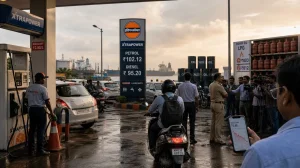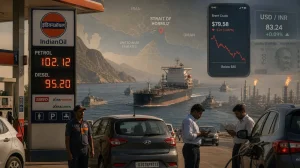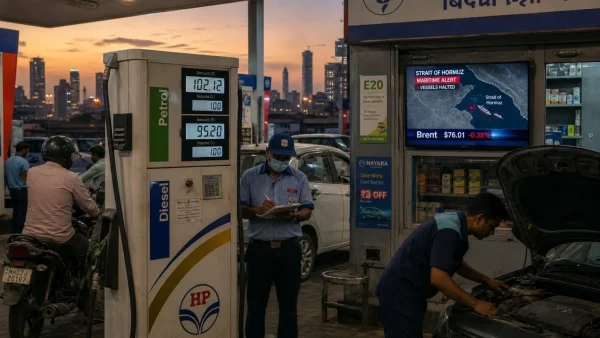
On 12th July, pump prices in India did not waver. While Iran put an end to the Strait of Hormuz and the US was making new strikes, petrol and diesel in the big cities were left as they were. The numbers from state-run marketers held firm, with Brent crude at $76.01 a barrel, a 0.38% drop.
You can read into that resolve: it is about insulating the buyer from a rough market and any geopolitical hiccups in the supply line. There has been no change from public-sector OMCs since the last time they put up prices on May 25 – by Rs 2.61 for petrol and Rs 2.71 for a litre of diesel.
Global flashpoint, local calm
Ship-tracking figures in the source material show traffic in the Persian Gulf all but stopping on Thursday. Then came word from Iran on Sunday of ‘warning shots’ at a non-compliant ship and the declaration that the Strait was to be closed for the time being.
The US Central Command has it that Tehran went after a container ship with a Cyprus flag, leaving a crewman unaccounted for and the ship out of commission with an engine room fire. Washington followed with a third set of strikes this week. “Iran made a poor choice. Now they pay,” was the way US defense secretary Pete Hegseth put it.
It is a waterway that sees a fifth of the world’s oil and LNG, so it has markets on edge. Yet, with the threat to tankers, the close of $76.01 for Brent is nothing like the over-$120 per barrel we saw in late April that had energy traders in a tizzy.
City-wise rates on 12th July
In Delhi, you will find petrol at Rs 102.12 and diesel at Rs 95.20, both over the top. Mumbai has its motorists shelling out Rs 111.21 for petrol and Rs 97.83 for diesel, well above the Rs 110 mark in the financial hub.
Bengaluru has it at Rs 111.68 for petrol and Rs 99.56 for diesel. In Kolkata, the going rate is Rs 113.51 and Rs 99.82 respectively. Chennai is at Rs 107.76 for petrol and Rs 99.55 for diesel.
Hyderabad is something of an exception for diesel in the metros, at Rs 103.82, with petrol at Rs 115.69. Over in the NCR, Gurugram is at Rs 102.97 for petrol and Rs 95.64 for diesel; Noida is a bit lower at Rs 101.96 and Rs 95.44.
Outside the major cities, Bhubaneswar is at Rs 108.97 for petrol and Rs 100.68 for diesel. Chandigarh comes in at Rs 101.54 and Rs 89.47.
As for Jaipur, the tab is Rs 112.69 for petrol and Rs 97.78 for diesel. In Lucknow, the price of a litre of petrol is Rs 101.86 and diesel comes in at Rs 95.36. Over in Patna, the figures are higher: Rs 113.93 for petrol and Rs 99.91 for diesel. Thiruvananthapuram has seen even steeper rates, with petrol at Rs 115.49 and diesel at Rs 104.40.
The case for stable prices in a rough market
It is the state-owned OMCs that set the retail price, and they have left them as they were on May 25 to provide some stability in the face of geopolitical uncertainty. In doing so, they have insulated the pump from the kind of short-term volatility one might see on the world stage.
There is more to India’s fuel pricing than just the international crude benchmark or the rupee-dollar rate. You have to factor in the various central and state taxes, not to mention freight and local supply. It is these elements that put a premium on fuel in one state over its neighbour.
What we are seeing today is driven by a few things:
– The ongoing risk of disruption in the Strait of Hormuz
– Brent’s close at $76.01, a 0.38% dip
– The fact that state OMCs have not moved their numbers since late May
A nudge from the private side
Then there is the matter of competition. While the public sector has been holding firm, Rosneft’s Nayara Energy made some moves last week, trimming the cost of petrol by Rs 5 and diesel by Rs 3 at its 7,000 or so outlets. Such discounts can be felt in certain areas, but for the most part, the consumer is still guided by what the state-run companies do. Even with the situation in the Gulf, the public sector’s inactivity is the prevailing mood.
Questions over E20
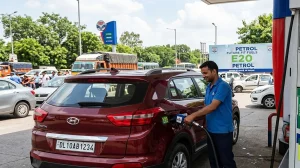
Fuel quality is also up for discussion. AAP’s Arvind Kejriwal was out in Delhi at a couple of stations to look into the E20 blend. “The government is telling blatant lies,” he put it, pointing to issues with mileage and the like.
The Petroleum Ministry, for its part, has said that having pure, E10 and E20 options would be too much of an operational headache. They will concede that E20 might mean a 3-5 per cent hit to fuel economy in some cars, but point to better octane and fewer emissions as the trade-off.
For a household or a fleet, this is where the rubber meets the road. With the sticker price not moving, it is down to how well the vehicle runs and what it costs to keep it in shape.
On the horizon
All eyes are on the shipping lanes in the Gulf and the next move from the OMCs. A shift in tanker traffic through Hormuz could alter the calculus in a hurry.
At the moment, the Indian market is in no rush. Prices are where they are, and for the consumer, there is some respite. But when you consider that a fifth of the world’s oil and LNG has to pass through a tight spot, it is worth keeping an eye on.