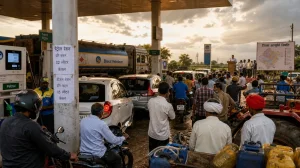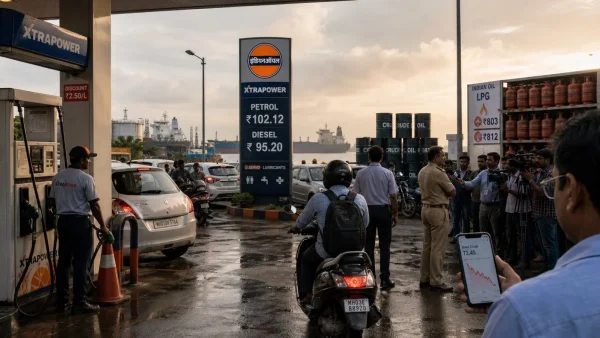
Those looking for a less expensive run to work will be put off for the time being. Petrol and diesel were left as they were on 4 and 5 July, with Brent making its way to a four-month low. Word from officials is that the state-run side is not going to be trimming any time soon; they have to get through some more expensive stock on hand.
Why the numbers at the pump are not budging
With things in West Asia calming down and the Strait of Hormuz seeing more traffic, the global markers have given back some ground. On 4 July, you could see Brent futures a hair over $72 a barrel, the kind of quarterly drop we have not had since 2020 after the war-time run-up.
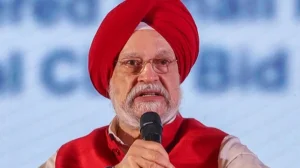
Hardeep Singh Puri, the Union petroleum minister, put it this way: the domestic Oil Marketing Companies are still churning through the pricier barrels they put in during the height of the crisis. A cut at the register is possible if the international side stays put. But for the moment, the hikes of 25 May – 2.61 on petrol and 2.71 on diesel from the state OMCs – are where it stands.
The tab for 5 July in some of the bigger cities
Delhi is still in the 100s in the north, and so are the NCR areas. In most of the country’s metros, you are looking at over 110 for a tank of petrol, and under 100 for diesel, though the south and east have their own figures.
A look at what the major cities are posting today:
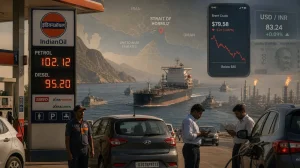
– Delhi: 102.12 for petrol, 95.20 for diesel
– Mumbai: 111.21 / 97.83
– Kolkata: 113.51 / 99.82
– Chennai: 107.77 / 99.55
– Hyderabad: 115.69 / 103.82
– Bengaluru: 111.68 / 99.56
– Gurugram: 102.97 / 95.64
– Noida: 101.96 / 95.44
Some other places on the map
You get a mixed bag in the east and along the coast. Bhubaneswar is at 110.49 for petrol and 102.15 for diesel. In Kolkata, the former is 113.51 and the latter 99.82, just shy of the 100 line.
Further south, Thiruvananthapuram has some of the heftiest numbers: 115.49 and 104.40. Chennai is 107.77 and 99.55, and in Bengaluru, 111.68 and 99.56.
Over in the west and north-west, Jaipur comes in at 112.66 for petrol and 97.78 for diesel. Chandigarh is one of the better values at 101.54 and 89.47. You have 101.86 and 95.36 in Lucknow, and 113.37 and 99.36 in Patna.
When the private side makes a move and the public side holds
The state OMCs are standing firm, but Rosneft’s Nayara has done something different. The private outfit has put up 5 on a litre of petrol and 3 on diesel at close to 7,000 of its stations, the first in over two years to do so.
It is a matter of strategy. The public sector wants to recoup what was spent on inventory before giving any leeway. Nayara seems to be after some market share while the crude is soft, with steeper pricing to pull in drivers when the rest of the field is static.
There has been some give on aviation and commercial products. As of 1 July, the OMCs have brought down Aviation Turbine Fuel by some 5 per litre and the 19-kg commercial LPG by 183.50. The 5-kg Free Trade cylinder is 13 lower, at 808.50.
On ethanol and policy
The minister has also made his case for the Centre’s push on ethanol blending – to stem crude imports, put a dent in emissions and help the farmer. He has put down talk of E20 being bad for an engine or drawing in pests as nothing but ‘rumours’, and said any feedback would be taken into account.
The line is to keep the long-term plan moving and let retail track with import costs in a sensible fashion. So, unless the softness in crude is here to stay, a wide-ranging cut is not in the cards.
What to watch: a potential glut and the path forward
Oil is finding its way around again. Since a US-Iran understanding in mid-June made the Hormuz a bit easier to cross, over 60 million of those held-up barrels have been on the move. Exports from the Saudis and the UAE are where they were before the war, and some Iranian product is in the mix thanks to waivers.
Natasha Kaneva of JPMorgan Chase & Co has put a warning out about a short-lived surplus, with all those barrels “having nowhere to go but China. And China is not buying.” Should that be the case, India may have an opening to ease up on the register.
Stability in the crude is the key. Until that is in place, the state OMCs will be where they are, even if one or two of the private operators are offering a better deal to the motorist.