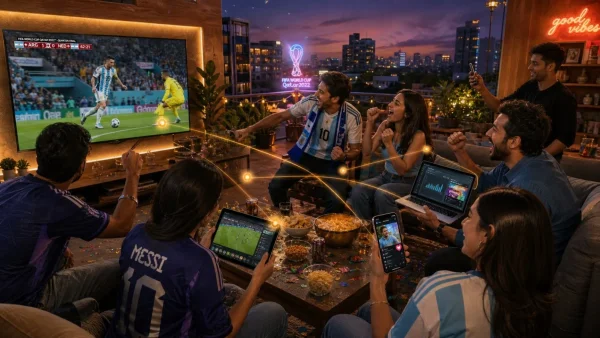
Ipsos puts it at 94%: an urban audience that has made the 2026 World Cup a multi-screen affair. With the quarter-finals under way, you can see the fan energy being stoked by a love for Argentina and by the fact that OTT is where the live action is, which is in turn putting new demands on advertising and consumption habits.
OTT edges TV as fans swarm World Cup 2026
Zee5, with its exclusive digital rights in India, is the place to be for 54% of urban viewers who want to watch a match as it happens. But there is still a 34% who will make for the television and the Unite8 Sports network. Then there are the 10% on YouTube or Instagram for a quick fix, and 2% for short-form highlights.
The numbers don’t lie. Some 56% are on top of the World Cup, 32% are in and out of it, and 6% are holding off for the semi-finals and final. Only 6% have no interest. It all adds up to that 94% engagement mark in cities across the country.
A multi-screen playbook emerges
There is a certain fluidity to how people are watching these days. One might use OTT for the game, the telly to be part of the room, and social media for the soundbites. For the broadcasters and streamers, the job is to make those experiences work in unison. Advertisers, for their part, have to be in the right place at the right time, with messages sequenced to catch the eye before, in and after the whistle.
Argentina’s dominance shapes India’s fandom map
You have France and Germany, each with 10%, and Spain with 5%. England is at 13% in the urban centres. Brazil is a solid 21%. But it is Argentina on top with 35%. A further 5% can’t be bothered to pick a side.
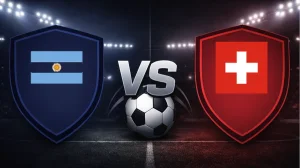
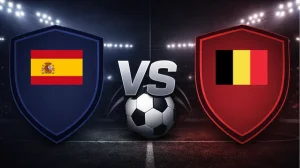
Now that we are down to eight, the bracket dictates where loyalties lie. You have the likes of Argentina, Spain, England and France in the mix with Morocco, Belgium, Norway and Switzerland. Four of the six teams with the most Indian backing are still in it, and that is what keeps the views and the talk going as things get more serious.
Why these allegiances matter now
As the tournament goes on, local fans will put more stock in the stories around the stars. Ipsos figures that with four of the top choices still in the running, the level of engagement is set to hold steady. There is a lot of momentum in India’s football market right now, and it is something rights holders and brands with an eye on the quarter-finals and beyond can’t afford to ignore.
A new read from Ipsos puts a fine point on where the audience, the platforms and the brands are heading:
– 94% of urban Indians have some form of engagement with the tournament
– 54% are live on Zee5
– 34% are still on television through Unite8 Sports
– 35% of fans are behind Argentina
– 30% of ad attention is on TV
Where the ad money is going
TV is king for attention at 30%, which makes sense given the draw of live, appointment viewing. OTT is a close second at 20%, as streaming is key to reaching viewers during a match. You see 15% of that focus on YouTube integrations, and 14% on brand posts from social media, be it from the brand itself or an influencer.
Then there are the sponsorships – on the jersey or by the side of the pitch – with 12% of people taking note. Add in 9% for work with celebrities and you get a picture of a landscape where no one channel has all the answers. The best visibility is in how well broadcast, streaming and social are put together.
“The Football World Cup is more than a sporting event these days,” says Suresh Ramalingam, CEO of Ipsos India. “It is a media and cultural moment of a scale we don’t often see, with a good deal of passion and conversation to go with the entertainment.”
Ramalingam notes that fans are out in force, not just for the game but for the content around it on various platforms. “For a brand, that is a chance to make a connection when the consumer is most receptive and recall is at its peak.”
*
The numbers behind the story
We put 641 urban Indians between the ages of 18 and 45 to the test in an online survey on May 29 and 30, 2026. They were drawn from across the board – metros, Tier 1, 2 and 3 – for a fair view of what is happening on the ground. The sample was an even 50-50 split on gender, with half in the 18-29 bracket and the other half 30-45. In terms of household income, 80% were NCCS A and 20% NCCS B.
What’s in store for the rest of the campaign**
You have a number of top-tier teams left in the running, so expect to see a spike in second-screen activity as the matches come up. Zee5 and Unite8 Sports can use this to build some loyalty with their features and language options. On the social side, a quick highlight is still the way to re-engage an audience.
The data from Ipsos is a case for marketers to put in place a plan that is as integrated as the way a fan actually behaves: be there on OTT and TV in real time, follow up on YouTube and Instagram, and have your sponsorship on show. While Argentina and the rest of the field do their thing, the Indian fan base is giving advertisers the kind of scale they are after.