
Those with diabetes who find themselves turning up the TV or losing track of a sentence in a crowded room should take note. The numbers show nearly one in four has some degree of hearing impairment. In a sense, the ears are as much at the mercy of high blood sugar over time as the eyes or kidneys are.
Dr Sudhir Kumar, a neurologist in Hyderabad, put it into perspective recently: for type 2 diabetics, one in four may be impacted. He pointed out that when you stack the deck against non-diabetics, the chance of a clinically relevant case of hearing loss is more than two times what it would be otherwise.
Why this matters for daily life
You don’t always see it coming. Most only become aware of a problem when it’s harder to keep up in a discussion or someone says the volume is up too high. If one is not careful, overlooking these early indicators can lead to a lack of care, less time with others and unnecessary friction at work or in the house.
There is no pain like with neuropathy and no sudden shift in sight; hearing issues have a way of being understated. For that reason, being proactive is what keeps your ability to communicate and feel secure intact.

What the new research shows
The figures come from a review of the literature, “Hearing Loss in Adults With Diabetes and Prediabetes: A Systematic Review and Meta-Analysis,” which looked at 29 studies from 2000 to 2025. While the focus was on type 2, prediabetes was in the mix as well, along with variables such as age and where one stands socioeconomically.
When 23 of those studies were put together, covering 5,221 people, 24 per cent of the diabetic group had moderate-to-severe hearing loss. Put simply, having diabetes means you are more than twice as likely to have it as someone who does not.
Age is not a get-out-of-jail-free card either. The risk is actually steeper for those under 60 than for older folks, so there is no point in putting off a screening until later in life.

Earlier evidence points the same way
A look back at a national health survey of over 5,000 adults tells a similar story. Even with other variables in play, hearing loss was about as common in diabetics as it was in the rest of the population – if you double the count.
The case is made all the more compelling by a 2023 systematic review and meta-analysis, which put forward the same numbers in a wide range of populations. Put this with the new data and it is hard to see hearing loss as an afterthought in diabetes; it is a pattern that calls for some proactive management from both the medical side and the patient.
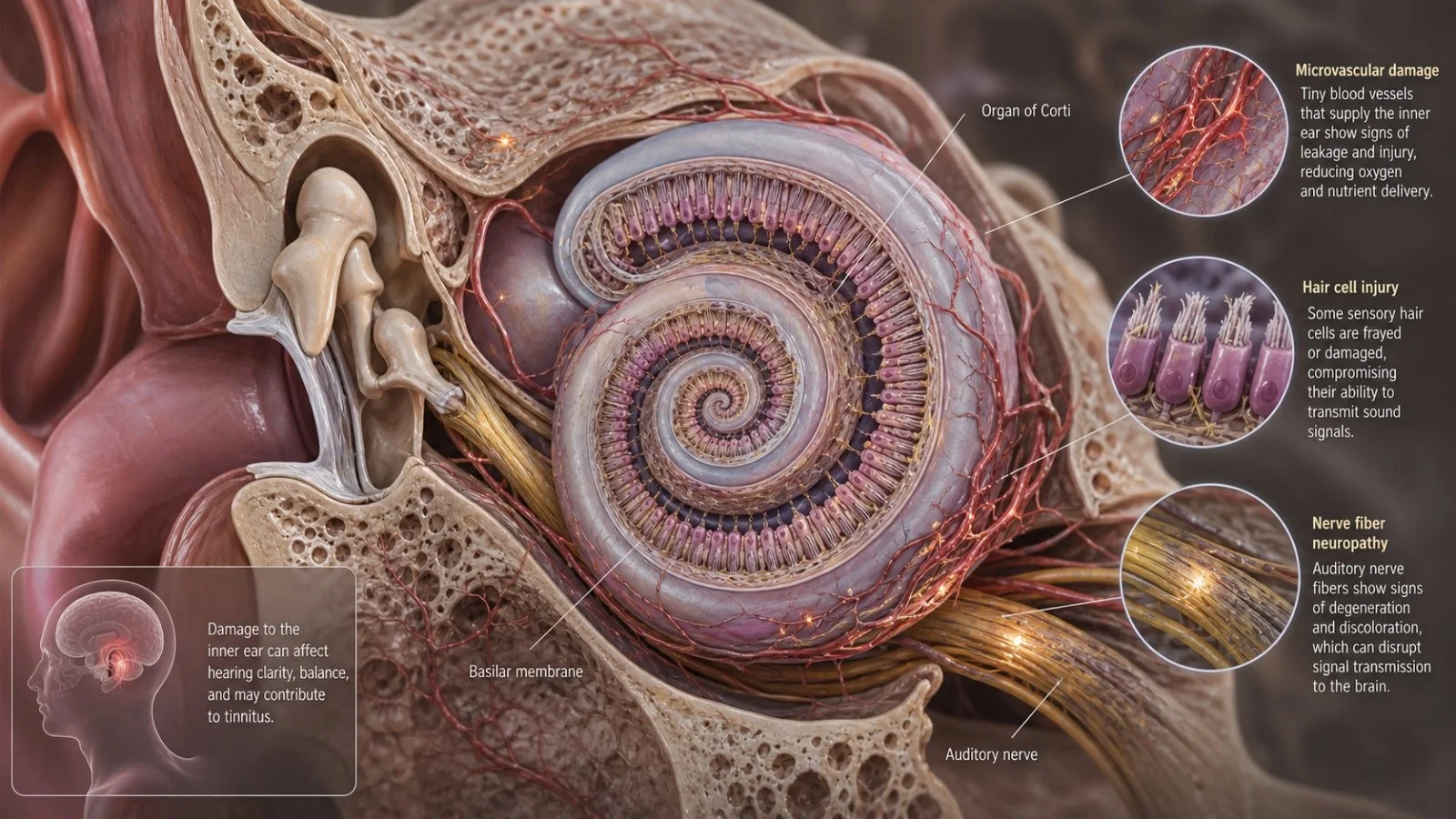
Why diabetes can be hard on your hearing
There are common threads at play, according to those in the field. When glucose stays up for too long, it can do harm to the minuscule blood vessels in the cochlea, the part of the inner ear responsible for making sense of sound. Then there is the matter of diabetic neuropathy and its effect on the auditory nerve, not to mention the toll of chronic inflammation and oxidative stress on fine-tuned hearing cells.
Once a sensory hair cell is gone, it is not coming back. That is the reality of human biology, and it is why you cannot afford to wait for things to become unmanageable. The authors of the study would have us view this as yet another microvascular complication of the disease.
What to make of it
For a start, stick with what you are already doing to stay on top of other issues. Keeping glucose in check is good for the small vessels in the body, the inner ear included. And when it comes to noise, whether it is loud or just goes on for a while, some protection is in order to spare a system that is already working hard.
If a few years with diabetes have left you straining to keep up in a conversation or reaching for the remote a bit more than before, it is time for an evaluation. Dr Kumar has been making the point in no uncertain terms: routine checks are in order, and hearing is a complication that should be on the list.
Some sensible, well-supported ways to go about it:
– Make a habit of regular hearing tests
– Be consistent with glucose control
– Stay away from excessive noise
– Get in to see someone if talking is becoming a chore
– Be honest about how often you are turning up the TV
– If you have had diabetes for some time, ask for a test
It is not a stretch to think that a hearing assessment will be as much a part of a standard diabetes work-up as an eye or kidney exam. Picking up on it early means better guidance, a quicker change in how one communicates and a referral down the line if need be.
There is also the day-to-day to consider. Being able to hear clearly can stave off the kind of fatigue and social retreat that can have a knock-on effect on one’s health.

In short
The figures are what they are: close to a quarter of adults with diabetes have some degree of hearing loss, and the likelihood is more than twice what it is for those who don’t. Even for the under-60 crowd, the risk is there, so it is not wise to put off action.
Hearing should be on the checklist. Get a screening done, mind the volume and watch the blood sugar. It is straightforward. The way you are heard in the future could come down to what is done now.