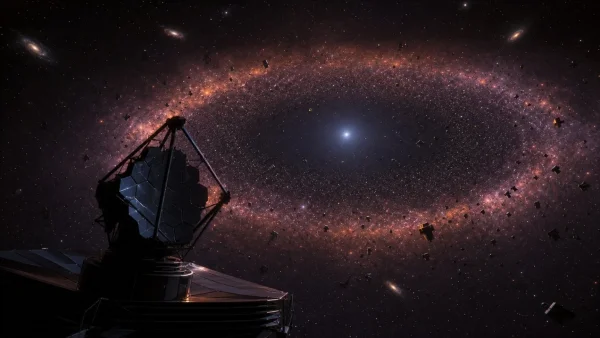
There is a case to be made that the frigid objects we call the coldest stars in our galaxy are not stars in any traditional sense. A new piece of work makes the argument that they could be the handiwork of another civilisation, with power sources out of sight but radiating as infrared. Proving this would be a game-changer in the search for life.

Why astronomers are on alert
Amirnezam Amiri, an astrophysicist at the University of Arkansas, has put together a mathematical approach to track down these kinds of structures, and his results will be in the journal Universe. He has found a number of very cold items that have been put down as stars but behave more like built systems, siphoning starlight and letting go of the excess as heat.
You can put the idea back to Freeman Dyson and 1960, when he put forward the notion of a star-spanning contraption as the mark of a society well beyond us. The difference today is the form: a Dyson swarm of millions of collectors in orbit is seen as a far more workable plan than some unyielding, solid shell.
What Amiri is saying is simple, if you let it sink in. Take a machine that soaks up the visible light from a star and gives it back in the infrared; the energy is there, but the thing looks much cooler. In effect, it is an ultra-cold star in all but name, while shining on in the invisible part of the spectrum.
The telltale sign
Where a star falls on the Hertzsprung-Russell diagram is a matter of its heat and luminosity. A Dyson swarm would not fit in with the rest. It would be in a part of the chart where you wouldn’t expect to find a normal star, even if the total output is in line with one.
The numbers don’t lie. You have your run-of-the-mill red dwarf at 3,000 Kelvin or so. Then you have a mature swarm with an apparent temperature in the 50s. That is well below what we see in nature and an oddity that calls for a closer look.
Making sure it isn’t just dust
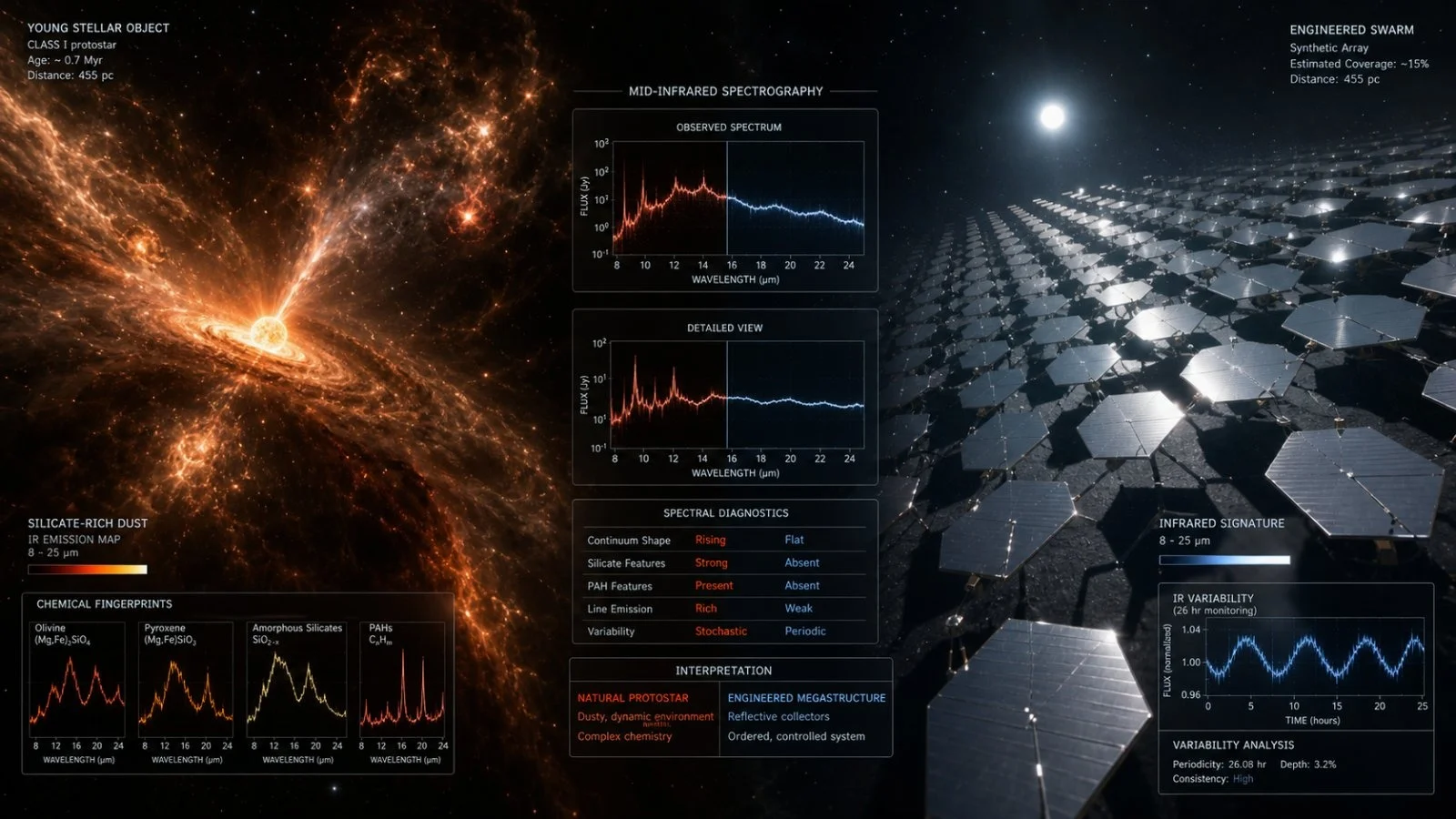
Of course, the universe has ways of imitating this. A star in its youth or old age can be shrouded in a cloud of dust that puts out an infrared glow and muddies the waters. But there are chemical traces, like silicate emissions, to be had if you know where to look.
A man-made swarm would be neater. The infrared readout would be of a piece with machinery, not with the kind of detritus you get from a star. On top of that, with so many collectors in the mix, you would get some unevenness in the shadows and a pattern of brightness that a regular variable star doesn’t produce.
The case for red and white dwarfs
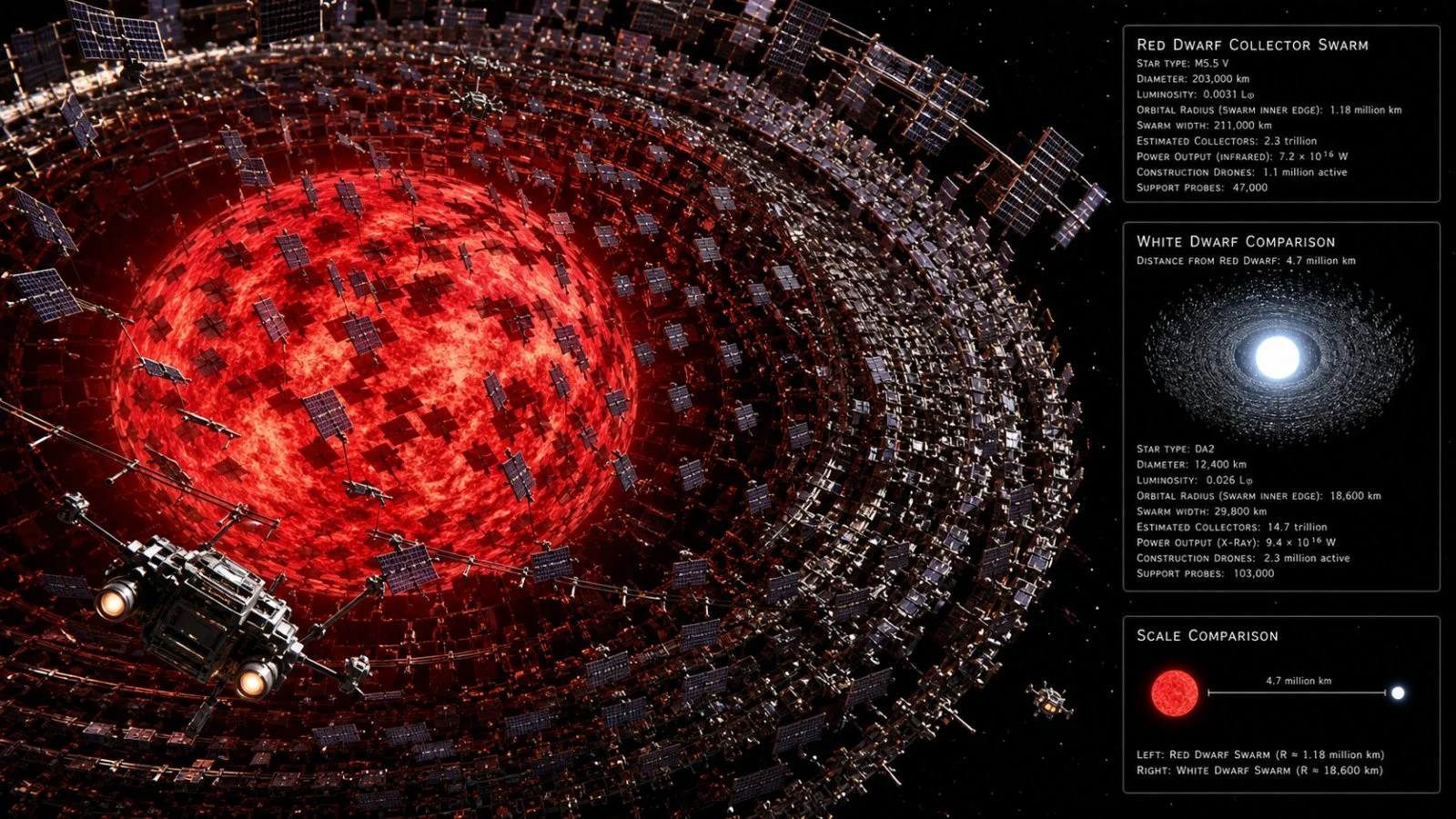
For Amiri, the small stars make the most sense. Red dwarfs are everywhere in the Galaxy and they are long-lived, burning through fuel at a leisurely pace over trillions of years. An advanced species would have no trouble making the time to put in place an energy grid of that magnitude.
Size is a factor too. “A Dyson swarm around a red dwarf could be 0.05 to 0.3 AU out,” says Amiri. That is a lot less to work with than you would need for something in the vicinity of a Sun-like star, and it makes for a simpler, cheaper proposition.
Then there are the white dwarfs. They are left-overs, no bigger than a per cent of what they were, but they keep on giving for eons. Put a swarm in orbit a few million kilometres up and you can make do with a fraction of the hardware to capture the same kind of power.
The economics of building it

In a way, the whole point of a swarm is to clear up a host of engineering problems in one go. You can put up a mirror or a panel in one phase, swap it out if it takes a hit, and reposition it to handle the heat. The energy harnessed is enough for a whole civilisation; what’s left over is an infrared afterglow.
That waste heat is where the story is. A well-covered object will be cold to the eye and not give off much visible light. In thermodynamic terms, it is a simple equation: the energy budget is unchanged, but the spectrum is something else entirely.
The work has begun
There is no need to reinvent the wheel. The James Webb Space Telescope is set up for infrared, so it is the instrument of choice. Old data is being put to good use as well, with some of the best returns coming from the Wide-field Infrared Survey Explorer.
Take Project Hephaistos, for instance. After running through five million stars, the team put forward a few interesting cases. They were on to seven potential Dyson spheres in May 2024, a number of them around red dwarfs. One had to be put aside when it was found that a supermassive black hole in the background was mimicking an infrared spike.
Five are left on the table, and Amiri’s model gives a way to put them to the test. It is a matter of seeing if they sit in the coldest part of the Hertzsprung-Russell diagram with no sign of dust, and if their brightness wavers in the way you would expect from panels in orbit.

What to look for
Time is at a premium, so there has to be a quick way to cull the field. The plan is to run a series of basic checks before any major resources are put in.
A few things to screen for:
– Anomalies that are bright in infrared but not in visible
– No silicate-heavy dust
– Dimming that does not follow a pattern
– Red or white dwarf hosts
If an object makes it through, it is worth a closer look with spectroscopy and timing. One positive find would change everything. If not, the exercise still cleans up the catalogues for later.
More than a talking point
To spot a Dyson swarm is to see a species that has figured out how to put a star to work. It says a lot about how long a civilisation can last and how far it has come. It puts the Galaxy in a new light, as a place of possible outposts.
But even a “no” has value. It puts limits on our models for stellar evolution and the like. A negative result is its own kind of progress, weeding out the false starts.
Proceed with care
It is easy to be led astray in the infrared. Even seasoned observers can be tricked by an odd alignment. The black hole mix-up is a case in point: if you are going to make a bold claim, you have to back it up with more than one line of evidence.
Amiri’s piece in Universe comes at the right moment. The tools are there, and the numbers are in. What is called for is a steady hand and open books.
Don’t hold your breath for a big announcement. The candidates will be put to the test, one by one. If they are just some form of dust or a quirk of a star, so be it. But the effort is warranted.
For those who have been following, the bottom line is this: looking in the infrared, especially at red and white dwarfs, is no longer a side project. It is the only way to do a proper search for technology on this scale.
There are plenty of dim, cold things in the Galaxy. Some of them may be the machinery of another world, and you will have to read the infrared to know. The next time we look up, we may have to decide if the coldest of these are really stars.