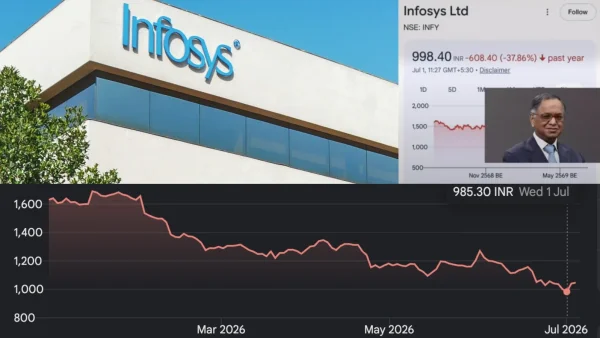
Infosys Falls Below ₹1,000
Infosys shares recently slipped below the ₹1,000 mark, triggering fresh discussions across social media. While market participants pointed to concerns over global IT spending, AI-led disruption and cautious business outlooks, the internet found another topic to revisit—N.R. Narayana Murthy’s famous remarks advocating a 70-hour work week.
As screenshots of the stock price circulated online, memes, jokes, investment opinions and debates quickly flooded social media platforms.
Murthy’s 70-Hour Work Week Returns to the Spotlight
Murthy’s 2023 suggestion that India’s youth should consider working 70 hours a week to help boost the nation’s productivity has remained one of the most debated statements by an Indian business leader.
With Infosys now trading below ₹1,000, many users sarcastically linked the company’s stock performance with those remarks, even though the stock’s movement is driven by broader business and economic factors.
One comment that particularly caught attention read:
“Looks like Narayana Murthy has stopped working 70 hours a week himself.”
While clearly intended as satire, it reflected how the internet continues to associate every major Infosys development with Murthy’s work culture comments.
Social Media Responds With Memes, Sarcasm and Support
The reactions ranged from humorous to supportive.
One user joked,
“Ab to weekend pe bhi kaam karna padega…”
Another escalated the meme further,
“Murthy Bhai ab toh 100hrs kaam krne padenge.”
Some users mocked the stock’s decline itself.
“Thoda aur ruko… 3 saal, abhi 2 digit me bhi dikhega.”
Not everyone enjoyed the jokes.
One user criticized those mocking Murthy, writing,
“Shameful post. First do something of the caliber that Mr. Murthy has done. Then comment.”
Another supporter reminded readers of Infosys’ contribution to India’s technology ecosystem, arguing that the company has built critical digital infrastructure, including the GST portal, and that Murthy’s decades-long contribution should not be judged solely on short-term stock movements.
Investors Focus on Opportunity Instead of Memes
Beyond the jokes, several investors discussed their market strategies.
One investor commented,
“Bought at 1K, will go extremely long below 850 if it happens.”
Another regretted not selling his entire holding earlier.
“Sold half of my Infosys at 1650+, kaash pura bech deta. My broker was saying it will break 1900.” 😂
One commenter also advised investors to stay away from IT stocks for now, claiming global market participants had already positioned themselves for weakness months ago. However, this represents an individual market opinion and should not be treated as investment advice.
Another user summarized the broader concern in a single line:
“Labour arbitrage no longer viable.”
The comment reflects a growing belief among some investors that India’s traditional outsourcing model faces increasing pressure from automation and artificial intelligence.
Why Is Infosys Stock Actually Under Pressure?
Despite the memes, analysts largely attribute Infosys’ recent weakness to business fundamentals rather than social media sentiment.
Among the key concerns are slower technology spending by global clients, uncertainty surrounding enterprise IT budgets, pricing pressure and the rapid evolution of artificial intelligence, which is reshaping the traditional outsourcing industry.
Like many IT companies, Infosys is navigating a period where clients are reassessing technology investments while simultaneously accelerating AI adoption.
The OpenAI Debate Returns
The stock decline has also revived discussion around what some consider one of Infosys’ biggest missed opportunities.
Recent reports have brought renewed attention to former Infosys CEO Vishal Sikka’s vision for a stronger AI-first strategy. According to those reports, Sikka supported an early association with OpenAI in 2015. Strategic differences within the company over its future direction later became a subject of public discussion, with critics arguing that Infosys may have missed an opportunity to become an early leader in the AI revolution.
While the extent to which this affected the company’s long-term trajectory remains debated, many social media users have once again referenced the episode while discussing Infosys’ current challenges.
Memes Come and Go, Markets Don’t
The online reactions highlight how Narayana Murthy’s 70-hour work week remarks continue to shape public conversations long after they were made.
For some, Infosys’ falling share price became another opportunity for memes and sarcasm. For others, it was a reminder of Murthy’s contribution to building one of India’s most successful technology companies.
Ultimately, social media jokes may dominate timelines for a few days, but stock prices are driven by earnings, business strategy, technological innovation and investor confidence. As Infosys adapts to an AI-driven future, the company’s long-term performance will depend far more on execution than on viral memes or online debates.