A politically explosive allegation has emerged in Delhi over the handling of subsidised rice meant for economically vulnerable citizens.
AAP leader Saurabh Bharadwaj has alleged that rice intended for beneficiaries was diverted and sold to a private company based in Haryana. He has further claimed that the alleged diversion could amount to ₹22,000 crore over three years.
But there is an important caveat: these figures and allegations need documentary verification before they can be described as a proven scam.
That makes the next step particularly important.
If the allegation is false, the government should disprove it with records. If it is true, someone must answer for it.
What Exactly Is Being Alleged?
At the centre of the controversy is subsidised foodgrain intended to support economically vulnerable sections of society.
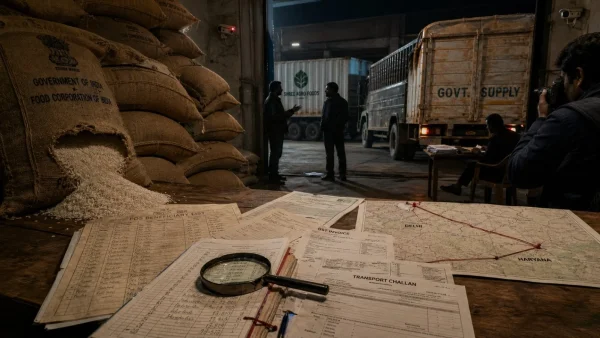
The allegation is that government-controlled rice, instead of reaching its intended beneficiaries, was allegedly diverted through a private Haryana-based company.
If established, such a diversion would raise serious questions about:
Procurement and allocation records
Government warehouses
Transportation records
Distribution registers
Beneficiary lists
Private-company contracts
Sale invoices
Payment trails
Officials responsible for authorising the transactions
The crucial issue is not simply the value of the rice.
It is whether food meant for citizens receiving government support was converted into a commercial opportunity for private entities.
₹22,000 Crore: The Number That Demands Proof
₹22,000 crore is an enormous figure.
But a number this large cannot responsibly be treated as fact merely because a politician has alleged it.
Authorities should publish the calculations behind the claim.
How much rice was allegedly diverted?
At what price was it purchased or transferred?
Who authorised the transaction?
Which company received it?
How much money changed hands?
Where did the money go?
Without answers to these questions, the ₹22,000-crore figure remains an allegation requiring verification, not an established finding of financial wrongdoing.
The Government Faces a Simple Test
The ruling BJP government in Delhi should not merely dismiss the allegation as political rhetoric.
It should release the relevant records and answer the questions publicly.
If every kilogram of subsidised rice was properly accounted for, the government should have little difficulty demonstrating it through official documentation.
That could include:
Allocation records → Warehouse records → Transport records → Distribution records → Beneficiary records → Sale/transfer records
A transparent audit could settle the controversy far more effectively than political statements.
Is This a Scam or a Political Allegation?
That distinction matters.
A scam implies established wrongdoing.
An allegation is a claim that still needs investigation.
At present, the responsible position is therefore:
The alleged diversion should be independently investigated, but the ₹22,000-crore figure should not be presented as proven fact without documentary evidence.
That does not weaken the allegation.
It strengthens the demand for accountability.
Why Subsidised Food Is Different
Government food subsidies are not ordinary commercial transactions.
They exist because millions of people depend on affordable foodgrain.
When taxpayers subsidise rice, the purpose is not to create a profit opportunity for a private intermediary.
The fundamental question is:
Did the food reach the people for whom the subsidy was intended? If yes, the government should demonstrate it.
If no, the responsible officials and beneficiaries of the alleged diversion must be identified.
Where Is the Audit Trail?
This is where the controversy can move beyond politics.
Instead of BJP versus AAP, the public deserves an evidence-based investigation.
Authorities should make available, subject to legitimate privacy restrictions:
Tender documents
Procurement records
Stock registers
Movement challans
Warehouse records
Company contracts
GST invoices
Payment records
Distribution data
Audit reports
If the alleged private company received government-subsidised rice, its contractual relationship with the government should also be examined.
The Sarcasm Writes Itself
Government slogan:
“Food security for the poor.”
Allegation:
“Food security for a private company’s balance sheet?”
If the allegation is false, that’s easy to settle.
Show the paperwork.
If the allegation is true, then the paperwork may become the most important evidence in the investigation.
Either way, citizens deserve to see it.
Questions for the BJP Government
The Delhi government should answer clearly:
1. Was subsidised rice transferred to a Haryana-based private company?
2. If yes, under what scheme or contractual arrangement?
3. How much rice was involved?
4. What was the financial value of the transaction?
5. Who authorised the transfer or sale?
6. Was the rice intended for economically vulnerable beneficiaries?
7. Was any independent audit conducted?
8. Does the government dispute the ₹22,000-crore figure?
9. If it disputes the figure, what is the government’s calculation?
10. Will the government order an independent investigation?
These questions are not political propaganda.
They are basic questions about public money and public food. And What About the Opposition? AAP also has a responsibility.
If it is making a ₹22,000-crore allegation, it should publish the evidence behind the calculation.
Political parties cannot demand transparency from governments while expecting the public to accept their own numbers without scrutiny.
Show the documents.
That is the standard everyone should face. The Bigger Issue: Public Welfare Must Not Become Private Opportunity India’s welfare programmes involve enormous quantities of foodgrain and public money.
Whenever government supplies enter a chain involving contractors, transporters, warehouses and private companies, strong auditing becomes essential.
One weak link can potentially turn a welfare programme into a leakage mechanism.
And when the intended beneficiaries are economically vulnerable people, the consequences are even more serious.
Final Take
The alleged rice diversion deserves a proper, independent and transparent investigation.
But journalism must also distinguish between an allegation and a proven scam.
The ₹22,000-crore figure currently requires documentary substantiation; notably, a separate ₹22,000-crore figure involving Saurabh Bharadwaj is documented in reporting from 2022 in connection with his allegations about advertising expenditure by BJP-ruled states—not this alleged rice diversion.
So the strongest question today is not:
“Where did ₹22,000 crore disappear?”
It is:
“Can the government show the complete paper trail proving where the subsidised rice went?” If the records clear the government, publish them.
If they expose wrongdoing, prosecute those responsible.
Because food meant for vulnerable citizens should never become a political slogan, a bureaucratic black hole—or, if the allegations are proven, a private profit machine.