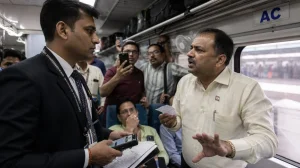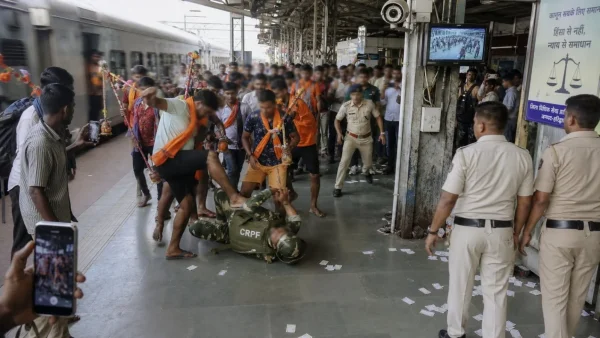
A disturbing incident at Mirzapur railway station in Uttar Pradesh has triggered a wider debate over law, order and accountability after a CRPF jawan was allegedly assaulted by a group of Kanwariyas during an argument reportedly linked to a train ticket.
According to reports accompanying the viral video, the incident occurred while the jawan was attempting to board the Brahmaputra Mail. The video allegedly shows several people punching and kicking him in public.
Following the circulation of the footage, seven people were reportedly arrested.
The arrests are an important first step.
But the incident raises a question that goes beyond Mirzapur:
Does the law remain equally firm when the accused belong to a large religious procession or politically sensitive group?
A Uniform Should Not Become a Punching Bag
A CRPF jawan is part of India’s security apparatus.
But before anything else, he is also a citizen.
If the allegation is established, assaulting him cannot be justified because of an argument over a ticket, a disagreement at a railway station or the identity of the people involved.
A uniform does not make someone invincible.
And belonging to a religious procession does not give anyone immunity from the law.
The principle should be remarkably simple:
A crowd has no right to become a court.
The Ticket Argument Is Not the Main Issue
Arguments over seats, tickets and boarding trains are hardly new.
People lose their tempers at railway stations every day.
But there is a line between an argument and physical violence.
Once punches and kicks enter the picture, the dispute stops being a simple disagreement.
It becomes a question of public safety and criminal accountability.
The proper response to a ticket dispute is to approach railway authorities or security personnel—not form a group and allegedly assault someone.
Seven Arrests After the Video: But Why Does It Take a Camera?
This is perhaps the most uncomfortable question.
The reported arrests came after the incident was captured on video and circulated widely.
That naturally raises a broader concern:
What happens to incidents that nobody records? A viral video can create public pressure.
But justice cannot depend on whether someone happened to have a smartphone pointed in the right direction.
Police investigations should be based on evidence, witness statements, CCTV footage and due process—not simply social-media outrage.
And Here Comes the Question of Selective Outrage
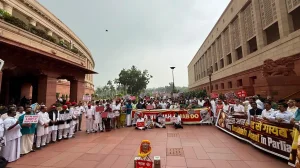
The incident has also prompted comparisons with police action against protesters in other situations, including the allegations surrounding student demonstrations.
But comparisons should be made carefully.
A religious procession, a student protest and a railway confrontation are not automatically equivalent situations.
Crowd size, police instructions, violence, threats and the exact circumstances can all be different.
However, one principle can be compared:
Should the standard of accountability change depending on who is involved? If police use excessive force against peaceful protesters, that should be investigated.
If civilians assault a police or security personnel, that should also be investigated.
If police personnel unlawfully assault civilians, they too should face accountability.
The law cannot have separate moral standards for different crowds.
“Who Protects the Protector?”
This is the heart of the story.
Security personnel are routinely expected to protect citizens.
But what happens when a security personnel himself becomes the target of a violent crowd?
Railway stations are already environments where large crowds, tight spaces and heightened emotions can create dangerous situations.
If an alleged assault occurs in broad daylight, authorities should establish:
What triggered the confrontation?
Who initiated the physical violence?
Were railway security personnel present?
Were CCTV cameras functioning?
How quickly did authorities respond?
What exactly led to the arrests?
What sections of law have been invoked?
Were there additional injured persons?
These questions matter because arrest is not the same as conviction.
The accused remain entitled to due process, while the victim is entitled to a proper investigation.
Does a Religious Procession Change the Rules?
It shouldn’t.
Religious freedom is constitutionally protected.
So is the right to peaceful assembly.
But neither creates a licence for violence.
Whether someone is:
a Kanwariya,
a student,
a political activist,
a police officer,
a CRPF jawan,
a farmer,
or an ordinary passenger,
the basic legal principle should remain the same:
You cannot assault another person simply because you are angry with them.
The Sarcasm Writes Itself
Ticket dispute:
Normal solution:
“Let’s call railway authorities.”
Apparently, the alleged alternative solution was:
“Let’s call everyone and start a boxing match.”
And the venue?
A railway station.
Because apparently Indian Railways wasn’t already providing enough reasons for passengers to lose their patience.
Jokes aside, public spaces cannot become places where a group decides that numerical strength gives it permission to enforce its own version of justice. What Should Authorities Do Now?
1. Conduct a fair investigation
The entire incident should be reconstructed using CCTV footage, the viral video, eyewitness accounts and statements from everyone involved.
2. Establish individual responsibility
Being present in a crowd is not automatically proof of assault. Investigators should establish who actually participated in violence.
3. Protect the victim’s rights
The CRPF personnel should receive appropriate medical and legal assistance.
4. Follow due process for the accused
Arrest does not mean guilt. The accused must receive a fair legal process.
5. Examine railway security arrangements
If a violent confrontation occurred at a busy railway station, authorities should determine whether security personnel responded adequately.
The Bigger Issue Is Not Kanwariyas. It Is Accountability.
It would be easy to turn this into another story about “one community versus another.”
That would miss the bigger point.
The real issue is whether India’s law-and-order system can enforce rules consistently even when the crowd involved is large, politically sensitive or religiously mobilised.
That is the real test.
A government doesn’t demonstrate strength by being tough only against people who have little political influence.
It demonstrates strength when it can enforce the law without fear or favour.
Final Take: Same Law, Same Standard
If the allegations are established, those responsible for assaulting the CRPF jawan should face the consequences prescribed by law.
But the principle should extend much further.
No religious identity should provide immunity. No uniform should provide immunity. No political identity should provide immunity. No crowd should provide immunity. And no citizen should have to wonder whether justice depends on who is standing behind the accused.
The Mirzapur incident therefore presents a simple test for authorities:
Investigate fairly. Act firmly. Follow due process. And apply the same standard to everyone.
Because in a democracy, the law should not ask which crowd you belong to before deciding whether violence is wrong.