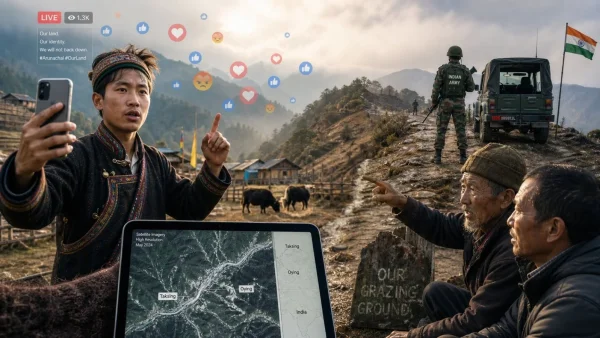
A video featuring Arunachal Pradesh youth Taba Nagu has gone viral after he made a provocative statement about the future of his home state.
In the video, Nagu is heard saying:
“Goodbye India. Very soon you all will see me in China. Not just me, the entire Arunachal will be visible in China.”
The statement has triggered intense reactions online, particularly because it comes amid renewed debate over alleged Chinese activity along the Arunachal Pradesh border.
But there is an important distinction between what the viral video alleges and what has been officially established.
At present, there is no verified evidence that Arunachal Pradesh is being transferred to China or that China has occupied the state.
In fact, the Indian Army has explicitly rejected recent reports alleging fresh Chinese encroachment in parts of Arunachal Pradesh, calling them “incorrect and without any basis.”
Why Did the Video Become So Controversial?
The timing is significant.
In June 2026, the Nah Welfare Society, a community organisation from Upper Subansiri district, submitted a memorandum alleging that Chinese forces had expanded their presence in areas traditionally used by local communities.
The organisation identified locations around the Taksing sector, including Oying, Paniar, Marpan, Potrang and Tingdingtang, and alleged that roads, infrastructure and camps had been established in areas it considers Indian territory.
Those claims generated concern across Arunachal Pradesh.
The Indian Army, however, rejected reports of fresh PLA encroachment and said the allegations had no basis.
That conflicting narrative provides the backdrop to Nagu’s viral video.
Local Concerns vs Official Denial
This is where the story becomes complicated.
On one side are local groups who say they have witnessed changes along traditional grazing, hunting and agricultural areas near the border.
On the other side, the Indian Army says the reports of recent Chinese occupation and camps inside Arunachal Pradesh are incorrect.
Arunachal Pradesh Chief Minister Pema Khandu has also rejected reports of Chinese military intrusion, saying the Army is effectively patrolling and safeguarding the state’s territory. He has indicated that the ground situation would be verified with the Army and local organisations.
So the central question remains:
What is actually happening on the ground?
Why Border Residents Matter
People living in India’s remote border regions are often the first to notice changes in roads, patrols, grazing access and military infrastructure.
That does not mean every claim made on social media is automatically true.
But it does mean such claims should not simply be dismissed without examination.
If a local community reports losing access to traditional land, authorities should investigate the claim on the ground and provide a clear explanation.
Border security is too serious to be settled by hashtags. It requires maps, satellite imagery, patrol records, local testimony and official verification.
The Bigger China Question
China has repeatedly claimed Arunachal Pradesh as part of what it calls “southern Tibet,” while India firmly considers Arunachal Pradesh an integral part of the country.
China has also periodically objected to Indian political and infrastructure activity in the state.
India, meanwhile, has significantly increased infrastructure development and security deployment in the border region.
That is why any credible allegation of territorial change deserves serious attention.
But there is a major difference between:
China claiming Arunachal Pradesh,
Chinese forces allegedly transgressing in disputed border areas,
and
China actually occupying Indian territory.
Those three claims should not be treated as interchangeable.
What Does Nagu’s Statement Actually Prove?
On its own, the viral video proves only that Nagu made the statement attributed to him.
It does not establish that China has occupied Arunachal Pradesh.
It does not establish that the entire state is going to China.
And it does not independently verify the allegations made by local organisations.
That is why responsible reporting should separate the viral claim from independently verified facts.
The Sarcasm Writes Itself
“Goodbye India, see you in China.”
If social media videos could redraw international borders, Google Maps would need a much larger server budget.
But unfortunately, borders aren’t changed by viral reels.
They are determined by military realities, diplomacy, international agreements and control on the ground.
And that is precisely why this issue deserves something more useful than social-media shouting.
It deserves facts.
Questions the Government Should Answer
Rather than simply dismissing every concern or allowing social media to fill the information vacuum, authorities could provide greater clarity.
1. What is the exact status of the locations named by local organisations?
2. Has the government conducted ground verification of the allegations?
3. What does satellite imagery show?
4. Are there any new Chinese structures or camps in areas claimed by local communities?
5. Have local residents lost access to traditional grazing or agricultural areas?
6. What measures are being taken to reassure border communities?
These are legitimate questions about national security—not anti-national questions.
Don’t Silence Border Communities—Verify Their Claims
There is an important lesson here.
If local people raise concerns about the border, the government’s response should not simply be:
“Nothing happened. Move on.”
Nor should social media automatically respond:
“China has taken Arunachal Pradesh.”
Both extremes are dangerous.
The responsible approach is:
Investigate. Verify. Publish the evidence. Explain the situation.
Because national security requires credibility.
Final Take: Viral Video, Real Anxiety, Unproven Claim
Taba Nagu’s statement has gone viral because it touches one of India’s most sensitive national-security issues: the India-China border and the status of Arunachal Pradesh.
But the viral statement should not be mistaken for proof that China has occupied the state.
The Indian Army has rejected recent reports of fresh Chinese encroachment, while local organisations have continued to raise concerns about activities near the border.
That contradiction itself deserves transparent investigation.
Because the people of Arunachal Pradesh deserve something better than either extreme:
blind reassurance or viral fear.
They deserve facts.
And when it comes to India’s borders, facts are not optional—they are national security.